






States With No Income Tax In 2026: A State-By-State Breakdown
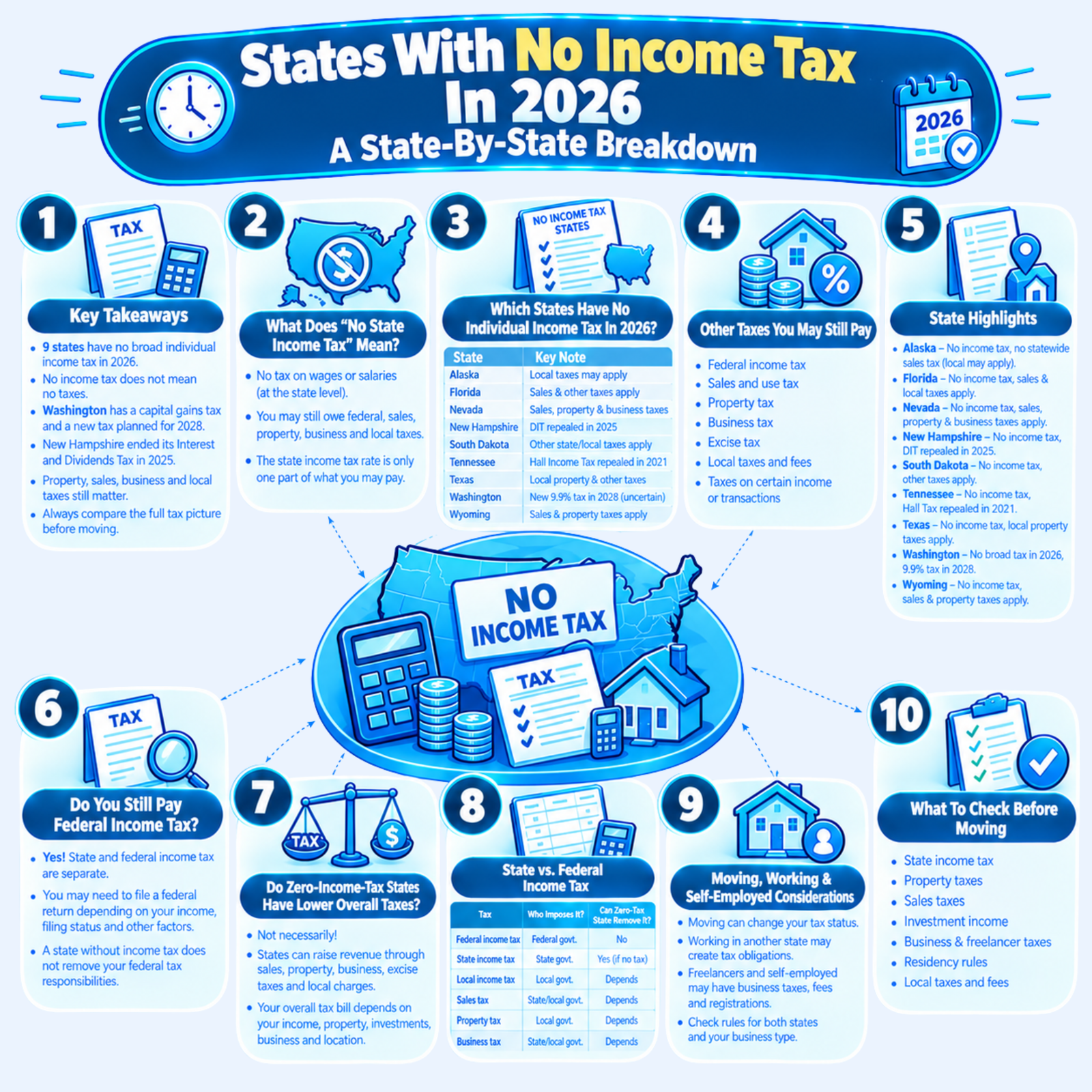
- 1 9 states have no broad individual income tax in 2026.
- 2 No income tax does not mean no taxes.
- 3 Washington has a capital gains tax and a new tax planned for 2028.
- 4 New Hampshire ended its Interest and Dividends Tax in 2025.
- 5 Property, sales, business, and local taxes still matter.
- 6 Always compare the full tax picture before moving.
If you are looking at your paycheck and wondering why your state takes a portion of your income, the answer depends heavily on where you live. Some states charge individual income tax, while others do not. In 2026, several states will not impose a broad individual state income tax on wages and other ordinary personal income. That does not mean you pay no taxes at all. You may still owe federal income tax, sales tax, property tax, business taxes, or other state and local taxes.
Washington’s tax rules are also changing. A new 9.9% state income tax is scheduled to take effect in 2028 under legislation passed in 2026. However, the law is facing a repeal vote in November 2026, so its future remains uncertain. For now, Washington does not impose a general individual income tax, but anyone planning a move should check the latest state updates before making a decision.
This state-by-state tax guide explains where you currently stand if you live, work, run a business, or plan to move to one of these states.
What Does “No State Income Tax” Mean?
A state with no individual income tax generally does not tax wages or salaries at the state level. But that does not mean you pay no taxes.
You have to pay other taxes like
-
- Federal income tax
- Sales and use taxes
- Property taxes
- Business taxes
- Excise taxes
- Local taxes and fees
- Taxes on certain types of income or transactions
The state income tax rate is only one part of what you may pay. Where you live, what you own, how you earn money, and what you spend can all make a difference.
Which States Have No Individual Income Tax In 2026?
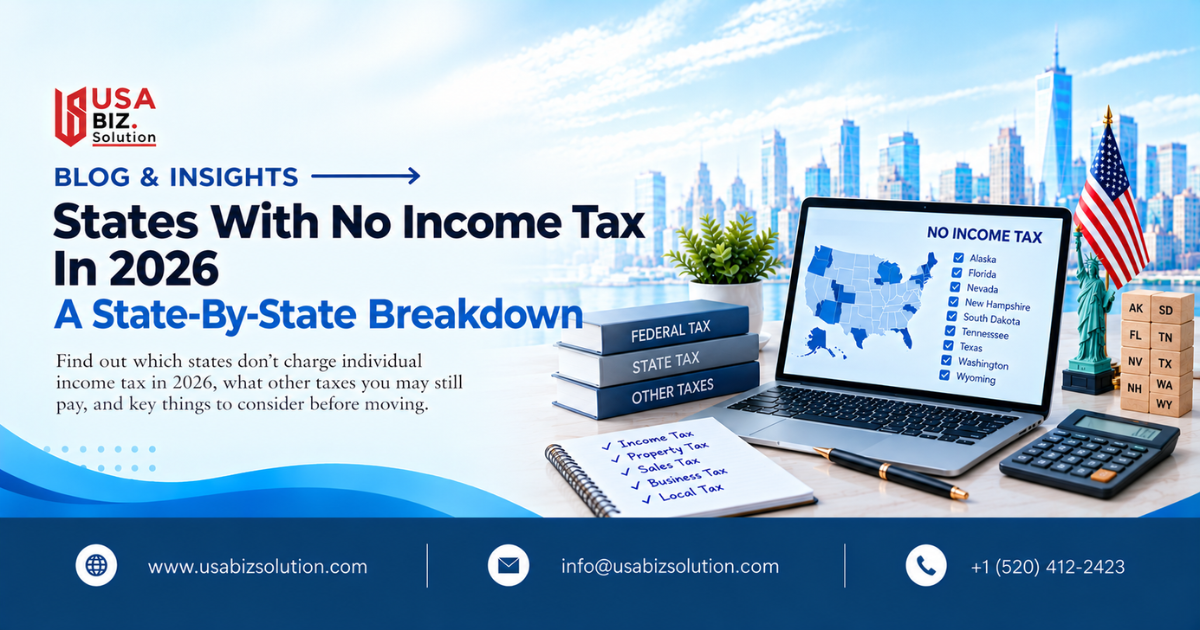
In 2026, the states that are generally identified as having no broad individual income tax are:
| State | Individual State Income Tax in 2026 | Important Tax Consideration |
| Alaska | No | Local taxes may still apply |
| Florida | No | Sales and other taxes still apply |
| Nevada | No | Sales, property, and business taxes apply |
| New Hampshire | No | Interest and Dividends Tax was repealed beginning in 2025 |
| South Dakota | No | Other state and local taxes still apply |
| Tennessee | No | Hall Income Tax was repealed beginning in 2021 |
| Texas | No | Local property taxes and other taxes apply |
| Washington | No broad tax currently | Capital gains tax applies to certain individuals; new income tax begins in 2028 |
| Wyoming | No | Sales and property taxes still apply |
*The exact tax rules differ from one state to another, so you should not treat every zero-income-tax state as having the same overall tax structure.
Alaska State Tax
Alaska does not impose a personal state income tax. The state also does not have a statewide sales tax, although local governments may impose sales taxes.
If you live and work in Alaska, your wages are not subject to an Alaska personal income tax. You still need to account for federal income tax and any applicable local taxes.
Property taxes are another consideration. Alaska local governments can impose property taxes, and the amount you pay depends on where your property is located.
Taxes You May Still Pay in Alaska
A personal income tax isn’t the only tax you may have to pay. Other taxes can include:
-
- Federal income tax
- Local sales taxes
- Property taxes
- Fuel and other specific taxes or fees
So, if you are comparing Alaska with another state, look beyond the income tax rate.
Florida State Tax
Florida does not impose a personal income tax. The Florida Department of Revenue states that individuals do not have to file a personal income tax because the state does not impose this tax.
Florida residents can still have other tax responsibilities. The state collects sales and use taxes, and local governments may impose additional taxes and fees.
Property-related costs can also affect your overall tax bill.
Taxes You May Still Pay in Florida
-
- Federal income tax
- State sales tax
- Local discretionary sales surtax
- Property taxes
- Communications services tax
- Fuel taxes
- Other state and local fees
Florida also imposes taxes on certain businesses, even though individuals do not pay a personal income tax.
Nevada State Tax
Nevada does not impose a state individual income tax on wages, salaries, or similar earnings. The Nevada Department of Taxation also states that residents do not need to file a Nevada state income tax return based on earned income.
That does not make Nevada a tax-free state.
Nevada collects other taxes, including sales and property taxes. Businesses can also have separate tax responsibilities.
Taxes You May Still Pay in Nevada
Your tax responsibilities may include:
-
- Federal income tax
- Sales and use tax
- Property tax
- Business taxes
- Certain industry-specific taxes and fees
Nevada also imposes a commerce tax on businesses with more than $4 million in Nevada gross revenue during a fiscal year. The tax rate depends on the business’s industry, and the rules apply to revenue covered by Nevada’s tax law. Business owners should check the state’s filing requirements rather than assume that having no personal income tax means their business has no state tax obligations.
*If you are self-employed or own a business, you should therefore look at business taxes separately from personal income tax.
New Hampshire State Tax Guide
New Hampshire is another state where you do not currently pay a broad individual income tax.
An important change took effect in 2025. New Hampshire repealed its Interest and Dividends Tax for taxable periods beginning on or after January 1, 2025.
This means New Hampshire no longer imposes that former tax on interest and dividend income for the applicable periods.
However, earlier tax years are not automatically erased. Taxpayers who had a filing or payment obligation for 2024 or earlier years may still have outstanding responsibilities related to those periods.
Other New Hampshire Taxes
Other taxes you may have to pay include:
-
- Property taxes
- Meals and room taxes
- Business taxes
- Other state and local taxes
*New Hampshire, therefore, should not be treated as a state where you have no tax responsibilities.
South Dakota State Tax
South Dakota does not impose a state income tax on individuals. The South Dakota Department of Revenue identifies the state as one of the states without a state income tax.
If you earn wages while living in South Dakota, the state does not take a percentage of those wages through an individual income tax.
You still need to consider federal taxes and other state or local taxes.
Taxes You May Still Pay In South Dakota
-
- Federal income tax
- Sales tax
- Use tax
- Property taxes
- Motor vehicle-related taxes and fees
If you are moving to South Dakota mainly because of its income tax structure, compare these other taxes before making your decision.
Tennessee State Tax
Tennessee does not have a state income tax on earned income. The state’s former Hall Income Tax, which applied to certain interest and dividend income, was fully repealed for tax years beginning January 1, 2021.
You therefore do not file a Tennessee individual income tax return on your wages under the former system.
Taxes You May Still Pay In Tennessee
-
- Sales and use taxes
- Local taxes
- Property taxes
- Business taxes
- Certain excise taxes and fees
This distinction matters if you are comparing Tennessee with a state that has an individual income tax but lower sales or property taxes.
Texas State Tax
Texas does not collect state or local individual income tax on personal income. The Texas Comptroller states that Texans pay federal income taxes but not state or local income taxes.
This means your wages are not subject to a Texas individual income tax.
However, Texas still has significant taxes outside the individual income tax system.
Taxes You May Still Pay in Texas
Depending on where you live and what you own, you may pay:
-
- Federal income tax
- Sales and use tax
- Local property taxes
- Motor vehicle taxes and fees
- Business-related taxes
Property taxes are particularly important because local taxing entities impose them rather than a statewide personal income tax.
If you are comparing Texas with another state, looking only at the absence of individual income tax can give you an incomplete picture.
Washington State Tax
Washington requires special attention in 2026.
The state does not currently impose a general individual income tax. However, Washington has enacted a new income tax that will take effect January 1, 2028. Under the enacted law, Washington’s new 9.9% income tax is scheduled to begin in 2028. The calculation starts with federal adjusted gross income and applies state-specific adjustments and deductions, including a $1 million standard deduction. As a result, crossing $1 million in federal adjusted gross income does not, by itself, determine the final amount of tax owed. The law’s future also depends on the pending repeal vote.
The first returns will be due in April 2029.
So, for 2026, Washington is still generally treated as a state without a broad individual income tax.
Washington Capital Gains Tax
Washington already has a separate capital gains tax that applies to certain long-term capital gains of individuals.
For tax year 2025 onward, Washington applies a tiered capital gains tax rate to taxable gains covered by the law. The first $1 million in taxable Washington capital gains is taxed at 7%. Any taxable amount above $1 million is taxed at 9.9%. These rates apply to taxable gains under Washington’s rules, not to every investment sale or every dollar of investment income.
The capital gains tax does not apply to every type of asset or transaction. For example, Washington excludes certain transactions involving real estate and qualifying retirement accounts.
This makes Washington different from a state with no individual income tax and no separate tax on certain investment gains.
Wyoming State Tax
Wyoming does not impose a personal state income tax. State economic development materials identify the absence of personal and corporate state income taxes as part of Wyoming’s tax structure.
If you earn wages in Wyoming, you do not pay a Wyoming individual income tax on those earnings.
Other taxes can still affect your household budget.
Taxes You May Still Pay in Wyoming
These can include:
-
- Federal income tax
- Sales and use taxes
- Property taxes
- Motor vehicle-related taxes and fees
- Other state and local charges
Wyoming’s tax structure is therefore more accurately described as having no personal state income tax, rather than having no taxes at all.
Do You Still Pay Federal Income Tax In A Zero-Income-Tax State?
Yes! State income tax and federal income tax are separate.
Living in a state without an individual income tax does not remove your federal tax responsibilities. Your federal tax responsibilities remain, even if you live in a state without individual income tax. Depending on your income, filing status, age, and other circumstances, you may need to file a federal income tax return. You may owe federal income tax, but filing a return does not always mean you will have a tax bill.
Your federal tax situation is determined under federal tax rules, not by whether your state charges an individual income tax.
Do Zero-Income-Tax States Have Lower Overall Taxes?
Not necessarily! Having no individual income tax does not mean you won’t pay other taxes. States can raise revenue in several different ways, such as sales taxes, property taxes, excise taxes, business taxes, and various local charges and fees.
Texas is a good example. It has no individual state income tax, but local governments levy property taxes. Washington also has no broad individual income tax, although it does tax certain long-term capital gains.
What you end up paying can therefore depend on much more than your income. Your spending habits, whether you own property, investment income, business activities, and even the city or county where you live can all affect your overall tax bill.
State Income Tax vs. Federal Income Tax
It is important to keep these two taxes separate.
| Tax | Who Imposes It? | Can a Zero-Income-Tax State Remove It? |
| Federal income tax | Federal government | No |
| State individual income tax | State government | Yes, if the state does not impose one |
| Local income tax | Certain local governments | Depends on the location |
| Sales tax | State and local governments | Depends on the state and locality |
| Property tax | Usually local governments | Depends on the property and location |
| Business taxes | State and local governments | Depends on your business activity |
A move from a high-income-tax state to a state without individual income tax may change your state tax bill, but it does not eliminate your federal tax responsibilities.
How Moving To A No-Income-Tax State Can Affect Your Taxes
If you genuinely move your residence from one state to another, your state tax situation can change.
However, simply renting a home or spending part of the year in another state does not automatically establish tax residency there.
States can have their own rules for determining residency and domicile. You should consider where you maintain your home, where you spend time, where you work, and other facts that may be relevant under the applicable state rules.
If you move during the year, you may also have filing responsibilities in more than one state.
What Happens If You Work in Another State?
Your work location can matter even when your home state does not have an individual income tax.
For example, you may live in a state with no individual income tax while earning income from work performed in another state. The other state’s tax rules may apply to that income.
Remote work can also create questions about which state considers your income taxable.
Before changing your residence or work location, check the rules of both states involved.
State Tax Considerations For Freelancers And Self-Employed Workers
If you work for yourself, do not assume that moving to a state without individual income tax means your business has no state tax responsibilities.
Your business may still have requirements involving:
-
- Sales tax
- Business registration
- Business activity taxes
- Gross receipts or similar taxes
- Employment taxes
- Local licenses
- Industry-specific fees
For example, Nevada has a Commerce Tax for businesses that exceed the applicable gross-revenue threshold, while Texas has a franchise tax system for qualifying businesses.
Your business structure and the type of services or products you provide can affect what you need to file.
State Tax Considerations for Retirees
A state without an individual income tax can be relevant when you are comparing where to live during retirement, but income tax is only one factor.
You should also look at how the state treats
-
- Retirement account distributions
- Investment income
- Capital gains
- Social Security benefits
- Pension income
- Property taxes
- Sales taxes
- Estate-related taxes
- Local taxes
Washington is a prime example of why the details matter. The state has no general individual income tax in 2026, but certain long-term capital gains can be subject to the state’s capital gains tax.
Are The Zero-Income-Tax States Completely Tax-Free?
No! A state can skip a broad individual income tax and still collect money from residents in plenty of other ways. Sales taxes, property taxes, business taxes, excise taxes, and various fees can all add to what people pay.
Washington is a clear example. It does not currently have a general individual income tax, but certain capital gains are taxed. The state is also set to begin taxing certain high-income individuals in 2028.
New Hampshire changed its rules as well. The state’s Interest and Dividends Tax ended for tax periods starting in 2025. That does not automatically clear tax responsibilities from earlier years, so anyone who still owes tax from those periods may have to deal with it.
What To Check Before Moving To A Zero-Income-Tax State
Before moving to another state for tax reasons, take a look at more than just the income tax rate.
- State income tax
First, find out whether the state charges individual income tax. Also see if your particular type of income is taxed differently.
- Property taxes
Buying a house means taking property taxes into account. The amount can add quite a bit to your yearly housing costs.
- Sales taxes
A state with low income taxes can still have sales taxes on everyday purchases. Local rates may also vary from one area to another.
- Investment income
If you earn money from stocks, investments, or capital gains, check how the state tax rules treat those earnings.
- Taxes for businesses and freelancers
Running a business or working for yourself can come with additional taxes, filings, or fees that don’t apply to regular employees.
- Residency
Moving isn’t only about changing your address. If you’re leaving one state and becoming a resident of another, keep records that show when your move and change of domicile took place.
- Local taxes and fees
Statewide tax rules don’t cover everything. Counties, cities, and other local governments may charge their taxes and fees, so your actual costs can depend on where you settle.
Official Resources:
Washington Department of Revenue Income Tax
Washington Department of Revenue Capital Gains Tax Rates
New Hampshire Department of Revenue Administration Interest and Dividends Tax Repeal
Nevada Department of Taxation Commerce Tax
IRS (Check If You Need to File a Tax Return
Frequently Asked Questions
Which states have no individual income tax in 2026?
Alaska, Florida, Nevada, New Hampshire, South Dakota, Tennessee, Texas, Washington, and Wyoming do not currently impose a broad individual state income tax in 2026. Washington has a new high-income individual income tax scheduled to begin in 2028, so its tax rules are set to change.
Does no state income tax mean you pay no taxes?
No. You can still owe federal income tax, sales tax, property tax, business taxes, excise taxes, and local taxes. Your actual tax costs depend on your income, spending, property, investments, business activity, and location.
Does New Hampshire have an income tax in 2026?
New Hampshire does not have a broad individual income tax, and its Interest and Dividends Tax was repealed for taxable periods beginning on or after January 1, 2025. Older tax periods can still have filing, payment, audit, or collection responsibilities.
Does Washington have an income tax in 2026?
Washington does not currently have a general individual income tax in 2026. However, a new 9.9% income tax on individuals and married couples filing jointly with adjusted gross income above $1 million is scheduled to begin January 1, 2028.
Do you pay federal income tax if you live in Texas or Florida?
Yes. A state choosing not to impose an individual income tax does not remove your federal income tax responsibilities. You must continue to follow federal income tax rules that apply to your income and filing status.
Which taxes should you compare besides state income tax?
Look at sales tax, property tax, business taxes, capital gains taxes, excise taxes, local taxes, and other fees. Your personal tax bill depends on your circumstances, so the state with no income tax is not automatically the state with the lowest total taxes for every taxpayer.
Conclusion
Living in a state without an individual income tax can mean keeping more of your paycheck, but it doesn’t tell you what your total tax bill will look like.
Sales taxes, property taxes, investment taxes, business taxes, and local charges can all affect your total tax bill. The impact will also vary depending on whether you’re an employee, homeowner, investor, retiree, or business owner.
It’s also worth checking the rules for the year you plan to move. Tax laws don’t stay the same, as recent changes in New Hampshire and the upcoming changes in Washington show.

States With No Income Tax in 2026: What to Know
Explore the nine states without a broad individual income tax in 2026, including state-by-state tax rules and important exceptions. Learn how sales taxes, property taxes, capital gains, and business taxes can affect your overall tax bill before moving.
Get 2026 Tax Guidance