






Can A Non-US Resident Own A US LLC? Rules And Limits
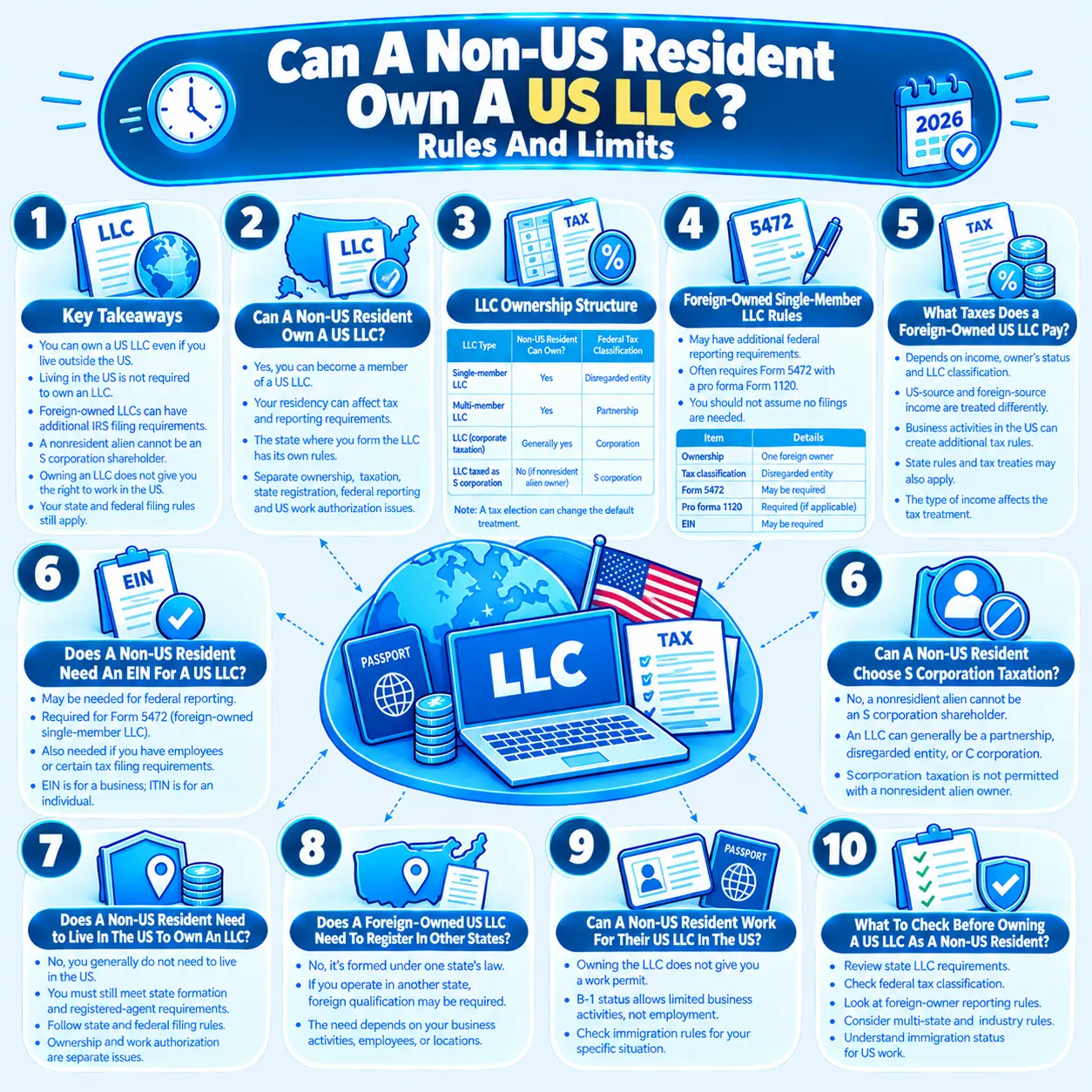
- 1 You can own a US LLC even if you live outside the US.
- 2 Living in the US is not required to own an LLC.
- 3 Foreign-owned LLCs can have additional IRS filing requirements.
- 4 A nonresident alien cannot be an S corporation shareholder.
- 5 Owning an LLC does not give you the right to work in the US.
- 6 Your state and federal filing rules still apply.
Starting a business in the United States does not need you to live in the country. A person living abroad can form a US LLC, become its owner, and run many types of businesses from outside the United States. The part that needs more attention is what happens after you form the LLC.
Your residency can affect the LLC’s tax treatment and reporting requirements. The state where you form the LLC has its own rules, and the work you perform while physically in the United States can raise separate immigration questions.
Before you form or buy into a US LLC, it helps to separate ownership, taxation, state registration, federal reporting, and US work authorization. These are different issues, and meeting one requirement does not automatically satisfy the others.
Can A Non-US Resident Own A US LLC?
Yes, a person who lives outside the United States can become a member of a US LLC. Often, a non-US resident can also own the entire LLC.
There is no general federal rule requiring the owner of an ordinary US LLC to be a US citizen or US resident. State law controls the process of forming and maintaining the LLC, so you still need to follow the requirements of the state where your LLC is registered.
Your LLC’s federal tax classification is a separate matter. The IRS generally treats a domestic LLC differently depending on whether it has one member, multiple members, or has elected corporate tax treatment.
| LLC ownership structure | Can a non-US resident own it? | Usual federal tax classification |
| Single-member LLC | Yes | Disregarded entity |
| Multi-member LLC | Yes | Partnership |
| LLC electing corporate taxation | Generally yes | Corporation |
| LLC taxed as an S corporation | No, if the owner is a nonresident alien | S corporation |
A tax classification election can change the default treatment. Foreign ownership by itself does not decide how the LLC will be taxed.
What Are The Rules For A Foreign-Owned Single-Member LLC?
A foreign-owned single-member LLC can have additional federal reporting requirements.
When a US single-member LLC is treated as a disregarded entity and is wholly owned by a foreign person, special federal reporting rules can apply. For certain reportable transactions, the LLC may have to file Form 5472 with a pro forma Form 1120.
The IRS has specific filing rules for foreign-owned US disregarded entities.
| Item | General treatment |
| Ownership | One foreign owner |
| Federal income tax classification | Usually disregarded entity |
| Separate regular corporate income tax return | Generally no, unless another rule applies |
| Form 5472 | May be required |
| Pro forma Form 1120 | Required with Form 5472 when the filing requirement applies |
| EIN | May be required depending on the circumstances |
You should not assume that a single-member LLC has no federal filing requirements simply because it is treated as a disregarded entity for income tax purposes.
When Does Form 5472 Apply?
Form 5472 is an information return used for certain reportable transactions involving foreign-owned US entities and related parties.
For a foreign-owned US disregarded entity, Form 5472 is required when the applicable reporting conditions are met. The form is attached to a pro forma Form 1120 for this type of entity.
| Question | Answer |
| Does every foreign-owned LLC file Form 5472? | No |
| Can Form 5472 apply to a foreign-owned single-member LLC? | Yes |
| Is Form 5472 an income tax return? | No, it is an information return |
| Is a pro forma Form 1120 used with Form 5472 for a foreign-owned US disregarded entity? | Yes, when the filing requirement applies |
The actual filing requirement depends on the ownership structure and transactions involved.
What Taxes Does a Foreign-Owned US LLC Pay?
A foreign-owned LLC does not automatically fall under one US tax rate. The tax treatment starts with the LLC being classified for federal tax purposes. It depends on the income it earns and the owner’s tax status.
| What to look at | Why it can change the tax treatment |
| How the LLC is taxed | An LLC may be treated differently for federal tax purposes depending on its classification and elections. |
| Income earned by the business | The rules can vary based on the kind of income the LLC receives. |
| Where the income comes from | The source of the income matters because US-source and foreign-source income are not always treated the same way. |
| Business activity in the US | Certain business activities can result in income being treated as effectively connected with a US trade or business. |
| Owner’s tax status | A nonresident alien, US person, and foreign entity have different tax rules. |
| Tax treaty | An applicable tax treaty may affect the US tax treatment of certain income. |
| State rules | Your state has its own income taxes, fees, and filing requirements in addition to federal requirements. |
For a nonresident owner, the type of income affects the tax treatment where it comes from. Income connected to a US trade or business is treated differently from certain US-source income that is not connected to the business. Your LLC’s tax treatment will also depend on how the LLC is classified for federal tax purposes and your tax status.
Does A Non-US Resident Need An EIN For A US LLC?
An Employer Identification Number (EIN) is the federal tax ID used by businesses and other entities.
A foreign-owned US LLC may need an EIN for federal reporting. A foreign-owned US disregarded entity must have one for filings such as Form 5472. You will also need an EIN if your LLC has employees or has certain federal tax filing requirements.
An EIN is for a business or entity, while an ITIN is issued to an individual for federal tax purposes.
| Number | Generally identifies | Purpose |
| EIN | Business or entity | Federal business tax identification |
| ITIN | Individual | Federal tax identification for a person who is not eligible for an SSN |
You should not assume that you need an ITIN simply because you own a US LLC.
Can A Non-US Resident Choose S Corporation Taxation?
A nonresident alien cannot be a shareholder of an S corporation.
The federal tax rules for S corporations require shareholders to meet specific eligibility requirements, and a nonresident alien is not an eligible shareholder.
For an LLC owner, the practical distinction is:
| Tax treatment | Nonresident alien owner |
| Disregarded entity | Generally possible |
| Partnership | Generally possible |
| C corporation taxation | Generally possible |
| S corporation taxation | Not permitted while the owner is an ineligible shareholder |
This matters if you are considering an LLC tax election. An LLC being eligible for corporate taxation does not mean it can automatically use S corporation taxation.
Does A Non-US Resident Need To Live In The US To Own An LLC?
No! You generally do not need to live in the United States to own a US LLC.
However, your LLC still has to meet the requirements of the state where it is formed. You may also have additional requirements if the company conducts business in another state.
A registered agent is generally required when forming an LLC. The registered agent must meet the requirements of the state where the business is registered.
| Requirement | Non-US resident |
| Live in the United States | Not generally required |
| Be a US citizen | Not generally required |
| Own a US LLC | Generally permitted |
| Have a registered agent | Generally required under state rules |
| Follow state filing requirements | Required |
| Follow applicable federal tax rules | Required |
Your physical location outside the United States does not remove the LLC’s US compliance requirements.
Does A Foreign-Owned US LLC Need To Register In Other States?
No, your LLC is formed under the law of a particular state. If it later conducts business activities in another state, that state may need the LLC to register there as a foreign LLC.
The exact requirement depends on what your business does and the activities it carries out in the other state.
| Business situation | Possible requirement |
| LLC operates only in its formation state | State formation and ongoing requirements |
| LLC conducts business in another state | Foreign qualification may be required |
| LLC has employees in another state | Additional state requirements may apply |
| LLC has a physical business location in another state | Additional registration may apply |
Forming an LLC in one state does not automatically allow you to ignore the rules of another state where your business operates.
Can A Non-US Resident Work For Their US LLC In The United States?
Owning a US LLC and having permission to work in the United States are two different matters.
You can generally own an LLC while living abroad. That ownership does not, by itself, give you permission to perform employment or other work in the United States.
For example, B-1 visitors may participate in certain permitted business activities, such as business meetings and contract negotiations. B-1 status does not authorize employment in the United States.
| Situation | LLC ownership | US immigration issue |
| Own a US LLC while living abroad | Generally permitted | Ownership alone is not a visa |
| Manage your business from outside the US | Generally possible | US work authorization is not the issue if the work is performed abroad |
| Attend permitted business meetings in the US | May be possible | Depends on your immigration status and activity |
| Perform work for your LLC while physically in the US | Ownership does not authorize it | Separate immigration rules may apply |
If you plan to travel to the United States and actively work for your LLC, check whether your particular immigration status permits the activity.
Does A Non-US Resident Have To Report Beneficial Ownership Information?
For a US-created LLC, current FinCEN rules do not require BOI reporting simply because the LLC is owned by a non-US resident.
FinCEN’s current rules distinguish between entities created under US law and certain entities formed under foreign law that register to do business in the United States.
| Entity | Current federal BOI position |
| LLC created under US state law | Exempt from BOI reporting |
| US LLC owned by a non-US resident | Foreign ownership alone does not make it a reporting company |
| Company formed under foreign law and registered to do business in the US | May have BOI reporting requirements if it meets the applicable definition and no exemption applies |
Because BOI rules have changed recently, check the current FinCEN requirements before relying on information from older articles.
What Should You Check Before Owning A US LLC As A Non-US Resident?
Before forming a US LLC or purchasing an ownership interest, check the requirements that apply to your particular business.
1. Check Your State’s LLC Requirement
Start with the state where you plan to form the LLC.
Check:
-
- LLC formation requirements
- Registered-agent requirements
- State filing fees
- Annual or periodic reports
- State taxes
- Business licenses and permits
- Rules for operating in other states
State requirements are separate from federal tax rules.
2. Check Your Federal Tax Classification
Know how the IRS will classify your LLC.
A single-member LLC generally defaults to disregarded-entity treatment, while a domestic multi-member LLC generally defaults to partnership treatment. An eligible LLC may elect corporate treatment.
Your tax classification affects how income and other federal tax requirements are reported.
3. Check Foreign-Owner Reporting Requirements
If you are the foreign owner of a US disregarded entity, check whether Form 5472 and the related pro forma Form 1120 filing requirements apply.
The IRS has specific rules for foreign-owned US disregarded entities, so such entities should not be treated like an ordinary single-member LLC with no additional reporting.
4. Check Where Your Business Actually Operates
Forming your LLC in one state does not automatically allow you to ignore the rules of another state.
If your business has activities, employees, offices, or other connections in another state, check whether foreign qualification or other state filings are required.
5. Check Whether Your Business Is Regulated
Some industries have additional federal or state requirements.
If your business involves a regulated activity, professional license, financial services, certain investments, or another restricted area, check the rules that apply to that specific industry before relying on the general LLC ownership rules.
6. Check Your Immigration Status Before Working In The US
If you intend to perform work for your LLC while physically present in the United States, treat that as a separate immigration question.
Owning the company does not automatically give you permission to work in the United States. The immigration rules depend on the status you hold and the activities you plan to perform.
Official Resources:
US Small Business Administration (SBA)
IRS (Single-Member Limited Liability Companies)
SBA (Registered Agents and Foreign Qualification)
Financial Crimes Enforcement Network (FinCEN)
US Department of State (B-1 Business Visitor Visa)
Frequently Asked Questions
Can a non-US resident own 100% of a US LLC?
Yes, a non-US resident can generally own 100% of a US LLC. There is no general federal ownership percentage limit for an ordinary LLC, although a particular industry or state may have additional rules.
Can I own a US LLC without living in the United States?
Yes. You generally do not have to live in the United States to own a US LLC. You still have to meet the formation, registered-agent, tax, reporting, and other requirements that apply to your LLC.
Can a nonresident alien own a single-member LLC?
Yes. A nonresident alien can generally own a single-member US LLC. If the LLC is treated as a foreign-owned US disregarded entity, additional IRS reporting requirements may apply.
Does a foreign-owned LLC have to file Form 5472?
Not every foreign-owned LLC has to file Form 5472. However, certain foreign-owned US disregarded entities must file Form 5472 when the applicable reporting requirements are met, generally together with a pro forma Form 1120.
Can a non-US resident make an LLC an S corporation?
A nonresident alien cannot be an S corporation shareholder. Therefore, an LLC owned by a nonresident alien generally cannot use S corporation taxation while that owner remains an ineligible shareholder.
Does owning a US LLC give you a US visa?
No. Owning a US LLC does not give you a US visa or work authorization. If you want to perform work for your LLC while physically in the United States, you must follow the immigration rules for the status you hold.
Does a US LLC owned by a foreign person have to file a BOI?
A US-created LLC is currently exempt from federal BOI reporting under FinCEN’s current rules. Foreign companies formed outside the United States and registered to do business in the United States can fall under different rules.
Does a non-US resident need an EIN for a US LLC?
A foreign-owned US disregarded LLC needs an EIN for certain federal reporting requirements. The EIN requirement also applies to LLCs with employees and certain other federal tax responsibilities.

Can a Non-US Resident Own a US LLC? Rules Explained
Learn how non-US residents can own and manage a US LLC, including ownership rules, IRS reporting requirements, EIN needs, tax classifications, state compliance, and work authorization limits. Understand the key requirements before forming or investing in a US business.
Get US LLC Guidance