






EIN vs ITIN vs SSN: What Is the Difference?
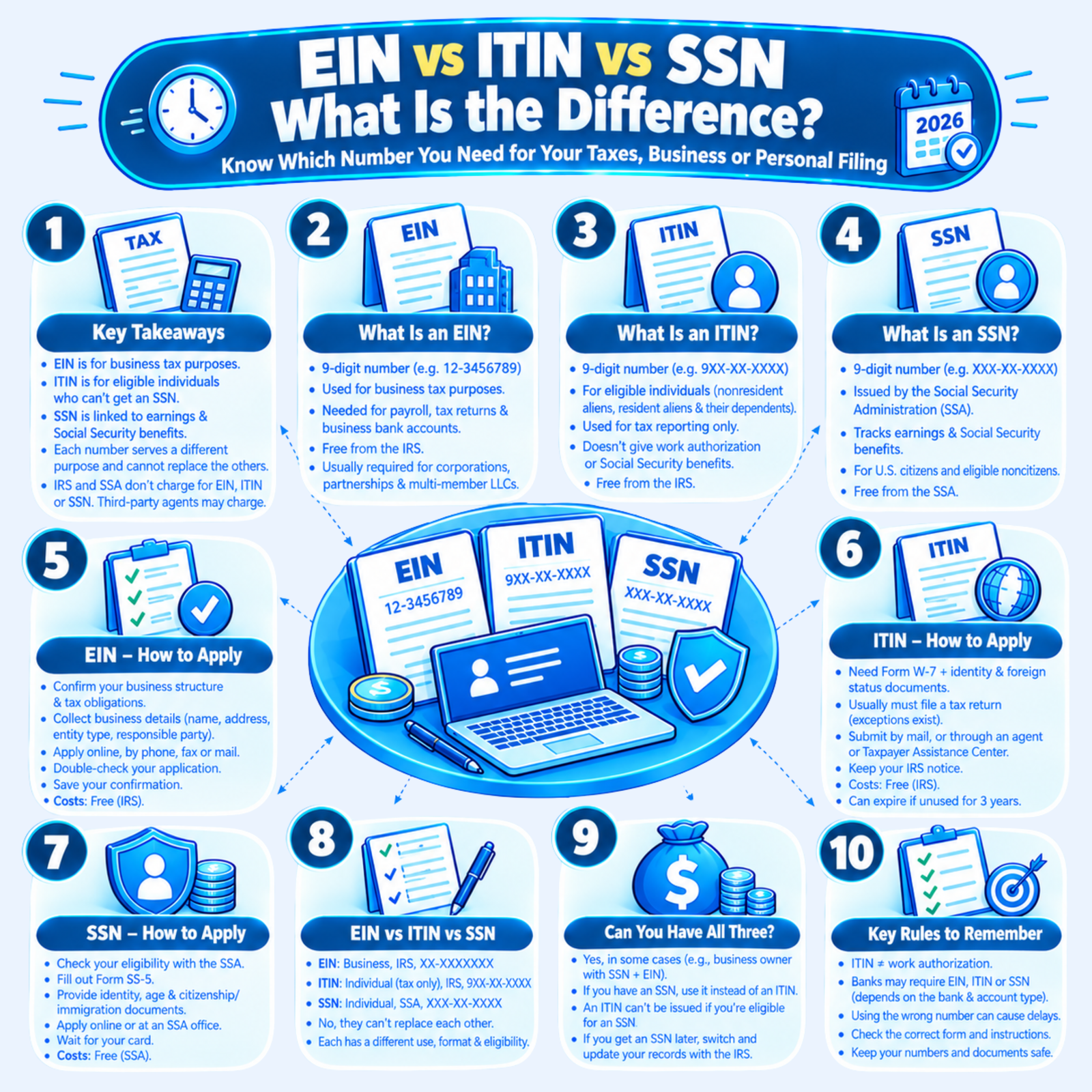
- 1 An EIN is used for business tax purposes.
- 2 An ITIN is for eligible individuals who need to file U.S. taxes but cannot get an SSN.
- 3 An SSN is linked to a person’s earnings and Social Security benefits.
- 4 Each number serves a different purpose and cannot replace the others.
- 5 The IRS and SSA don’t charge to apply for an EIN, ITIN, or SSN. Third-party agents may charge a service fee.
A U.S. tax form asks for your taxpayer identification number, and you’re not sure whether to enter your EIN, your ITIN, or your SSN. They each have nine digits, but they’re issued for different reasons. If you enter the wrong one, the IRS may send you questions about your paperwork, or they may delay your form while they check the information.
Business owners, foreign nationals, and first-time US tax filers can easily confuse these three numbers. A business may need an EIN, while its owner may use an SSN or qualify for an ITIN, depending on their circumstances. Understanding the difference between an EIN, ITIN, and SSN can help you choose the correct number for a tax form, business application, or other official paperwork.
What Is an EIN?
An EIN, or Employer Identification Number, is a nine-digit number the IRS assigns to a business so it can be identified for federal tax purposes. It’s usually written like this: 12-3456789.
You’ll use it when you file federal tax returns, handle payroll taxes, or open a business bank account. Banks and other institutions often ask for it too.
Do You Need One?
It depends on how your business is set up. You’ll generally need an EIN if you:
- have employees
- run a partnership or a corporation
- run a multi-member LLC
- manage certain trusts or estates
If you operate as a sole proprietor without employees, you generally may use your SSN for federal tax purposes instead of obtaining an EIN, provided no other EIN requirement applies. A single-member LLC may also be able to use its owner’s SSN for federal income tax reporting if it is treated as a disregarded entity and has no separate EIN requirement. However, many business owners choose to obtain an EIN to help limit the use of their SSN in business paperwork. The rules can differ based on your business structure and tax obligations.
How to Apply
- Confirm you need one: Look at your business structure & tax obligations first.
- Collect your details: You will need the business’s legal name & address, the type of entity and information about the responsible party (the person who controls the business).
- Pick how to apply: If your business is based in the US or its territories, the online application on the IRS website is the fastest option. Others may have to apply by phone, fax, or mail.
- Fill out the application: Double-check everything. Mistakes can cause delays later.
- Save your confirmation: Keep the IRS notice with your business records. You’ll probably need it again.
What Does It Cost?
Nothing. The IRS issues EINs for free. Some third-party services charge a fee to do the application for you, but you don’t need them.
What Is An ITIN?
An Individual Taxpayer Identification Number (ITIN) is a nine-digit number issued by the IRS to eligible individuals who need a US taxpayer identification number for federal tax purposes but are not eligible for a Social Security number (SSN). It is formatted as 9XX-XX-XXXX and is used for tax reporting and processing when an ITIN is appropriate for the individual’s circumstances.
It’s meant for nonresident aliens, resident aliens, and their spouses or dependents who have a real filing or reporting requirement.
One thing to be clear about: an ITIN is for taxes only. It doesn’t give you permission to work in the U.S., it says nothing about your immigration status, and it doesn’t qualify you for Social Security benefits.
Do You Need One?
Only if you can’t get an SSN and have a genuine tax reason. Common ones include:
- filing a federal income tax return
- reporting income or claiming a refund you’re allowed to claim
- listing a spouse or dependent on a return
- filing jointly with a spouse who is a US citizen or resident alien
- claiming benefits under a tax treaty
Plenty of foreign nationals never need one. Your filing obligations, tax residency, and eligibility for an SSN determine whether you need one.
How to Apply
You’ll need Form W-7 (Application for IRS Individual Taxpayer Identification Number) plus documents proving your identity and foreign status.
- Before you start: If you have an SSN or are eligible to obtain one, you generally can’t get an ITIN.
- Know your reason: Figure out why you need the number and whether it fits IRS rules.
- Fill out Form W-7: Add your personal details and pick the reason that matches your situation.
- Gather your documents: The IRS lists what it accepts. In many cases, a valid passport covers both identity and foreign status. Dependents and some other applicants may need extra documents, so check the Form W-7 instructions.
- Attach your tax return: Most first-time applicants send the W-7 together with a federal return, though there are exceptions.
- Submit it: You can mail it to the IRS, or go through a Certifying Acceptance Agent or an eligible Taxpayer Assistance Center.
- Keep the notice: Once approved, hold on to the IRS letter. You’ll need the number for future filings.
What Does It Cost?
The IRS doesn’t charge anything for an ITIN. An authorized agent might charge for helping you with the process.
Does an ITIN Expire?
Yes, it can. An ITIN that isn’t used on a federal tax return for three consecutive years may expire. If yours has expired and you need it again, you renew it with Form W-7. Check the IRS website for the current renewal rules.
What Is An SSN?
The Social Security Number (SSN) is the nine digit unique number that is issued by the Social Security Administration (SSA) to eligible persons. The SSN is used to maintain records of earnings of the individual in connection with the Social Security program.
American citizens can get the SSN, along with some noncitizens who are eligible to get it, as per the rules set by the SSA, and either authorized to work in the US or have a valid nonwork reason for getting it.
Another point of confusion is that the SSN is the number of the person and not of the business. Even if you are the owner of a business, then you can use your SSN in the personal tax filing.
Who can get one?
Eligibility for SSN depends on whether you are a:
- US citizen who fulfills the requirements for proof of identity established by the SSA.
- Lawful permanent resident.
- Noncitizen who is eligible to work in the US under immigration laws.
- Noncitizen who qualifies for an SSN based on the SSA’s requirements for a nonwork SSN.
Noncitizens have to meet SSA’s requirements for qualification for an SSN. A nonwork SSN can be granted only under certain conditions.
How to Apply
If you’re eligible, you apply through the SSA.
- Check your eligibility: Review the SSA’s current conditions for your citizenship or immigration status & determine which documents you must provide.
- Fill out Form SS-5: This is the application for a Social Security Card.
- Gather your documents. You will need proof of your identity, your age & your citizenship or lawful immigration status.
- Submit your application: Follow the SSA’s application process for your circumstances. Depending on your eligibility, you may be able to apply online or need to submit documents through an SSA office.
- Wait for your card: Once approved, the SSA mails you your Social Security card.
What Does It Cost?
Nothing. Applying through the SSA is free.
What Is the Difference Between EIN, ITIN, and SSN?
Each number identifies something different. An EIN is for a business. An ITIN is for a person who has to deal with US taxes but can’t get an SSN. An SSN is for a person in the Social Security system.
| Features | EIN | ITIN | SSN |
| Stands for | Employer Identification Number | Individual Taxpayer Identification Number | Social Security Number |
| Issued by | IRS | IRS | Social Security Administration |
| Identifies | A business or other entity | A person, for tax purposes only | A person |
| Used for | Business taxes and related paperwork | Filing federal returns and meeting tax reporting requirements | Earnings records, taxes, and Social Security |
| Format | XX-XXXXXXX | 9XX-XX-XXXX | XXX-XX-XXXX |
| Who gets one | Eligible businesses and entities | People with a tax reason who can’t get an SSN | U.S. citizens and eligible noncitizens |
| Lets you work in the US? | No | No | Not by itself. Work authorization rules still apply |
| Can it replace the others? | No | No | No |
You’ll often see all three on tax paperwork, but you can’t swap one for another. Which one you use depends on who is filing (a person or a business) and what the form asks for.
Can You Have An EIN, ITIN, And SSN At The Same Time?
An individual who has an SSN should use it for federal tax purposes instead of an ITIN. A business owner may have an SSN and an EIN, or an ITIN and an EIN if they are eligible for an ITIN and do not qualify for an SSN. The appropriate number depends on the person, the business’s tax classification, and the specific form being completed. A business owner should not assume that every business form requires the EIN or that every personal tax form requires the same identification number.
An ITIN is different. If you already have an SSN, or you’re eligible for one, you generally can’t get an ITIN. And if you have an ITIN and later receive an SSN, switch to the SSN for federal tax purposes and let the IRS know so it can update your records.
Two quick examples. A U.S. citizen running a company uses an SSN personally and an EIN for the company. A foreign business owner who can’t get an SSN can still get an EIN for the business, and an ITIN too if they separately meet the IRS requirements.
Does An ITIN Let You Work In The US?
No! An ITIN is for federal taxes only. It isn’t a visa, a work permit or proof of immigration status.
Noncitizens must meet the applicable immigration & employment authorization requirements to work in the United States. A person may have US tax filing obligations without being authorized to work in the country. Tax identification & work authorization are separate matters, and an ITIN does not provide permission to work.
Can You Open A Bank Account With An EIN, ITIN, Or SSN?
The answer depends on the bank and type of the account.
- EIN: In the case of the business accounts, the banks require an Employer Identification Number when creating an account.
- ITIN: An individual taxpayer identification number may be accepted by certain banks for the individual accounts, although this number is not a general requirement.
- SSN: Most banks would require the social security number in case of individual accounts.
Having one of these numbers does not necessarily mean that your application will be processed. The banks may ask for identification, proof of residence, documents regarding business incorporation or even ownership. In case you want to create the US business account from abroad, you must learn about the requirements of the bank.
What Happens If You Use the Wrong Number?
Your tax records may not match, processing can slow down & you may get letters asking for corrected information. It can also cause headaches when you file business returns or hand documents to a bank.
Before you submit anything:
- Check whether the form wants a personal or business number.
- Make sure the number belongs to the person or entity named on the form.
- Read the instructions for that IRS form or that bank’s requirements.
- Keep your EIN confirmation, ITIN notice or Social Security card somewhere safe.
- If your situation changes, like getting an SSN after having an ITIN, follow the IRS steps for updating your records.
And don’t apply for an ITIN just because you don’t have an EIN or for an EIN just because you can not get an SSN. They aren’t replacements for each other.
Frequently Asked Questions
Is an EIN the same as an ITIN?
An EIN is assigned to a business or another eligible entity, such as a trust or estate. An ITIN belongs to a person. People mix them up because both are nine digits and both come from the IRS, but if you’re an individual without an SSN, an EIN won’t do what an ITIN does, and vice versa.
Is an ITIN the same as an SSN?
No, the SSA hands out SSNs, and they’re tied to work and Social Security benefits. The IRS hands out ITINs, and that’s all they’re for: filing taxes when you can’t get an SSN. An ITIN doesn’t qualify you for Social Security benefits on its own.
Can a foreigner get an EIN without an SSN?
Yes, and lots of non-U.S. founders do. The catch is that the online application usually expects an SSN or ITIN, so applicants without one typically apply with Form SS-4 by fax or mail, and international applicants can also apply by phone. On the SSN/ITIN line, write “Foreign” or “N/A”. Mail can take several weeks, which is longer than the online route.
Can I get an ITIN without filing a tax return?
Sometimes, but it’s the exception. Normally you send Form W-7 along with your return. If you fall under one of the IRS exceptions (claiming a tax treaty benefit is a common one), you can skip the return, but you’ll need to attach proof that you actually qualify. Without that proof, they’ll just send it back.
Does every LLC need an EIN?
Multi-member LLCs generally need an EIN, particularly when taxed as partnerships. The exact requirements depend on the LLC’s tax classification and circumstances.
Can I use my ITIN to get a job in the United States?
No. An ITIN is for taxes only and is not valid proof of work authorization for employment verification. See “Does an ITIN Let You Work in the U.S.?” for details.
What should I do if I receive an SSN after getting an ITIN?
Switch to the SSN and tell the IRS you’ve got one now. They’ll link your old ITIN history to the new number so earlier payments and refunds don’t get lost. If you skip that step, you can end up with two separate tax records, which can cause delays and confusion. Follow the current steps on the IRS website.
Conclusion
An EIN, ITIN, and SSN each serve a different purpose. An EIN identifies a business or other eligible entity for federal tax purposes. An ITIN identifies an eligible individual who needs a taxpayer identification number but is not eligible for an SSN. An SSN identifies an individual & is used for Social Security records & applicable tax reporting.
Before applying, determine whether you need a number for yourself or your business and check the eligibility requirements. Use the IRS website for EIN and ITIN applications and the Social Security Administration website for SSN applications. If you are a non-US resident forming a US business or are unsure which number applies to your situation, consult a qualified tax professional before submitting your application.
Official Resources:
IRS (Employer Identification Number)
IRS (Instructions for Form SS-4)
IRS (Individual Taxpayer Identification Number)
IRS (Instructions for Form W-7)
Social Security Administration (Social Security Numbers for Noncitizens)

EIN vs. ITIN vs. SSN: Key Differences Explained
Understand the differences between an EIN, ITIN, and SSN, including eligibility, application processes, tax purposes, and business uses. Learn which identification number applies to your situation and how to avoid common application and filing mistakes.
Get Tax ID Guidance