






How to Create a US LLC From India: Complete Formation Process
- 1 You can own a US LLC while living in India.
- 2 Pick the state based on your business needs and costs.
- 3 A registered agent is required in the state you choose.
- 4 You may need an EIN and other tax filings.
- 5 Indian tax and foreign-exchange rules may also apply.
- 6 An LLC does not give you a US visa or work permit.
Forming a US limited liability company (LLC) while living in India is generally possible. You do not ordinarily need to become a US resident before forming a US LLC, and the IRS’s current Form SS-4 instructions specifically accommodate applicants whose principal place of business is outside the United States.
But forming the LLC is just the beginning.
A person living in India may also need a US registered agent, an Employer Identification Number (EIN), business banking or payment infrastructure, appropriate federal and state filings, and a plan for Indian tax and foreign-exchange compliance. The US tax result also depends on how the LLC is classified for federal tax purposes and what the business actually does. Having American customers does not, by itself, answer the US tax question.
There is another distinction worth making at the beginning: owning a US LLC does not give the owner a US visa, immigration status, or permission to work physically in the United States.
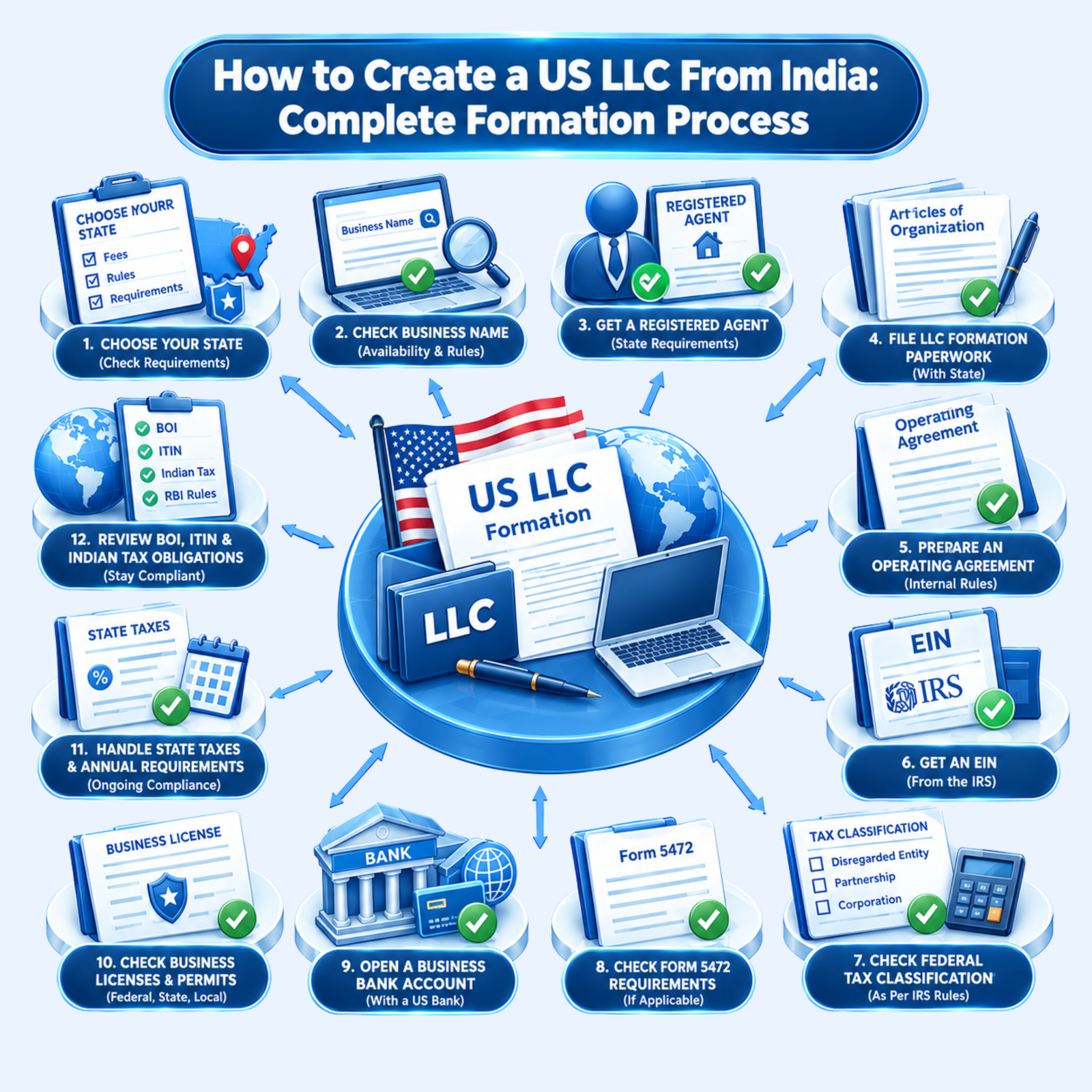
This article explains the process in the order that a business owner in India is likely to encounter it, based on current official guidance from the US and Indian governments.
Can You Form A US LLC From India?
Yes! A person living in India can generally own a US LLC, subject to the formation and ownership rules of the state where the LLC is created.
US LLCs are created under state law, not by the federal government. The state determines the formation procedure, required filing, registered-agent rules, name requirements, and ongoing state obligations.
For someone living in India, the practical point is that US residency is not normally a prerequisite to becoming an LLC member. The IRS’s current Form SS-4 instructions also expressly contemplate businesses whose mailing and physical addresses are outside the United States.
A US Social Security number is also not the same thing as an LLC formation requirement. An SSN may become relevant for particular tax or identification purposes, but an Indian owner does not automatically need an SSN simply to create a US LLC.
Owning the LLC is different from working in the United States
This distinction is often missed. You can own a US business while living and working in India. That does not mean you can travel to the United States and perform ordinary employment or operational work there without the appropriate immigration authorization.
For example, a person may:
- own a US LLC
- manage the business from India
- provide services from India
- contract with US customers
- receive business revenue through the LLC
without that ownership itself creating US immigration status.
If the owner later wants to physically work in the United States, separate immigration rules apply. A B-1 business visitor visa does not generally authorize employment or ordinary productive work in the United States. The appropriate visa category depends on the person’s circumstances and intended activities.
What Do You Need To Form A US LLC From India?
The exact requirements depend on the state, but a typical foreign owner should expect to deal with the following:
| Requirement | Usually Needed? | Purpose |
| LLC name | Yes | Identifies the legal entity |
| State of formation | Yes | Determines where the LLC is created |
| Registered agent | Yes | Receives official and legal documents |
| Member/owner information | Yes | Identifies the ownership structure |
| Formation document | Yes | Legally creates the LLC |
| Business address | Depends | Used for business, tax, banking, or other purposes |
| Mailing address | Usually | Receives correspondence |
| Operating agreement | Strongly recommended | Records ownership and internal rules |
| Identification documents | Often | Used for state, banking, tax, or service-provider verification |
| EIN | Often needed | Federal tax and business identification |
| Banking information | Depends | Needed to establish business financial infrastructure |
| Payment method | Depends | Needed to pay state filing fees or service providers |
The important distinction is between government requirements and requirements imposed by private companies.
For example, a bank may request a passport, proof of residential address, video verification, or additional documentation. That does not mean those items are universally required to form an LLC.
Likewise, a formation service may ask for information that is useful for its onboarding process but is not necessarily a state-law requirement.
Choose The Right US State For Your LLC
There is no universally best state for a person living in India.
The right state depends first on where the business actually operates.
If you have a US office, employees, significant physical activity, or another meaningful connection to a particular state, forming an LLC somewhere else simply because that state advertises a low formation fee can create additional registration and tax obligations.
The US Small Business Administration explains that a business may need to register in states where it conducts business activities and may need foreign qualification if it operates across multiple states.
- Wyoming
Wyoming is commonly considered by small businesses because its state formation and ongoing filing structure can be relatively straightforward.
The Wyoming Secretary of State currently lists a $100 filing fee for Articles of Organization for an LLC. Wyoming LLC annual reports are generally due on the first day of the anniversary month of formation. The annual license tax is generally at least $60, or $0.0002 of assets located and employed in Wyoming, whichever is greater.
Wyoming also requires an LLC to maintain a registered agent with a physical Wyoming address.
These are state-level obligations. They do not mean that forming in Wyoming eliminates federal or Indian tax obligations.
- Delaware
Delaware is especially well known for business entities and has a sophisticated corporate legal system. That does not automatically make it the best choice for a small India-based freelancer, consultant, or online business.
The Delaware Division of Corporations currently lists a $110 filing fee for an LLC Certificate of Formation and a $300 annual tax for an LLC.
That means a Delaware LLC can have a higher recurring state cost than someone might expect from articles describing only the initial formation fee.
- New Mexico
New Mexico is another state frequently considered by nonresident business owners. Its Secretary of State provides an online business filing system for forming and maintaining entities.
However, a person should not choose New Mexico merely because an older article says it is the “best state” or has a particular fee structure. State fees, forms, filing procedures, and business requirements can change. Check the current New Mexico Secretary of State portal before filing.
What should determine your choice?
Consider:
- Where the business is actually operated.
- Whether you have US employees.
- Whether you have a US office or physical location.
- Whether you expect to operate in several states.
- Initial formation fee.
- Annual report or annual tax requirements.
- Franchise taxes.
- Registered-agent costs.
- State income, sales, or other business taxes.
- Foreign-qualification requirements in other states.
- The nature and size of the business.
Do not select a state based solely on a “100 LLC” headline. The formation fee is only one part of the cost.
Choose And Check Your LLC Name
Your LLC name must satisfy the naming rules of the state where you form the entity.
The state will generally require the name to be distinguishable from existing entities and may want an LLC designation such as “LLC” or “Limited Liability Company.”
Before filing:
- Search the state’s business-name database
- Check whether the name satisfies the state’s naming rules
- Check for restricted or regulated words
- Search relevant federal and state trademark records
- Check the domain name if an online business will use the name
- Check major marketplaces or social platforms if the brand will depend on them.
A state approving your LLC name does not mean that you have trademark clearance.
For example, your state may accept a name because no identical LLC exists in its database while another business owns trademark rights in a similar name.
Legal LLC name vs. DBA
Your legal entity name and your trading name do not always have to be identical.
A DBA, or “doing business as” name, may allow a business to operate under another name where the applicable state or local rules permit it.
The DBA does not create a separate LLC.
Get A Registered Agent
A registered agent is a person or business designated to receive official documents for the LLC.
The registered agent typically receives:
- lawsuits and service of process
- state notices
- certain government correspondence
- other official documents.
The registered agent must meet the state’s requirements and generally have a physical address in the state.
For someone living in India, a commercial registered-agent service is often the practical solution.
Registered agent vs. business address
These are different things.
A registered-agent address is primarily for official service and state notices.
A business address may be used for:
- customers
- invoices
- banking
- payment processors
- licensing
- tax correspondence
- general business communication.
A virtual mailbox is also different from a registered agent.
Do not assume that one address will satisfy every organization.
The SBA specifically states that an LLC needs a registered agent in the state where it is registered and that the registered agent must be located in that state.
File The LLC Formation Documents
Once you have selected the state, the actual formation process generally follows this sequence:
1. Go to the appropriate state authority
Usually this is the Secretary of State or another designated state business agency.
Use the official state website rather than relying on a third-party filing site for the legal requirements.
2. Confirm the formation document
Depending on the state, it may be called:
- Articles of Organization
- Certificate of Organization
- Certificate of Formation.
The name is state-specific.
3. Enter the LLC information
The filing commonly asks for information such as:
- LLC name
- registered agent
- principal or mailing address
- organizer
- management information
- effective date, where applicable.
4. Pay the state filing fee
The amount depends on the state.
5. Save the approved documents
Keep the state-approved formation document and any certificate or confirmation issued by the state.
You will likely need these documents later for banking, payment services, tax administration, or other verification.
Create An Operating Agreement
An operating agreement is the internal document that explains how the LLC is owned and managed.
A single-member LLC can benefit from an operating agreement even when the state does not need the document to be filed with the formation paperwork.
It can address:
- the owner or members
- ownership percentages
- capital contributions
- management authority
- distributions
- business decision-making
- treatment of company property
- admission of future members
- transfer of ownership
- procedures if the LLC is closed.
For a single-member LLC, the agreement can also help show that the business intends to operate as a separate legal entity.
The operating agreement is different from the Articles of Organization.
The Articles of Organization create the LLC with the state.
The operating agreement establishes the internal rules of the LLC.
Get An EIN From India
An Employer Identification Number (EIN) is a federal tax identification number issued by the IRS.
The EIN is separate from:
- The LLC’s state filing number
- An ITIN
- An SSN
- A registered agent number.
Does a foreign-owned LLC need an EIN?
The answer depends on the LLC’s structure and federal filing obligations.
An EIN may be needed for federal tax reporting, employment taxes, banking, or other business purposes. A foreign-owned disregarded entity can also need an EIN for certain information-reporting requirements.
Therefore, do not assume either of these statements is always correct:
“Every LLC automatically needs an EIN.”
or
“A single-member LLC never needs an EIN.”
The actual requirement depends on the facts.
How a person in India applies
The current IRS Form SS-4 instructions are particularly important here.
If the applicant has no legal residence, principal place of business, or principal office or agency in the United States or its territories, the applicant cannot use the IRS online EIN application.
The current instructions provide that international applicants may apply by telephone at 267-941-1099, a non-toll-free number. Form SS-4 can also be submitted through the IRS’s applicable fax or mail procedures.
The IRS’s current Form SS-4 instructions state that the online system is for applicants with a legal residence, principal place of business, or principal office or agency in the United States or US territories.
Responsible party
This is an important part of Form SS-4.
The responsible party is generally the individual who ultimately owns or controls the entity or exercises ultimate effective control over it.
For a foreign-owned single-member LLC, that will often be the actual owner.
Do not put a formation company, registered agent, nominee, or other third party on the form merely because that person helped establish the LLC.
If the responsible party has neither an SSN nor an ITIN and is ineligible to obtain one, the current Form SS-4 instructions permit the responsible-party field to contain “foreign” or “N/A”, as applicable.
The responsible party must still be the actual person who meets the IRS definition.
Open A US Business Bank Account
Forming the LLC does not automatically give you a US bank account.
A bank or financial platform decides independently whether it will onboard a particular business and owner.
You may be asked for:
- approved formation documents
- EIN
- passport or other identification
- residential address
- business address
- operating agreement
- information about the business model
- expected transaction activity
- ownership information
- additional identity or compliance documentation.
A bank may also ask why the business is connected to the United States while the owner lives in India.
How Much Does It Cost To Form A US LLC From India?
There is no single correct “total LLC cost.”
The cost depends on the state, the registered agent, the business’s tax needs, and whether professional assistance is used.
| Cost | What It Covers | Mandatory or Optional |
| State formation fee | Creates the LLC | Mandatory |
| Registered-agent fee | Maintains required registered-agent service | Usually recurring |
| Operating agreement preparation | Internal LLC governance document | Usually recommended; professional drafting optional |
| EIN | Federal business identification | No IRS fee |
| Annual report/annual tax | State-level ongoing compliance | Depends on state |
| Franchise tax | State tax imposed by some states | Depends on state |
| Accounting | Bookkeeping and financial records | Depends on business |
| Tax preparation | Federal/state filings | Depends on tax position |
| Banking fees | Account or transaction charges | Provider-specific |
| Payment processing | Card/payment transactions | Provider-specific |
| Attorney/CPA fees | Professional assistance | Optional, but useful for complex structures |
Example of state-level differences
For a Wyoming LLC, the official state materials currently show a $100 initial LLC filing fee and a minimum $60 annual license tax.
For a Delaware LLC, the official Delaware Division of Corporations currently shows a $110 formation fee and $300 annual tax.
These examples demonstrate why comparing only the initial formation fee can be misleading.
Always verify the fee directly with the relevant state before filing.
US LLC Taxes For Someone Living In India
Forming a US LLC does not automatically mean the owner pays US federal income tax on all LLC revenue.
It also does not mean that the owner is automatically exempt from US tax.
The tax analysis depends on several factors, including:
- the LLC’s federal tax classification
- whether it has one member or multiple members
- whether it elected corporate taxation
- whether the owner is a US tax resident
- where services are physically performed
- whether the business is engaged in a US trade or business
- the source of the income
- whether income is effectively connected with a US trade or business
- the nature of the business
- state tax rules
- any applicable treaty provisions.
How the LLC Is Classified For US Federal Tax
An LLC is a state-law entity, but the IRS has its federal tax classification rules.
A domestic single-member LLC generally defaults to disregarded entity status for federal income tax purposes unless it elects to be treated as a corporation.
A domestic multi-member LLC generally defaults to partnership status unless it elects corporate treatment.
An eligible LLC can generally use Form 8832 to elect corporate classification.
This classification matters because it determines which federal tax rules and returns can apply.
It is therefore useful to decide the LLC structure before assuming what its annual US tax filing will look like.
Does A US LLC Need To File BOI Information?
The Corporate Transparency Act rules changed significantly in 2025.
Under the current FinCEN rule, entities created in the United States, including US-formed domestic LLCs, are exempt from the federal BOI reporting requirement.
This means a person in India who creates a new LLC under the law of a US state is not currently required to file a BOI report with FinCEN merely because the LLC is foreign-owned.
There is an important distinction.
A US-formed domestic LLC is different from a foreign entity formed under another country’s law that registers to do business in the United States.
Under the current FinCEN framework, the reporting-company definition was narrowed to foreign entities registered to do business in a US state or tribal jurisdiction by filing with the relevant authority.
Do You Need An ITIN To Form A US LLC?
No, an ITIN is not automatically required simply because an Indian resident owns a US LLC.
An ITIN, or Individual Taxpayer Identification Number, is an IRS number used by certain individuals who need a US taxpayer identification number but are not eligible for an SSN.
An ITIN is different from an EIN:
| Number | Identifies | Main Purpose |
| EIN | Business/entity | Federal business tax identification |
| ITIN | Individual | US federal tax identification for eligible individuals |
| SSN | Individual | Social Security and tax identification |
An Indian resident may need an ITIN if a particular US tax filing, treaty claim, withholding requirement, or other tax situation requires one.
But forming an LLC alone does not automatically trigger an ITIN requirement.
An ITIN also does not provide US work authorization or change a person’s immigration status.
US LLC and Indian Tax Obligations
Creating a US LLC does not remove Indian tax obligations.
For a person who remains an Indian tax resident, the India-side analysis can be significant.
The relevant questions may include:
- What is the person’s Indian tax-residency status?
- What income does the person receive?
- What interest does the person hold in the US entity?
- Is the US entity treated as a foreign asset or foreign business interest for Indian reporting purposes?
- Where is the business actually managed and operated?
- What foreign income is received?
- What taxes have been paid in the United States?
- Is foreign tax credit available?
- What foreign-exchange rules apply to the investment or remittance?
The Indian Income Tax Department currently provides foreign-asset and foreign-income reporting guidance for residents. Schedule FA covers categories such as foreign equity or debt interests, financial interests in foreign entities, foreign accounts, and other foreign assets.
*The exact ITR form and disclosure depend on the taxpayer’s circumstances.
Do You Need A US Address?
Not necessarily for every purpose.
Several addresses can exist in connection with the same business:
- Registered-agent address
This is the address associated with the registered agent and service of process.
- Business address
This may represent where the business operates.
- Mailing address
This is where correspondence is received.
- Owner’s residential address
An Indian owner may continue to have an Indian residential address.
- Bank address
A bank may impose its own requirements for physical and mailing addresses.
*These addresses should not be treated as interchangeable.
For example, using a registered-agent address on a bank application when the bank specifically requires the owner’s residential address can create verification problems.
Likewise, a virtual mailbox does not automatically satisfy every state, tax, bank, or payment-provider requirement.
Can You Run The LLC From India?
Yes, a US LLC can be owned and managed by someone who physically lives in India.
The more useful question is where the business activity actually takes place.
For example, an Indian software developer might:
- form a US LLC
- live in India
- work from India
- manage the LLC from India
- contract with US clients
- Use business banking and payment infrastructure connected to the LLC.
That arrangement still needs appropriate US and Indian tax analysis.
The situation becomes more complicated if the business has:
- a US office
- US employees
- inventory in the United States
- a US warehouse
- agents acting on its behalf
- significant physical operations
- the owner regularly performing services in the United States
- operations in several states.
Those facts can affect tax, state registration, payroll, licensing, and immigration issues.
Visiting the United States is a separate issue
Owning the LLC does not give the owner a right to work in the United States.
The Department of State distinguishes temporary business activities such as meetings, consultations, negotiations, and conferences from employment or productive work.
If the owner plans to physically work in the United States, the appropriate immigration category should be determined separately.
Annual Compliance After Forming The LLC
Creating the LLC does not end the compliance process.
A foreign owner should maintain a calendar covering at least the following:
- state annual reports
- state annual taxes
- franchise taxes, where applicable
- registered-agent renewal
- federal tax returns
- information returns
- Form 5472, where applicable
- pro forma Form 1120, where applicable
- bookkeeping
- business bank records
- ownership records
- changes to business addresses
- changes to the IRS responsible party
- licenses and permits
- sales-tax obligations, where applicable
- foreign qualification in other states when required.
The exact list depends on the state and the LLC’s tax classification.
Example: Wyoming
Wyoming LLC annual reports are generally due on the first day of the anniversary month of formation. The state uses an annual license-tax system with a minimum amount.
Example: Delaware
Delaware LLCs do not use the same annual-report structure as Delaware corporations. Instead, Delaware LLCs are subject to an annual tax, currently listed by the Division of Corporations at $300.
The point is not that either Wyoming or Delaware is better. The point is that ongoing compliance differs by state.
US LLC From India (Example Scenario)
Consider an entrepreneur living in India who provides software development services to US companies.
She wants to operate through a US single-member LLC.
Step 1: State selection
She first examines where the business actually operates rather than automatically selecting a state because an online article calls it the “best state.”
If she has no US office or employees and operates the business from India, her analysis may be different from that of a founder opening an office in California.
Step 2: Registered agent
She appoints a registered agent that satisfies the requirements of the chosen state.
The registered agent provides the state-required address for service of process. It does not become her business office in India.
Step 3: Formation
She files the state’s Articles of Organization or equivalent document and receives the approved formation documents.
Step 4: Operating agreement
Even as the only member, she prepares an operating agreement recording her ownership and management authority.
Step 5: EIN
Because she is applying from outside the United States, she follows the IRS procedure for international applicants rather than assuming she can use the ordinary US online EIN application.
She identifies herself as the actual responsible party and follows the current Form SS-4 instructions.
Step 6: Banking and payments
She applies for a business account or payment solution that accepts businesses with an Indian-resident owner.
The provider may conduct its own identity and business verification.
Formation of the LLC does not guarantee approval.
Step 7: Federal tax classification
If the single-member LLC remains a disregarded entity, she does not automatically have a normal corporate income-tax return merely because the LLC exists.
However, because it is foreign-owned, she must examine whether the Form 5472 and pro forma Form 1120 reporting regime applies.
Step 8: Where the work is performed
She performs all software development work from India.
That fact matters when analyzing the source of personal-service income. US customers do not, by themselves, determine where personal services are performed for US sourcing purposes.
Step 9: Indian compliance
She separately reviews her Indian tax-residency position, foreign-asset & foreign-income reporting, and RBI overseas-investment/remittance requirements.
This example does not establish her actual US or Indian tax liability. The result could change if she hires US employees, opens an office, performs services in the United States, adds members, elects corporate taxation, or changes how the business operates.
When Should You Speak With A Tax Professional Or Attorney?
Professional advice becomes particularly useful when the structure is more complicated than a simple single-owner business operated from India.
Consider getting advice before formation or before starting operations if you have:
- Multiple LLC members
- US employees
- A US office
- Inventory or warehousing in the United States
- Substantial US operations
- Operations in multiple states
- Significant US income
- Related-party transactions
- Loans between the owner and LLC
- Plans to elect corporate taxation
- Substantial cross-border payments
- Indian and US filing obligations
- Uncertainty about Form 5472
- Uncertainty about US trade-or-business status
- Questions about RBI overseas-investment compliance.
For an India-based founder, it can be useful to work with professionals who understand both sides of the transaction, rather than treating the US LLC and Indian tax questions as unrelated matters.
Official Resources:
US Small Business Administration (SBA)
Internal Revenue Service (IRS) ( Instructions for Form SS-4)
Internal Revenue Service (IRS) (Single-Member Limited Liability Companies)
Internal Revenue Service (IRS) (Instructions for Form 5472)
Financial Crimes Enforcement Network (FinCEN) (Beneficial Ownership Information Reporting)
US Department of State (US Business Visas (B-1))
Income Tax Department, Government of India (Foreign Assets and Foreign Income / Schedule FA)
Reserve Bank of India (RBI) (Liberalised Remittance Scheme (LRS))
Wyoming Secretary of State (Business Division)
Delaware Division of Corporations (How to Form a New Business Entity)
Frequently Asked Questions
Can an Indian citizen open an LLC in the USA?
Yes, a person living in India can generally own a US LLC, subject to the requirements of the state where the LLC is formed. US residency is not automatically required.
Can I form a US LLC while living in India?
Yes! The formation process can generally be handled without moving to the United States. You will need to satisfy the chosen state’s formation requirements and maintain a qualifying registered agent.
Do I need a US address to form an LLC?
Not necessarily for every purpose. A registered agent must generally have a qualifying address in the formation state, but that address is different from the owner’s residential address or the LLC’s general business address.
Can I get an EIN without an SSN?
A foreign applicant who is ineligible for an SSN or ITIN can still apply for an EIN under the IRS’s international-applicant procedures. Current Form SS-4 instructions specifically address what to enter when the responsible party has neither an SSN nor ITIN and is ineligible to obtain one.
How much does it cost to form a US LLC from India?
There is no single total cost. You may have a state formation fee, registered-agent cost, annual state fees or taxes, accounting costs, tax-preparation costs, banking charges, and payment-processing fees. The amount varies substantially by state and business structure.
Does a foreign-owned US LLC pay US taxes?
It can, but the answer depends on the LLC’s tax classification, activities, income source, US trade or business status, state rules, and other facts. Having a US LLC does not automatically make all income taxable in the United States, and it does not automatically make the income tax-free.
Does a single-member LLC owned by an Indian resident need Form 5472?
A foreign-owned US single-member LLC that is treated as a disregarded entity can have Form 5472 reporting obligations when it has reportable transactions. A pro forma Form 1120 is generally used with the Form 5472 filing. The exact filing position should be reviewed based on the LLC’s transactions.
Do I need a US bank account for my LLC?
Not necessarily in every situation. The LLC can exist without a particular bank account, but the business may need suitable banking or payment infrastructure to receive customer payments and pay expenses. Individual providers have their own eligibility rules.
Do I need an ITIN to own a US LLC?
Not automatically. An ITIN is an individual tax identification number and may become relevant if a particular US tax filing, treaty claim, or other requirement applies. It is not simply an ownership requirement for every foreign LLC owner.
Does owning a US LLC give me a US visa or work authorization?
No. LLC ownership does not itself provide a US visa, immigration status, or work authorization. If you want to physically work in the United States, you must separately comply with applicable US immigration rules.

How to Create a US LLC From India
Learn how to form and manage a US LLC from India, including state selection, registered agents, EIN requirements, banking, US and Indian tax considerations, and ongoing compliance.
Get US LLC Formation Guidance