






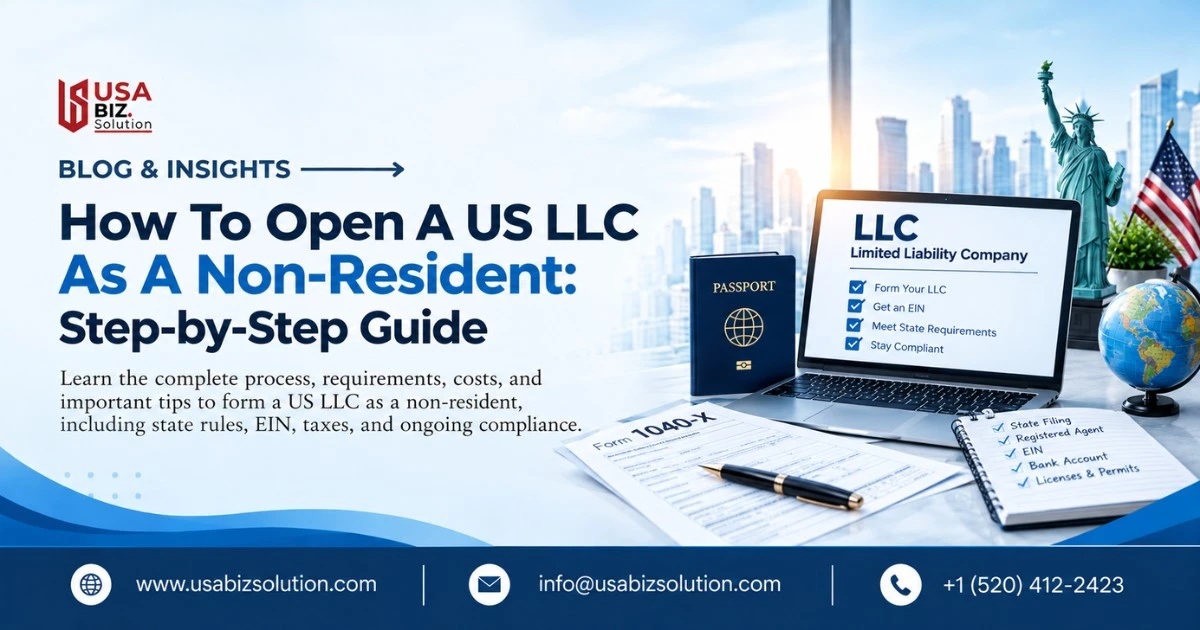
How To Open A US LLC As A Non-Resident: Step-by-Step Guide
- 1 Non-residents can apply to form a U.S. LLC.
- 2 State rules, fees, and filing requirements vary.
- 3 An EIN is free through the IRS.
- 4 Foreign-owned LLCs may have extra tax filings.
- 5 Forming an LLC does not give you U.S. work permission.
- 6 Check current state and federal rules after formation.
You can start a US LLC even if you live outside the United States. You don’t need to move to the US or become a resident just to own a company there.
The process is fairly straightforward at the state level, but there are a few things you need to handle after the company is formed. Your state filing, registered agent, EIN, tax classification, banking, licenses, and ongoing filings all matter. The rules also differ from one state to another.
Can A Non-Resident Open A US LLC?
Yes, a non-resident can generally form and own a US LLC. You can register the company while living in another country. The state where you form the LLC will set the basic formation requirements, including the registered agent and filing process.
Your immigration status is separate from your ownership of the company. Forming an LLC also does not give you permission to work in the United States. If you plan to travel to or work in the US, separate immigration rules may apply.
What Do You Need To Open A US LLC?
The exact paperwork depends on the state, but most non-resident owners will need:
-
- A business name
- A state for registration
- A registered agent
- The state’s LLC formation document
- Owner and business information
- An operating agreement
- An EIN, when required
- Any licenses or permits required for the business
You should also think about taxes and ongoing state filings before you submit the formation application.
How To Open A US LLC As A Non-Resident?
An LLC is formed under the laws of a particular US state. The IRS, however, handles federal tax matters such as the EIN. The two processes are separate.
Here is how you can set up the LLC.
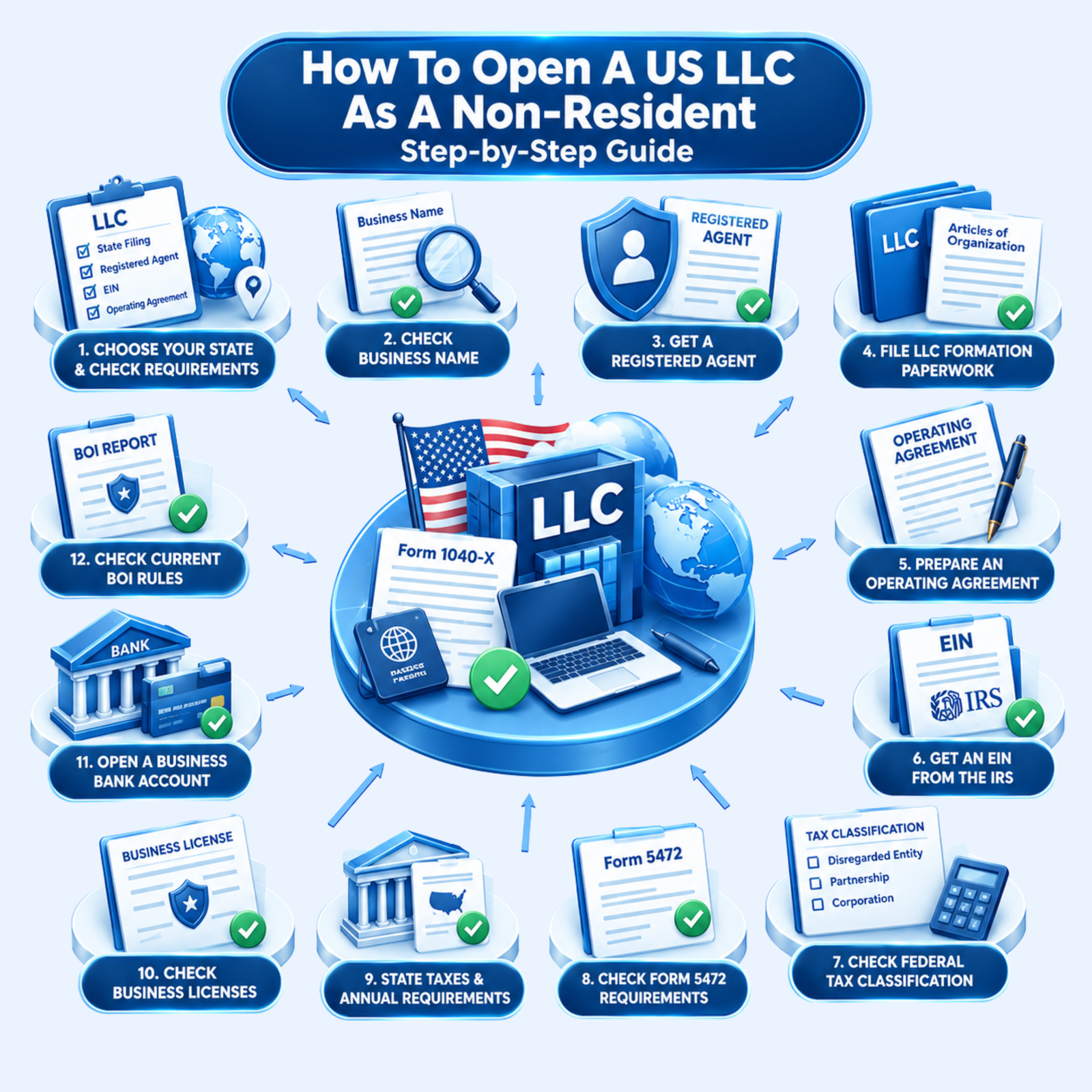
Step 1: Choose Your State
First, decide where you want to form your LLC. Then check the state’s filing requirements, fees, taxes, and ongoing reporting rules before making your choice.
The SBA State Registration Lookup helps you find the business registration office for each state.
Select your state and use the official state website for the rest of the LLC filing process.
Step 2: Check The Business Name
Visit your state’s page for searching business names & search for your LLC name.
If the name is available and meets the state’s rules, you can use it for your LLC filing.
Step 3: Get A Registered Agent
Most states need an LLC to have a registered agent. The agent gets legal papers and official notices for the LLC.
The registered agent must meet your state’s requirements. Depending on the state, you can use a person or a business as your agent.
You’ll need the agent’s information when you file the LLC paperwork.
Step 4: File the LLC Formation Paperwork
The name of the LLC formation document varies by state. Articles of Organization and Certificate of Organization are two common examples.
Fill out the required information, submit the filing to the state’s business agency, and pay the applicable fee.
The LLC comes into existence when the state accepts and approves the filing.
Step 5: Prepare an Operating Agreement
The operating agreement explains how your LLC will be operated. This can be useful for single-member LLCs as well as multi-member LLCs because it explains how your business will be operated and how decisions will be made.
You can use it to set out:
-
- Who owns the LLC
- How the company will be managed
- How profits and losses will be divided
- How major decisions will be made
- What happens if an owner leaves the LLC
An operating agreement is normally held with the records of the company rather than filed with the state. It is a good idea to make sure you are complying with the rules of your state as they are not the same everywhere.
Step 6: Get An EIN From The IRS
After forming your LLC, check whether you need an Employer Identification Number (EIN). The IRS issues EINs for free.
If you have no US legal residence, principal place of business, or principal office or agency, you cannot use the IRS online EIN application. International applicants can apply by phone, fax, or mail using Form SS-4.
A foreign-owned US disregarded entity that needs to file Form 5472 must obtain an EIN to meet that reporting requirement.
Go to the official IRS EIN page and Form SS-4 page for the current application instructions.
Step 7: Check Your Federal Tax Classification
The way your LLC is taxed depends on the number of members and if you select an election with the IRS.
A domestic LLC with 1 owner is normally treated as a disregarded entity for federal income tax unless it elects to be taxed as a corporation. A domestic LLC with two or more owners is routinely treated as a partnership unless it elects corporate treatment.
Check the IRS LLC information for the rules that apply to your LLC.
Step 8: Check Form 5472 Requirements
Determine whether Form 5472 reporting is required if your LLC is a foreign-owned US disregarded entity.
For a foreign-owned US disregarded entity that has reportable transactions, the IRS calls for the filing of Form 5472 with a pay-in form 1120. Reportable transactions can include certain transactions between the LLC and the foreign owner or other related parties.
Review the current Form 5472 instructions to determine whether your LLC has a filing requirement.
Step 9: Check State Taxes and Annual Requirements
Go back to your state’s official website and check:
-
- Annual or biennial reports
- State taxes
- Filing fees
- Renewal requirements
- Registered-agent requirements
These requirements are different from one state to another.
Step 10: Check Business Licenses
Registering your LLC might not be the only registration you need to operate a business.
Determine whether you need federal, state, county, or city licenses or permits. It varies as the type of business you will operate and your location.
Step 11: Open A Business Bank Account
When you have obtained your LLC and EIN, call the bank you intend to do business with and inquire about the procedures for a non-resident owner.
The bank may request to see a photo ID, documentation establishing the LLC, details of the EIN and business, including address, and other business specifics. Bank rules will differ according to the bank and the particular account.
Step 12: Check Current BOI Rules
If you are forming a US LLC, check the current FinCEN rules before filing any BOI report.
Under the FinCEN rule currently in effect, companies created in the United States are exempt from BOI reporting requirements. This includes a US formed LLC even when its owner is a non-US person. Certain foreign companies registered to do business in the United States may still have BOI reporting obligations.
How Long Does It Take To Open A US LLC?
The duration required to include a US LLC varies by state and filing method. Certain states expedite procedures for electronic submissions compared to traditional paper submissions and others provide accelerated processing for an extra charge.
Getting the LLC established is only a portion of your business start-up time. Getting an EIN, starting a business checking account, setup up licenses and file for any other requisite tax registrations may take additional time. Your total start-up time because of this depends on your choice of the state and your business.
How Much Does It Cost To Form A US LLC?
The amount you pay depends on the state. Some states have a relatively low formation fee, while others charge several hundred dollars. The cost of maintaining the LLC can also continue after the initial filing.
You may also have recurring state payments, registered agent charges, business licenses, and taxes. An EIN itself is issued by the IRS without a fee.
US LLC Costs By State:
| State | Initial LLC Filing Fee | Recurring Filing or State Charge |
| Alabama | $200 | $100 annual |
| Alaska | $250 | $100 biennial report |
| Arizona | $50 | No annual report for LLCs |
| Arkansas | $45 online / $50 mail | $150 annual |
| California | $70 | $800 annual franchise tax + $20 biennial statement |
| Colorado | $50 | $25 annual |
| Connecticut | $120 | $80 annual |
| Delaware | $110 | $300 annual franchise tax |
| Florida | $125 | $138.75 annual |
| Georgia | $100 online / $110 mail | $50 annual |
| Hawaii | $50 | $15 annual |
| Idaho | $100 online / $120 mail | Annual report required; no filing fee |
| Illinois | $150 | $75 annual |
| Indiana | $95 online / $100 mail | $32 online / $50 paper biennial report |
| Iowa | $50 | $30 online / $45 paper biennial report |
| Kansas | $90 | $90 online / $110 paper biennial information report |
| Kentucky | $40 | $15 annual |
| Louisiana | $125 | $35 annual report |
| Maine | $175 | $85 annual |
| Maryland | $100 | $300 annual |
| Massachusetts | $500 | $500 annual |
| Michigan | $50 | $25 annual |
| Minnesota | $155 online / $135 mail | Annual renewal required; no fee |
| Mississippi | $50 | Annual report required; no fee |
| Missouri | $50 online / $105 mail | No annual fee |
| Montana | $35 | $20 annual |
| Nebraska | $100 online / $110 paper | $25 online / $30 paper biennial report |
| Nevada | $425 | $350 annual |
| New Hampshire | $100 | $100 annual |
| New Jersey | $125 | $75 annual |
| New Mexico | $50 | No annual fee |
| New York | $200 + publication requirement | $9 biennial |
| North Carolina | $125 | $200 annual |
| North Dakota | $135 | $50 annual |
| Ohio | $99 | No annual fee |
| Oklahoma | $100 | $25 annual |
| Oregon | $100 | $100 annual |
| Pennsylvania | $125 | $7 annual |
| Rhode Island | $150 | $50 annual report + $400 minimum annual tax |
| South Carolina | $110 | No annual fee |
| South Dakota | $150 online / $165 mail | $50 annual |
| Tennessee | $300 minimum | $300 minimum annual report fee; franchise and excise taxes may also apply |
| Texas | $300 | No annual filing fee; franchise tax/report rules may apply |
| Utah | $54 | $18 annual |
| Vermont | $125 | $35 annual |
| Virginia | $100 | $50 annual |
| Washington | $200 online / $180 paper | $70 annual report |
| Washington, D.C. | $99 | $300 biennial |
| West Virginia | $100 | $25 annual report + $1 online processing fee |
| Wisconsin | $130 online / $170 paper | $25 online / $40 paper annual report |
| Wyoming | $100 | $60 minimum annual |
Note: The amounts in this table are state filing fees or specific recurring state charges, not necessarily the total cost of maintaining an LLC. Some states also impose franchise, business, or other taxes that depend on the business and its circumstances. Filing fees and tax rules can change, so check the relevant state’s official website before forming or maintaining an LLC.
Other costs may include:
-
- Registered agent fees
- Business licenses and permits
- State and local taxes
- Bank fees
- Accounting or legal fees
- Any other services you decide to use
What Happens After Your LLC Is Formed?
Getting the LLC approved is only the first part. After that, you may have to sort out your EIN, bank account, licenses, state taxes, and other filings.
Keep your registered agent information and business records up to date. You should also check your state and federal filing deadlines so you do not miss anything.
Frequently Asked Questions
Can I open a US LLC while living in another country?
Yes, you can generally form and own a U.S. LLC while living outside the United States. You still need to meet the requirements of the state where you register the company.
Do I need an SSN to form a US LLC?
You do not generally need an SSN simply to create the LLC. However, the IRS has separate procedures for non-residents applying for an EIN when their principal place of business is outside the United States.
Can I get an EIN from outside the US?
Yes. International applicants can request an EIN from the IRS through the available phone, fax, or mail process. Form SS-4 is used for the application.
Do I need a US address?
You generally do not have to live in the United States or have a U.S. residential address to own a U.S. LLC. However, the LLC generally needs a registered agent that meets the address requirements of the state where the LLC is formed.
Does a foreign-owned LLC have to file Form 5472?
It can. A foreign-owned U.S. disregarded entity generally must file Form 5472 with a pro forma Form 1120 when it has reportable transactions covered by the IRS rules. The filing requirement depends on the entity’s ownership and transactions.
Does a US LLC have to file a BOI report?
Under the current FinCEN rules, companies created in the United States are exempt from BOI reporting. A U.S.-formed LLC remains exempt even if a non-US person owns it. Certain foreign companies registered to do business in the United States may still have reporting obligations.
Conclusion
A nonresident can form a US LLC without living in the country. Filing the LLC paperwork is not the end of the process. You need to deal with federal taxes, state requirements, banking, licenses, and any filings that apply to your business. Before filing, check the current IRS requirements and the rules of the state where you plan to form the LLC. Once you form your LLC, you should monitor the federal and state deadlines that apply to your business.

How to Open a US LLC as a Non-Resident
Learn how to form a US LLC as a non-resident, including state registration, registered agents, EIN requirements, federal tax filings, banking, licenses, and ongoing compliance.
Get LLC Formation Guidance