






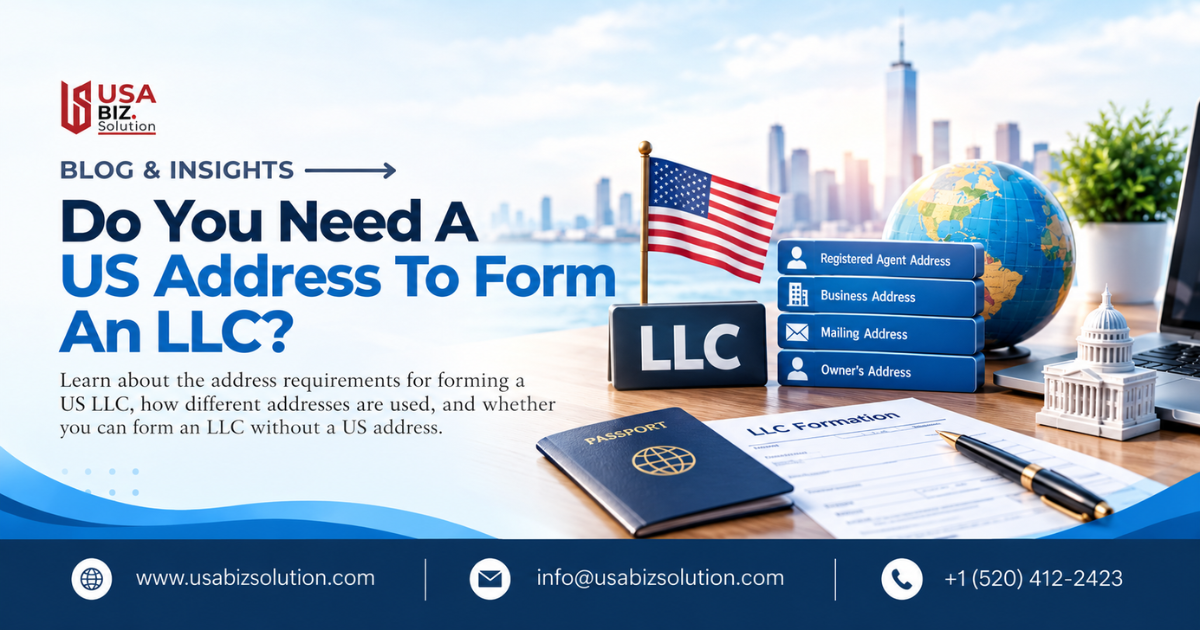
Do You Need a US Address to Form an LLC? Requirements for Non-US Residents
- 1 You generally do not need a personal US address to form an LLC.
- 2 Your LLC needs a registered agent in its formation state.
- 3 Foreign addresses may be accepted for certain state and IRS filings.
- 4 A registered-agent address is not the same as a business address.
- 5 Virtual addresses may not meet registered-agent requirements.
- 6 Banks and payment providers have their own address rules.
- 7 Always check your state’s filing requirements before forming an LLC.
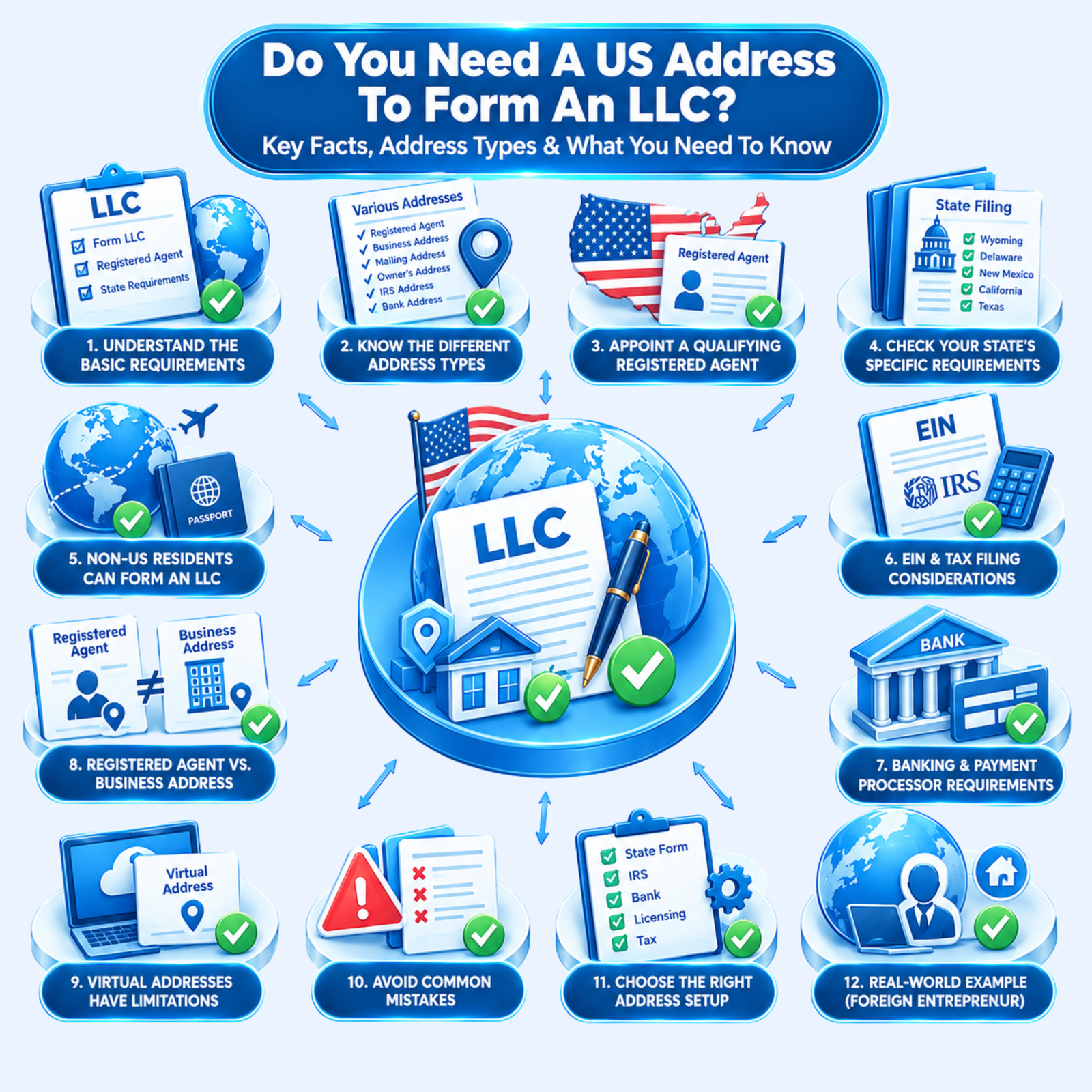
If you are forming a US LLC from outside the United States, you may assume you first need an American home, office, or business address. Usually, you do not need to personally have a US residential or office address simply to form an LLC. However, the LLC itself generally needs a registered agent in the state where it is formed, and that registered agent must meet that state’s address requirements. The US Small Business Administration also explains that registration requirements vary by state and that an LLC needs a registered agent located in the state before filing.
The confusion comes from the fact that an LLC can have several different addresses. A registered-agent address, principal business address, mailing address, owner’s residential address, IRS address, and bank address can serve different purposes. They should not automatically be treated as interchangeable.
For someone living in India, Pakistan, Canada, the UK, or another country, the practical question is therefore not simply, “Do I need a US address?” It is “Which address do I need, for which requirement?”
Do You Need A US Address To Form An LLC?
Not necessarily. You generally do not have to personally own or rent a US home or office to form a US LLC.
The exact information required depends on the state in which you form the LLC. State registration requirements vary, but the SBA identifies a registered agent as a standard requirement for LLC formation. The registered agent receives official papers and legal documents and must be located in the state where the business is registered.
This creates an important distinction:
- Your personal address: Where you actually live.
- Registered-agent address: The physical address where the registered agent can receive legal documents for the LLC.
- Business address: Where the business is actually located or operates, depending on the circumstances and applicable filing.
- Mailing address: Where correspondence should be sent.
- Principal business address: The location identified as the business’s main physical location for a particular filing or purpose.
A person living outside the United States may therefore form an LLC without having a US residence.
For example, a software consultant living in Pakistan could form an LLC in Wyoming. The consultant would not necessarily need to rent an apartment or office in Wyoming. The LLC would still need a qualifying registered agent in Wyoming, and the consultant would need to provide whatever other information the Wyoming formation filing requires.
The important qualification is that state requirements are not identical. The address requirements on a Wyoming LLC filing should not automatically be assumed to apply to a Delaware, New Mexico, California, or Texas LLC.
What Address Does An LLC Actually Need?
An LLC can encounter several different address requirements during formation and afterward.
| Address Type | What It Is Used For | US Address Usually Needed? |
| Registered-agent address | Receiving service of process and official legal documents | Yes, generally in the formation state |
| Principal business address | Identifying the main physical location of the business | Depends on the filing and actual business location |
| Mailing address | Receiving correspondence and notices | Not necessarily; a foreign address may be accepted in some federal contexts |
| Owner’s residential address | Identifying the individual owner/member or responsible party | Not necessarily |
| Business address | Business correspondence, operations, or verification | Depends on the purpose and provider |
| IRS address | Tax correspondence and federal filings | Not necessarily; IRS forms can accommodate foreign addresses |
| Bank address | Customer and business verification | Bank-specific |
The IRS’s current Form SS-4 instructions are particularly important for foreign entrepreneurs. They state that an entity’s mailing address may be outside the United States, and the physical street address may also be outside the United States when applicable. The instructions also require the principal business location to be reported separately.
That is why saying “every US LLC needs a US address” is misleading.
What Is A Registered-Agent Address?
A registered-agent address is the address associated with the person or business appointed to receive official legal documents for the LLC.
The registered agent may receive:
- Service of process
- Lawsuit-related documents
- Certain state notices
- Other official communications that must be delivered to the business
The registered agent must satisfy the state’s requirements.
For example, Delaware requires every entity to maintain a registered agent with a physical office address in Delaware. The state says the registered agent must generally be present at that location during normal business hours to accept service of process.
Wyoming requires a registered agent to maintain a physical street address in the state where legal documents can be accepted. A PO box, virtual address, mail-forwarding location, or UPS/FedEx store cannot be used as the registered office on its own. Wyoming’s LLC formation form permits a PO box to be listed in addition to the required physical address.
This is why a non-US resident can generally use a qualifying registered-agent service rather than personally maintaining a home in the formation state.
Registered-agent address vs. owner address
These addresses can belong to completely different people.
For example:
- Owner: Lives in Lahore, Pakistan
- LLC: Formed in Wyoming
- Registered agent: Located at a qualifying physical address in Wyoming
The registered-agent address does not mean the owner lives there.
It also does not automatically mean the LLC conducts its everyday business there.
Can You Form An LLC Without Having A Personal US Address?
Yes, a person living outside the United States may be able to form a US LLC without having a US home or office.
The state will still need the information and addresses specified by its formation law and filing forms. The SBA emphasizes that the documents and information required to register a business vary by state.
A non-US resident may therefore have a setup such as:
- Foreign residential address
- US LLC
- Registered agent in the formation state
- Foreign owner/responsible-party information where required
- Separate mailing or business address if needed
That does not mean every state filing will accept the same combination of addresses.
For example, Wyoming’s current Articles of Organization request the registered agent’s name and physical address, as well as the LLC’s mailing address and principal office address.
The lesson is simple: check the actual formation form for the state you choose rather than assuming that one state’s requirements apply nationwide.
Do Non-US Residents Need A US Address To Form An LLC?
Living outside the United States does not, by itself, mean you must rent a US office or have a US residence before forming an LLC.
This applies to entrepreneurs living in countries such as:
- India
- Pakistan
- Canada
- United Kingdom
- Australia
- Germany
- Singapore
- Other countries
The relevant questions are instead:
- Which state are you forming the LLC in?
- What does that state’s formation form require?
- Who is serving as the registered agent?
- Where is the business actually operated?
- Where should government correspondence be sent?
- What information does your bank or payment provider require?
- What federal tax filings apply to the LLC?
A foreign entrepreneur should use their real information wherever the applicable form requests it. A registered-agent address should not be substituted for a personal residential address simply because it is located in the United States.
Do You Need A US Address To Get An EIN?
Not compulsorily.
The current IRS Form SS-4 instructions specifically address applicants that do not have a legal residence, principal place of business, or principal office or agency in the United States.
The IRS says that an applicant with no such US location cannot use the online EIN application, but international applicants can use other application methods, including the IRS’s international telephone process.
The current Form SS-4 also has separate fields for:
- Mailing address
- Street address, if different
- County and state where the principal business is located
- Responsible party
The IRS instructions expressly state that a mailing address can be outside the United States and that a physical street address can also be outside the United States or its territories when applicable.
For the responsible party, the IRS defines the responsible party as the individual who ultimately owns or controls the entity. If that person does not have and is ineligible to obtain an SSN or ITIN, the current SS-4 instructions say to enter “foreign” or “N/A” on line 7b as applicable.
The important distinction
Having a registered agent in the United States does not automatically mean the registered-agent address should be entered everywhere on Form SS-4.
The IRS asks for information based on the purpose of each field. Use the actual address that corresponds to the field and the entity’s circumstances.
Can You Use A Foreign Address For Your LLC?
In some situations, yes.
The IRS expressly allows foreign addresses on Form SS-4 when the entity’s relevant mailing or physical address is outside the United States.
However, that does not mean every state agency, bank, payment processor, licensing authority, or other organization will handle foreign addresses in exactly the same way.
For example:
- The owner’s residential address may be outside the US.
- The LLC’s registered-agent address may be in the US.
- The business’s actual operating location may be outside the US.
- The mailing address may be different from all three.
- A bank may ask for a physical residential or business address as part of its own verification process.
A foreign address being accepted by the IRS therefore does not guarantee that the same address will satisfy a bank’s requirements.
What Is the Difference Between A Registered Agent And A Business Address?
This is one of the most important distinctions when forming an LLC.
| Feature | Registered Agent | Business Address |
| Legal notices | Specifically receives service of process and qualifying official documents | Not necessarily responsible for this |
| Physical location | Must meet the state’s registered-agent requirements | Depends on the business and the purpose |
| State requirement | Generally required for LLC formation | Varies by state and filing |
| Public records | Registered-agent information may appear in state records | Business/principal address may also appear depending on state |
| May receive official documents and forward them according to the service arrangement | May receive ordinary business correspondence | |
| Banking use | Should not automatically be treated as the business’s operating address | A bank may ask for a separate physical/business address |
| Purpose | Legal service and official communications | Business location, correspondence, or verification |
Delaware makes this distinction particularly clear. Its official information describes the registered office as the address of the registered agent and separately defines the principal place of business. Delaware’s entity information also says that, in specified circumstances, the principal business address should not be the registered office or another registered agent’s address.
So, a registered-agent address and a business address are not automatically interchangeable.
Can You Use A Virtual Address For An LLC?
A virtual business address is an address service that can provide a business with a physical-looking mailing location without the business maintaining a traditional office there.
Businesses may use these services for:
- Business correspondence
- Privacy
- Mail handling
- A professional business presence
- Separating personal and business correspondence
But a virtual address is not automatically a registered-agent address.
This distinction matters because some states require the registered office to be a physical location where service of process can actually be accepted.
Wyoming, for example, explicitly excludes virtual addresses and mail-forwarding locations from qualifying as registered offices.
A virtual business address may therefore solve a mailing or business-address problem while failing to solve the registered-agent requirement.
It can also be unsuitable for a particular bank, payment processor, licensing authority, or tax filing if that organization requires an actual physical location or proof of address.
Can A Registered Agent’s Address Be Used As The LLC’s Business Address?
Sometimes, but you should not assume that it can.
The registered-agent address exists for a specific legal function: receiving service of process and other qualifying official communications.
A state filing may ask for additional information about the LLC’s mailing address, principal office, or business location.
Wyoming’s Articles of Organization, for example, separately request:
- Registered agent and physical address
- LLC mailing address
- Principal office address
Delaware also distinguishes the registered office from the principal place of business.
Banks and payment providers may impose their own requirements as well.
The safest approach is to use each address for the purpose for which it is actually appropriate, rather than assuming that one US address can be copied into every form.
Does The IRS Require A US Address For An LLC?
No, the IRS does not impose a blanket rule that every LLC must have a US physical address.
The current Form SS-4 instructions specifically provide for foreign mailing and street addresses. They also explain how applicants with no US legal residence, principal place of business, or principal office/agency can apply for an EIN using methods other than the online application.
The IRS also distinguishes between the mailing address and physical street address on Form SS-4.
The appropriate address also depends on the federal tax form being filed and how the LLC is classified for tax purposes. Do not assume that instructions for corporations filing Form 1120 automatically apply to every LLC. Use the instructions for the specific return or information-reporting form that applies to your business.
For foreign-owned US disregarded entities, additional federal reporting obligations can also apply depending on the entity’s circumstances. The IRS states that a foreign-owned US disregarded entity required to file Form 5472 generally files a pro forma Form 1120 with Form 5472 attached.
That is a tax-reporting issue, not a general requirement that the LLC owner obtain a US home address.
Does The State Require A Physical US Address For An LLC?
The answer depends on which address the state is asking for.
A state may require a qualifying registered-agent address while handling the LLC’s principal or mailing address differently.
Wyoming
Wyoming requires a registered agent to have a physical Wyoming address. Its Secretary of State specifically says that virtual addresses, mail-forwarding locations, PO boxes, and similar locations do not qualify as the registered office.
Wyoming’s LLC formation form separately asks for the LLC’s mailing address and principal office address.
Delaware
Delaware requires every business entity to maintain a registered agent with a physical street address in Delaware. The state also distinguishes the registered office from the principal place of business.
New Mexico
New Mexico has its own business filing system and state-specific requirements. Before forming an LLC, review the current instructions and filing form provided by the New Mexico Secretary of State to confirm what registered-agent and business-address information is required. Do not assume that address rules from Wyoming or Delaware apply to New Mexico.
What If You Actually Operate The Business From Outside The US?
Your LLC’s state of formation and your actual place of business are not necessarily the same thing.
Consider a consultant who:
- Lives in India
- Works from a home office in India
- Forms a US LLC
- Serves clients in several countries
- Has no US employees
- Has no US office
The LLC can still be a US legal entity, but that does not automatically mean the consultant’s actual physical business location is in the United States.
This distinction can matter for:
- State registration
- Foreign qualification
- Tax analysis
- Licensing
- Banking
- Business verification
- Where work is actually performed
The SBA notes that where a business conducts activities can determine whether it needs to register in additional states. It identifies factors such as physical presence, employees, and significant business activity when discussing state registration.
A US LLC therefore should not be treated as proof that the owner physically operates from the United States.
Does A US LLC Need A Physical Office?
Usually, forming an LLC does not mean you need to rent a traditional US office.
Many small businesses operate without conventional office space.
A business might operate:
- From the owner’s home
- From a coworking space
- Remotely
- From outside the United States
- From a rented commercial location
The important issue is what the applicable state, licensing authority, bank, or other organization requires.
A registered-agent address can satisfy a specific registered-agent requirement, but it does not magically turn into an office where the business operates.
Some industries also have separate physical-location, licensing, zoning, or regulatory requirements. A regulated healthcare, financial, food-service, or professional business may face requirements that a remote software consultant does not.
Address Requirements For Online Businesses And Freelancers
Online businesses often have more flexibility in where they physically operate, but that does not eliminate address requirements.
Freelancers and consultants
A consultant living outside the United States may have:
- Foreign residential address
- US LLC
- State-qualifying registered agent
- Foreign principal business location
- Separate mailing address if necessary
Software developers and SaaS companies
A SaaS founder may operate entirely remotely. The founder may still need to provide different addresses to the state, IRS, bank, or payment processor.
E-commerce businesses
An online seller may need to consider additional locations such as:
- Inventory warehouse
- Fulfillment center
- Office
- Registered-agent location
- Mailing address
Digital agencies
A remote agency may have owners and employees in several countries. Its LLC address requirements will depend on its state filing, actual operations, licensing, tax situation, and provider requirements.
The common theme is that online does not mean address-free. It means the relevant address may not be a traditional US office.
What Happens If You Use The Wrong Address?
Using an incorrect or inappropriate address can create practical problems.
Possible issues include:
- Missing important legal notices
- Problems with state filings
- Delayed or rejected applications
- Banking verification difficulties
- Payment-processing verification problems
- Tax correspondence being sent somewhere you cannot access
- State compliance problems
- Difficulty proving where the business or owner is actually located
The solution is not to find one “magic” US address that works everywhere.
Instead:
Use an accurate address for the specific purpose, understand what the recipient is asking for, and update the relevant records when the address changes.
Do not use a friend’s address, a random US address, or a fictitious residential address merely to make an application appear American.
How to Choose the Right Address Setup for Your LLC
If you live in the US
You may be able to use your actual home or business location where appropriate, while using a separate registered agent if you do not want to serve as your own agent or your state permits another arrangement.
If you live outside the US
Start by identifying:
- The state where the LLC will be formed.
- The state’s registered-agent requirement.
- The address information required on the formation filing.
- Your actual foreign residential/business location.
- Your federal EIN requirements.
- Banking requirements.
- Payment processor requirements.
- Any licensing or tax obligations.
You may not need a US home or office, but you may still need a US registered-agent address.
If you have a US office
Your actual office may be relevant as the LLC’s principal business address or for other purposes. Do not automatically replace it with the registered-agent address.
If you run an online business
Determine where the business is actually operated and then check the requirements of the formation state, IRS, bank, payment providers, and any relevant licensing authorities.
If you only need a registered agent
A registered-agent service can solve the registered-agent requirement when you do not personally have a qualifying address in the formation state.
It does not necessarily solve:
- Banking requirements
- Payment processor requirements
- Tax questions
- Licensing requirements
- Proof of owner’s residence
- Proof of actual business location
Example: Forming A US LLC Without Living In The US
Imagine a software consultant who lives in Pakistan and works remotely with clients in the United States.
The consultant:
- Does not own a US home.
- Does not rent a US office.
- Wants to establish a US LLC.
- Chooses a state after considering its actual legal, tax, and administrative requirements.
- Appoints a qualifying registered agent in that state.
- Uses the consultant’s actual Pakistani residential information wherever the applicable form requests the owner’s or responsible party’s address.
- Provides the appropriate business or mailing information where required.
- Applies for an EIN using the IRS procedure applicable to an applicant without a US principal place of business.
- Separately checks the requirements of prospective banks and payment processors.
This does not mean that every Pakistani entrepreneur can use exactly the same setup.
The state, business activity, tax classification, ownership structure, bank, payment provider, and other facts can change the requirements.
The example simply illustrates the central distinction: owning a US LLC does not automatically require the owner to have a US residence.
Official Resources:
US Small Business Administration (SBA) Launch Your Business
Internal Revenue Service (IRS) (Instructions for Form SS-4)
IRS (Where to File Form SS-4)
IRS (About Form 5472)
IRS ( Instructions for Form 5472)
Frequently Asked Questions
Do you need a US address to form an LLC?
Not necessarily. You generally do not need to personally have a US home or office, but the LLC must satisfy the formation state’s requirements, including its registered-agent requirement. The exact address information requested can vary by state.
Can a non-US resident form an LLC without a US address?
Yes, a person living outside the United States may be able to form a US LLC without personally having a U.S. residential address. The LLC still needs to comply with the applicable state requirements, including having a qualifying registered agent.
Can I use my foreign home address for a US LLC?
A foreign address may be acceptable for certain purposes. The IRS, for example, expressly provides for foreign mailing and street addresses on Form SS-4 when applicable. State and private-provider requirements can be different.
Does an LLC need a physical address?
An LLC may need a physical address for a particular purpose, but that does not necessarily mean the owner needs a US office. A registered agent generally needs a qualifying physical address in the formation state, while other address requirements depend on the state and institution.
Is a registered-agent address enough for an LLC?
It may satisfy the registered-agent requirement, but it should not automatically be treated as the LLC’s principal business, mailing, banking, or operating address. Some state forms separately request these addresses.
Can I use a virtual address for my LLC?
Sometimes. A virtual business address can be useful for certain mailing or business purposes, but it may not satisfy registered-agent requirements. Wyoming, for example, specifically excludes virtual addresses from qualifying registered-office addresses.
Do I need a US address to get an EIN?
No blanket US-address requirement applies. The IRS provides procedures for applicants with no US legal residence, principal place of business, or principal office/agency, and its Form SS-4 instructions accommodate foreign addresses.
Do I need a US address to open an LLC bank account?
Not necessarily in every case, but banks have their own eligibility and verification requirements. A bank may request a physical address, proof of address, owner information, business information, and other documents.
Can I form a US LLC while living in another country?
Yes, a person living abroad can potentially form a US LLC. However, formation is only one part of the process. You should separately review state, federal tax, banking, payment-processing, licensing, and other applicable requirements.

Do You Need a US Address to Form an LLC?
Learn which addresses are required to form a US LLC, including registered-agent, business, mailing, and residential addresses, plus IRS, banking, and virtual address requirements for non-US residents.
Get US LLC Address Guidance