






How To Prepare A Cash Flow Statement For A Small Business
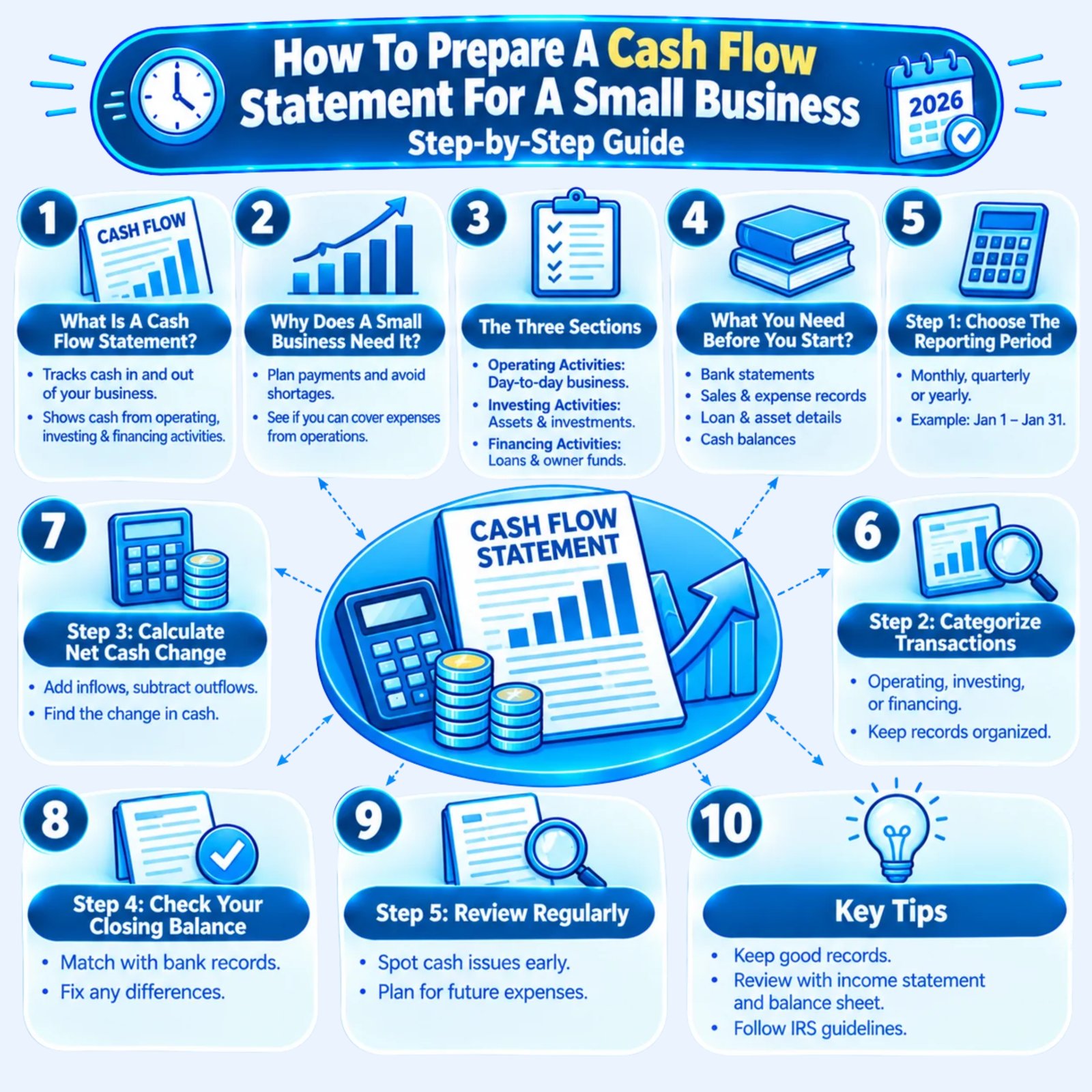
- 1
Record all cash received and paid by the business. - 2
Sort transactions into operating, investing, and financing activities. - 3
Calculate the net change in cash for the period. - 4
Check that the closing balance matches your records. - 5
Review cash flow regularly to plan expenses and avoid shortages.
A business can report strong sales and still struggle to pay its bills. Customers pay invoices late, and rent and supplier payments come due sooner than expected, tying up cash in inventory or equipment. Profit on paper does not tell you when money will actually reach your bank account.
A cash flow statement answers that question. It records how cash entered and left the business during a specific period, whether regular operations generate enough of it, how much was spent on assets, and which funds came from outside sources. With this information, scheduling payments and planning upcoming expenses becomes far more manageable.
Preparing one does not require accounting training. Bank statements, sales receipts, expense records, loan statements and details of asset purchases are enough to begin. The key is to place each transaction in the correct category and confirm that the closing balance matches the cash you actually hold.
What Is A Cash Flow Statement?
The cash flow statement is a summary of all the cash and cash equivalents that moved into and out of a business in a given period. That period may be a month, a quarter or a financial year. Each movement is placed under one of three heads:
-
- Operating Activities: Cash collected from customers and cash paid for the usual expenses of running the business.
- Investing Activities: Cash paid to buy long-term assets or investments and cash received when they are sold.
- Financing Activities: Cash brought in through loans or owner contributions and cash paid out to repay loan principal or to distribute funds to owners.
Once the figures are grouped like this, the picture becomes clear whether the business can meet its expenses from operations alone or whether it relies on loans or new investment to keep going.
Why Does A Small Business Need A Cash Flow Statement?
A business can only plan its payments well if it knows how much cash it will have when they fall due. The cash flow statement provides this information by recording when money comes in and when it goes out, so a possible shortage is visible before it becomes a problem and expenses can be scheduled accordingly.
The statement also helps you judge whether you can pay suppliers, employees, taxes, and loan obligations in full. It supports decisions about equipment too, such as whether a purchase can be made from existing cash or whether extra funding is needed.
It is most useful when read with the income statement and the balance sheet. The income statement reports profit or loss, the balance sheet gives the financial position on a particular date, and the cash flow statement accounts for the movement of cash during the period.
The Three Sections Of A Cash Flow Statement
Transactions in the statement fall into three categories, and each one shows a different source or use of cash.
1. Operating Activities
This section covers cash generated or spent in the course of regular business operations, such as customer collections, supplier payments, wages, rent and utilities.
2. Investing Activities
This section covers cash paid for or received from long-term assets and qualifying investments. Buying equipment, purchasing business property and selling old machinery all belong here.
3. Financing Activities
This section covers cash received through loans or owner contributions, along with cash paid out as loan principal repayments or distributions to owners, where applicable.
Interest and income taxes are classified differently depending on the accounting framework in use, so this point should be kept in mind while recording transactions in the steps that follow.
What You Need Before You Start?
Start by collecting every record that shows money moving in or out of the business. When the records are complete, sorting transactions goes faster and gaps are easier to notice. You will need:
-
- Bank statements with deposits, withdrawals, transfers and bank charges
- Cash records, such as cash sales, petty cash and any other cash received or paid
- Sales invoices and receipts to confirm which customer payments came in during the period
- Expense records for supplier bills, rent, utilities, payroll, insurance and other payments
- Loan statements showing the amount borrowed, principal repaid and interest charged
- Records of asset purchases and sales, showing cash paid for equipment or property and money received from selling them
- Owner records for capital put in and for withdrawals or distributions
- Cash balances at the start and end of the period
The IRS advises businesses to keep records that clearly show income and expenses, supported by documents such as invoices, receipts, deposit slips and cancelled cheques. File everything in a way that lets you trace each figure in the statement back to the document behind it.
How To Prepare A Cash Flow Statement?
These steps work for a month, a quarter or a full year. A monthly statement is a sensible starting point, because a cash shortage shows up while you can still do something about it.
Step 1: Choose The Reporting Period
Pick the dates the statement will cover, such as January 1 to January 31. Use the same dates when you collect transactions and when you work out the opening and closing balances.
If you prepare statements every month, stick to one schedule. Comparing periods then becomes straightforward, and seasonal swings are simpler to spot.
Step 2: Find The Opening Cash Balance
Total the cash and cash equivalents the business held at the start of the period. This includes eligible business bank balances and cash on hand. Cash equivalents should be counted the way your accounting framework defines them, not as every short-term investment you own.
A business that begins January with $12,000 in cash and qualifying bank balances has an opening balance of $12,000.
Reconcile your bank accounts and cash records before using this number, and look into any difference you can’t explain.
Step 3: Record Cash Received And Cash Paid
Use your bank statements, cash records and supporting documents to list the cash that actually came in and went out during the period.
Customer collections shouldn’t be mixed with loan proceeds, owner contributions or money from asset sales. The same rule applies to payments, so operating expenses, equipment purchases, loan principal repayments and owner distributions each get their own line.
Revenue and cash don’t always match. With growth accounting, a sale can be recorded before the customer pays. The cash flow statement reflects only real cash movement, and the indirect method corrects accounting profit for these timing gaps.
Step 4: Calculate Cash Flow From Operating Activities
Start by grouping the cash received and paid in the course of normal business operations. If you use the direct method, subtract operating cash payments from operating cash receipts to get the net figure.
Net operating cash flow = Operating cash receipts − Operating cash payments
A small consulting business might collect $18,000 from customers in a month while paying $11,500 in operating expenses.
Net operating cash flow = $18,000 − $11,500 = $6,500
The operations of the business brought in $6,500 in cash that month. Investing and financing transactions are not part of this figure.
The indirect method takes a different starting point, which is net income. From there, you adjust for non-cash expenses, gains or losses on relevant transactions, and changes in operating assets and liabilities, as your accounting framework requires.
Step 5: Calculate Cash Flow From Investing Activities
List the cash spent on long-term assets and the cash received from selling those assets or qualifying investments.
In the same example, the consulting business buys computers for $2,000 and sells old office equipment for $500.
Net investing cash flow = $500 − 2,000 = −1,500
This negative figure means that investing used $1,500 of cash that month. That isn’t automatically a problem, since new equipment can support future work. What matters is that enough cash is left for your other commitments.
Step 6: Calculate Cash Flow From Financing Activities
Record the cash received from loans or owner contributions and the cash paid out as loan principal repayments or owner distributions, depending on what applies to you.
The business receives a $3,000 loan and repays $1,000 of principal.
Net financing cash flow = $3,000 − $1,000 = $2,000
Financing therefore brought in $2,000 more than it took out.
Only the principal part of a loan repayment goes here. A loan payment is made up of principal and interest, and booking interest expense doesn’t reduce the loan balance.
Step 7: Work Out The Net Change In Cash
Add together the net cash flows from all three categories.
Net change in cash = Operating cash flow + Investing cash flow + Financing cash flow
With the example figures, $6,500 − $1,500 + $2,000 = $7,000. The business ended January with $7,000 more cash than it started with.
Step 8: Calculate The Closing Cash Balance
Add the net change to the opening balance.
Closing cash balance = Opening cash balance + Net change in cash
The business opened at $12,000 and gained $7,000, which gives a closing balance of $19,000.
Compare this figure with the actual cash and cash-equivalent balances at the end of the period. If the two differ, check for missing transactions, wrong classifications, bank transfers and reconciliation differences.
Cash Flow Statement Example
The calculations from the earlier steps are combined below into a single statement. The figures are illustrative and cover one month.
|
Cash flow item |
Amount |
| Operating activities | |
| Cash received from customers | $18,000 |
| Cash paid for operating expenses | ($11,500) |
| Net cash from operating activities | $6,500 |
| Investing activities | |
| Proceeds from equipment sale | $500 |
| Equipment purchases | ($2,000) |
| Net cash used in investing activities | ($1,500) |
| Financing activities | |
| Loan proceeds | $3,000 |
| Loan principal repayment | ($1,000) |
| Net cash from financing activities | $2,000 |
| Net increase in cash | $7,000 |
| Opening cash balance | $12,000 |
| Closing cash balance | $19,000 |
Cash rose by $7,000 over the month, which takes the closing balance to $19,000. That amount combines the results of operating, investing and financing activities, so it cannot be read as the business’s profit for the month.
Direct Method vs. Indirect Method
Both methods report cash flow from operating activities. They just get there differently.
| Feature | Direct method | Indirect method |
| Starting point | Actual operating cash receipts and payments | Net income or profit |
| Main focus | Where operating cash came from and where it went | Why accounting profit differs from operating cash flow |
| Information needed | Detailed cash receipt and payment records | Income statement and relevant balance sheet information |
| Useful for | Tracking collections and operating payments | Reconciling profit with cash generation |
The direct method tends to be easier to follow when you mainly want to track customer collections and payments. The indirect method suits you better if your accounting software already produces an income statement and balance sheet.
Pick whichever fits your reporting needs and accounting requirements. If you prepare financial statements under a formal reporting framework, follow that framework’s presentation and disclosure rules.
How Often Should You Prepare It?
The right reporting frequency varies with the size of the business, the dates on which payments fall due and the amount of cash it normally keeps.
-
- Weekly: suits businesses with small cash reserves, regular payroll runs or customers who pay at unpredictable times.
- Monthly: the common starting point for small businesses, as one month holds enough activity to review and compare.
- Quarterly: brings out longer-term trends and shows how the business is moving against its plan.
- Annually: offers a long-term view and serves mainly for financial reporting and year-end analysis.
The cash flow statement covers transactions that have already taken place. A cash flow forecast looks ahead, estimating the money expected to come in and go out, so the business can prepare for upcoming expenses and possible shortages.
Using The Statement To Improve Your Finances
Preparing the statement is only half the job. It becomes useful once you review the figures and act on them. Some things to focus on:
-
- Operating Cash Flow: Check whether normal business activity regularly generates enough cash for day-to-day expenses.
- Overdue Invoices: Late customer payments can leave you short of cash even in a strong sales month, so follow up on them.
- Large Upcoming Expenses. Plan ahead for equipment purchases, insurance renewals, tax payments and other big commitments.
- Actuals Against Forecasts: Look at where collections or payments differed from what you expected, and adjust future estimates.
- A cash Reserve: Set money aside for surprises and slower months, sized to your own business.
- Borrowing Needs: If you expect a shortfall, look at funding options early, before payment deadlines are on top of you.
Where possible, look at more than one period. One month of negative cash flow may just reflect a planned equipment purchase. Operating cash flow that stays negative month after month points to a more profound problem.
Frequently Asked Questions
Can I prepare a cash flow statement in Excel?
Yes. Excel or any other spreadsheet application works for organizing cash receipts, payments and the three categories. Add formulas for net cash flow and closing cash, and reconcile the results with your business records.
Is a cash flow statement the same as a profit and loss statement?
No. A profit and loss statement covers the revenue and expenses of a period, while a cash flow statement covers only the cash that actually moved. The two seldom agree because of unpaid customer invoices, noncash expenses, equipment purchases and loan principal repayments.
What is a good cash flow for a small business?
A good cash flow looks different for each business, so no one figure can serve as the standard. Operating cash flow that stays positive from period to period is a strong start, but the amount a business actually needs is shaped by its payroll, loan repayments, seasonal changes, planned investments and other costs. The figure becomes meaningful when it is set beside the payments that fall due soon.
Should owner withdrawals be included?
Yes. Owner withdrawals or distributions reduce the cash available to the business. Their classification depends on the business structure, the nature of the transaction and the accounting framework being followed. Do not automatically record an owner’s withdrawal as an ordinary operating expense.
What’s the difference between a cash flow statement and a cash flow forecast?
A cash flow statement reports cash movements that have already taken place. A forecast estimates the receipts and payments still to come. With both in hand, you can compare expected figures against actual ones and prepare for any shortfall.
Do I need to prepare one every month?
Monthly preparation is a good management habit, but the legal and financial reporting requirements depend on your business structure, your jurisdiction and the reporting rules that apply. If you often run short of cash, you may also want to review cash movements weekly.
Conclusion
A cash flow statement shows whether a small business has enough cash to pay what it owes. To prepare one, begin with accurate records, place each transaction under operating, investing, or financing activities, and check that the closing balance agrees with the cash actually held. The statement should be reviewed at regular intervals and read alongside the profit and loss statement, the balance sheet and the cash flow forecast. A business that tracks its cash steadily is able to spot shortages early and take better decisions on spending, borrowing and expansion.
Official Resources:

How to Prepare a Cash Flow Statement for a Small Business
Learn how to organize cash receipts and payments, calculate operating, investing, and financing cash flow, and check your business’s closing cash balance.
Explore related resources on business profitability, financial management, and LLC operating costs:
– What Is A Registered Agent And Do You Need One? A Guide For US Business Owners
Explains registered agent responsibilities, legal compliance, and associated service costs. Helps business owners understand recurring LLC expenses when tracking cash outflows and planning operating budgets.
– How To Calculate Business Profit Margin: Formulas, Examples, And Steps
Covers gross, operating, and net profit margin calculations with practical examples. Helps business owners compare profitability with actual cash flow and evaluate how effectively their revenue covers business expenses.
– How To Open A US LLC As A Non-Resident: Step-by-Step Guide
Explains the LLC formation process, registration requirements, and ongoing compliance responsibilities for non-residents. Helps entrepreneurs plan startup costs and recurring expenses before establishing a US business.