







How To Fix Payroll Tax Errors: Steps To Correct Mistakes And Avoid IRS Penalties
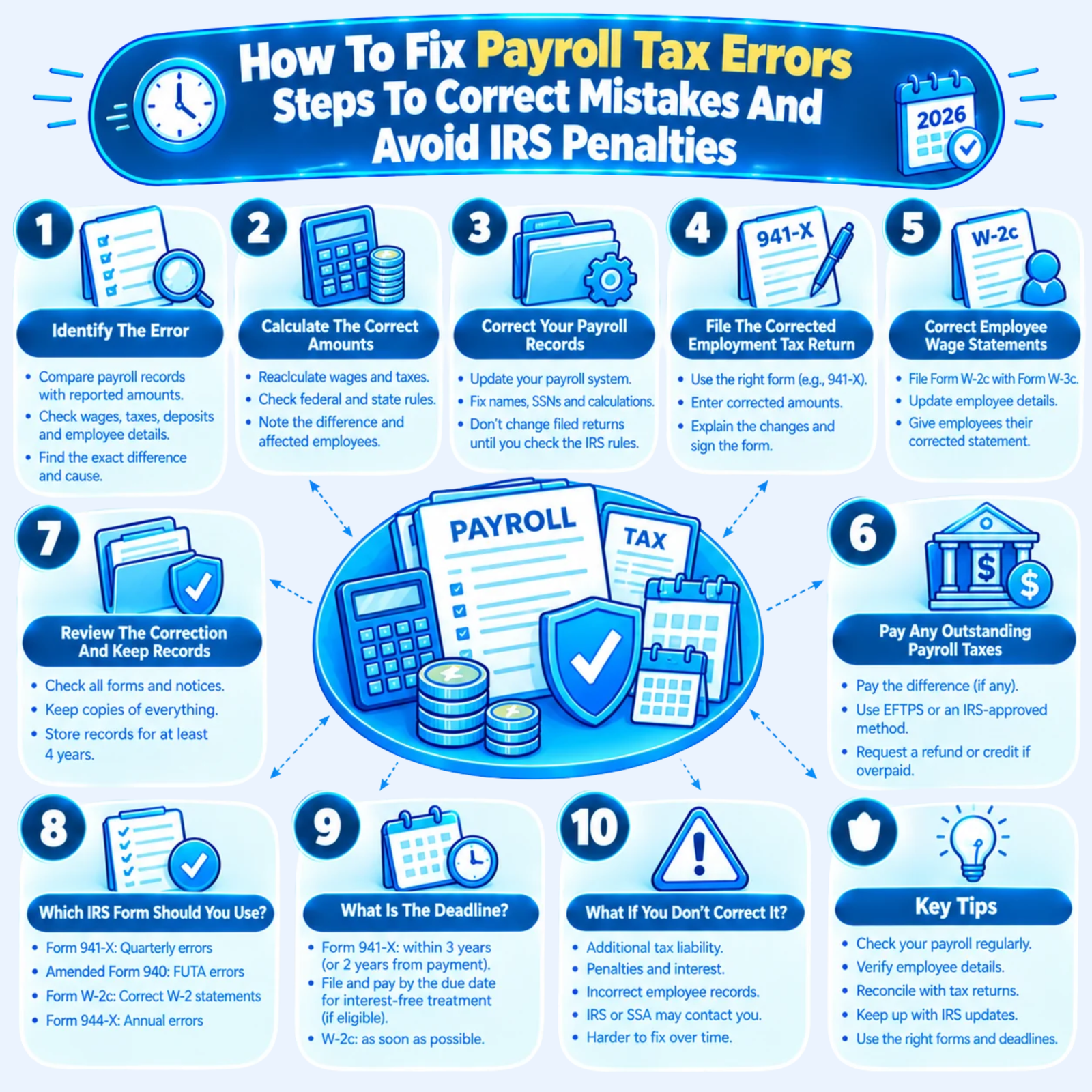
- 1
Find out exactly what went wrong and confirm the correct amounts before you touch anything. - 2
Fix your payroll records first, then file the correction. - 3
Use Form 941-X (or the matching adjusted return) to correct what you filed with the IRS. - 4
If an employee’s W-2 was wrong, send them a corrected one on Form W-2c. - 5
Pay any outstanding taxes promptly, and keep copies of everything. - 6
Check your payroll every quarter so small mistakes don’t repeat.
Payroll tax mistakes can happen even when a business follows a regular payroll process. An incorrect tax withholding, miscalculated employee wages, missed tax deposit, or reporting error on Form 941 can create problems with the IRS if it is not corrected on time. Even a small payroll tax error may lead to penalties, interest charges, incorrect employee tax records, or discrepancies between reported wages and taxes paid.
The important thing is to identify the mistake, understand which tax records are affected, and take the right steps to correct it before it creates further complications. If you discover an error in a previous payroll tax return, you may need to file Form 941-X to adjust the reported amounts.
Other mistakes may require correcting employee wage statements, updating payroll records, or making an outstanding tax payment. Knowing how to correct a payroll tax mistake helps employers maintain accurate records, meet IRS requirements, and avoid unnecessary compliance issues. Acting promptly and keeping proper documentation can also make future payroll reporting more straightforward.
What Is A Payroll Tax Mistake?
A payroll tax mistake is any slip in how you calculate, withhold, deposit, or report employment taxes. It can change your business’s tax liability, and it can change what shows up on an employee’s wage statement.
Here’s where things usually go wrong:
-
- You withhold too much or too little federal income tax from someone’s paycheck.
- Social Security or Medicare contributions get calculated incorrectly on the employee side, on the employer side, or both.
- Wages, tips, or other taxable pay are reported with the wrong figures.
- An employee’s name is misspelt, or their SSN is wrong, on payroll records or Form W-2.
- The payroll numbers on Form 941 or another employment tax return don’t match reality.
- A deposit goes in late or for less than what was actually due.
Once you know which of these you’re dealing with, it’s much easier to tell which records and forms need fixing.
How To Correct A Payroll Tax Mistake?
Take these steps in order. First find the error, then fix your own records, and only after that report the correction to the right agency.
1. Identify The Payroll Tax Error
Compare your payroll records with what you reported on your employment tax returns. Look at pay statements, wage records, withholding calculations, and deposit confirmations.
Pay attention to differences in:
-
- Gross wages and taxable pay
- Federal income tax withheld
- Social Security and Medicare wages and taxes
- Employee names and SSNs
- Tax deposits versus the amounts on your returns
Say your payroll shows you paid an employee $5,000, but Form 941 says $6,000. Go back through the entries and find out why the two don’t match.
Then work out where it went wrong: during payroll processing, in the tax calculation, in data entry, or when the return was prepared. Hold on to whatever documents explain the gap.
2. Calculate The Correct Payroll Tax Amount
Once you know what’s wrong, redo the math for the affected wages and taxes and compare it to what you originally recorded or reported.
Check the federal rules before adjusting anything. Social Security and Medicare, for instance, each have their own wage and tax calculations, while income tax withholding depends on the employee’s Form W-4 and the withholding method you use.
By the end, you should know:
-
- What you originally reported
- What the correct amount is
- The difference between them
- Which employees and tax periods are affected
- Whether you overpaid or underpaid
Save these calculations with your payroll records. You’ll need the exact figures when you fill out the corrected forms.
3. Correct Your Payroll Records
After you’ve confirmed the right numbers, update your payroll system so it reflects what was actually paid and the correct tax amounts.
If the problem is an employee’s name or SSN, check it against the employee’s records and Social Security card. Fix it in your system before you prepare any corrected wage statements.
Withholding errors need extra care. Mistakes in federal income tax withholding can generally be corrected only in the same calendar year the wages were paid, although some administrative errors found in a later year follow different rules.
And don’t change figures you’ve already filed until you’ve checked the IRS correction procedure that applies.
4. File The Corrected Employment Tax Return
If you already filed a return with wrong information, you may need to submit an adjusted one. The IRS has a specific correction form for each return:
| Original Tax Return | Correction Form |
| Form 941 | Form 941-X |
| Form 940 | Amended Form 940 |
| Form 943 | Form 943-X |
| Form 944 | Form 944-X |
| Form 945 | Form 945-X |
| Form CT-1 | Form CT-1X |
If you reported the wrong wages or Social Security and Medicare taxes on Form 941, for example, you’d correct it with Form 941-X.
On Form 941-X, you’ll need to:
-
- Choose the adjustment or claim process that fits your situation.
- Enter the corrected amounts alongside the amounts you originally reported.
- Work out the difference.
- Explain why each correction is needed.
- Give the date you discovered the error.
- Complete the certifications and sign.
Some corrected employment tax returns can be filed electronically through the IRS Modernized e-File system.
Keep in mind: Form 941-X isn’t the fix for every payroll tax mistake. Use the form that matches the original return and follow the instructions for the specific tax involved.
5. Correct Employee Wage Statements When Required
Some mistakes carry over to employees’ wage statements. If you sent the Social Security Administration (SSA) an incorrect Form W-2, you’ll generally need to file Form W-2c, Corrected Wage and Tax Statement.
Form W-2c goes in with Form W-3c, Transmittal of Corrected Wage and Tax Statements. Give the employee their corrected statement as soon as you can.
Things you might need to correct:
-
- Employee name or SSN
- Social Security wages and taxes
- Medicare wages and taxes
- Federal income tax withheld
- Any other wage details that were reported wrong
File one W-2c per affected employee, and follow the SSA’s filing instructions.
If the issue is a wrong name or SSN, verify the employee’s details before you submit the correction. That way the same error doesn’t show up again in future reports.
6. Pay Any outstanding Payroll Taxes
If the correction shows you underpaid, you’ll need to pay the difference.
Suppose you reported less Social Security and Medicare tax than you should have. Work out the gap and follow the IRS payment instructions.
With Form 941-X, the IRS generally expects you to pay the additional tax when you file the adjusted return if you want interest-free treatment, as long as the conditions are met.
Federal employment tax deposits are generally made electronically through the Electronic Federal Tax Payment System (EFTPS) or another IRS-approved payment method. Check the IRS payment instructions for the method that applies to your tax obligation.
Overpayments work differently. Depending on your situation, you can generally ask for a refund or apply the overpayment as a credit to another tax period. If you collected too much Social Security or Medicare tax from employees, you may also have to repay or reimburse them.
7. Review The Correction And Keep Supporting Records
Once the corrected forms are filed and any extra tax is paid, do a final check. Your payroll records, the corrected returns, and the employees’ wage statements should all tell the same story.
Hold on to copies of the following:
-
- The original and corrected employment tax returns
- Forms W-2 and W-2c
- Payroll registers and pay statements
- Your calculations and any adjustment records
- Deposit confirmations
- Letters or notices from the IRS or SSA
- Anything else that backs up the correction
The IRS generally wants employment tax records kept for at least four years. Store them somewhere you can reach quickly, in case a request comes in.
Which IRS Form Should You Use To Correct A Payroll Tax Mistake?
It depends on which return you originally filed.
1. Form 941-X: Correcting Quarterly Payroll Tax Errors
Use Form 941-X to fix mistakes on a Form 941 you’ve already filed. It covers errors in reported wages, federal income tax withholding, Social Security wages and taxes, and Medicare wages and taxes.
You can use it for both underpayments and overpayments, following the adjustment or refund claim process that applies.
2. Form 940: Correcting Federal Unemployment Tax Errors
The IRS does not provide a separate Form 940-X. If you find an error on a previously filed Form 940, submit an amended Form 940. Check the amended return box, enter the corrected information, and explain the reason for the changes. Follow the current Form 940 instructions for filing the amended return.
3. Form W-2c: Correcting Employee Wage Statements
Form W-2c corrects a Form W-2 you’ve already sent to the SSA. Send Form W-3c along with it, and give the employee a copy.
4. Form 944-X: Correcting Annual Employment Tax Errors
If you filed Form 944 and later found an error, use Form 944-X. It’s meant for employers who file the annual employment tax return.
Whichever form you use, read its instructions before you submit.
What Is The Deadline For Correcting A Payroll Tax Mistake?
There isn’t one deadline. It varies with the type of correction and the tax involved.
For Form 941-X, the IRS generally lets you correct over-reported taxes within three years of the date you filed the original Form 941, or two years from the date you paid the tax, whichever is later. Underreported taxes generally have to be corrected within three years of the original filing date.
To qualify for interest-free treatment on eligible underreported taxes, you generally need to file Form 941-X and pay the additional tax by the due date of the Form 941 for the quarter in which you discovered the error. The IRS applies specific conditions to this treatment.
For corrected Forms W-2, the SSA says to file Forms W-2c and W-3c as soon as possible after you find the error.
*Don’t assume all corrections follow the same timeline. Check the IRS and SSA instructions for your specific form and tax year.
What Happens If You Do Not Correct A Payroll Tax Mistake?
Ignoring a payroll tax mistake almost always worsens it for you and for your employees.
Here’s what can go wrong:
-
- You may face additional tax liability: If employment taxes were underreported, you’ll still have to pay what’s missing.
- Penalties and interest add up: If you deposit taxes late or pay less than you should, the IRS can charge you extra.
- Employee records may be wrong: Your employees’ W-2s might not show what they were actually paid or what was withheld.
- The numbers may not match: If your payroll records, tax returns, and W-2s don’t line up, the IRS or Social Security Administration may send you questions.
- It gets harder the longer you wait: You’ll have more to redo, more to correct, and more to explain to your staff.
Keep in mind that fixing the mistake doesn’t automatically remove penalties or interest. Check the IRS rules for your situation, and reply to any notice you receive.
How Can Employers Prevent Payroll Tax Mistakes?
Most payroll mistakes can be caught if you check your numbers regularly. Do a quick review before you run payroll, and again before you file any returns.
Here’s what to look at:
-
- Make sure each employee’s name, SSN, and W-4 are correct before you add them to payroll.
- Check every pay period that gross pay, taxable pay, deductions, and withholding add up.
- Before filing, compare your payroll records with Forms 941, 940, and W-2.
- Know if you deposit monthly or semiweekly and pay on time.
- Update your payroll software so it uses the latest tax tables and IRS withholding rules.
- Read through the W-2s yourself before sending them to the SSA.
- Keep your payroll reports, returns, payment receipts, and any correction papers for as long as the IRS says you should.
If you check often, you can fix small problems early, before they show up in your filings or on your employees’ W-2s.
Official Resources:
-
- IRS (Correcting Employment Taxes)
- IRS ( Instructions for Form 941-X)
- IRS (General Instructions for Forms W-2 and W-3)
- Social Security Administration (Employer W-2 Filing Instructions and Information)
- IRS (Publication 15 (Circular E), Employer’s Tax Guide)
- IRS (Employment Tax Recordkeeping)
- IRS (Depositing and Reporting Employment Taxes)
- IRS (Failure to Deposit Penalty)
Frequently Asked Questions
Can I correct a payroll tax mistake after filing Form 941?
Yes. If you find an error on a Form 941 you’ve already filed, you generally report the fix on Form 941-X. How you handle it depends on the kind of error and whether you underreported or over-reported.
How do I correct an incorrect employee W-2?
File Form W-2c with the SSA. You’ll also need to submit Form W-3c and give the employee their corrected statement.
Can I correct a payroll tax mistake from a previous year?
In many cases, yes. But the IRS applies different rules to wage reporting, Social Security and Medicare taxes, and federal income tax withholding, so read the instructions for the correction form before you file.
What happens if I underpaid payroll taxes?
You’ll need to file an adjusted return showing the correct amount and pay the difference. If the money reaches the IRS late, expect penalties and interest on top of the outstanding amount. The sooner you fix it, the less that extra cost tends to grow.
What if I overpaid payroll taxes?
You can ask for the money back or have it applied as a credit toward future payroll taxes. Either way, you do this by filing an adjusted return. The IRS may ask for supporting paperwork, and in some cases you’ll have to repay or reimburse your employees first, especially if the extra tax was taken out of their pay cheques.
How long should employers keep payroll tax records?
Keep employment tax records for at least four years after the tax becomes due or is paid, whichever is later. These records include wage payments, employee information, withholding details, tax deposit confirmations, and filed returns.
Can payroll tax mistakes lead to IRS penalties?
Yes. Paying late, paying too little, or missing a filing deadline can each trigger a penalty. Fixing the mistake is the right move, but it doesn’t wipe the penalty away automatically. You may have to request relief separately if you think you have a good reason.
Conclusion
Fixing a payroll tax mistake takes accurate records, the right math, and the correct IRS or SSA forms. Go through the affected payroll data, decide whether you underpaid or overpaid, and file the correction before the deadline that applies. Keep your supporting documents and double-check the updated records after you file. A regular payroll review also makes these errors less likely in the first place and keeps you on track with federal employment tax requirements.

How to Fix Payroll Tax Errors and Avoid IRS Penalties
Learn how to correct payroll records, file Form 941-X or other required forms, fix employee W-2s, pay outstanding taxes, and avoid future payroll mistakes.
Explore related resources on tax identification, IRS reporting, and federal tax requirements for employers and business owners:
– Taxpayer Identification Number (TIN): Meaning, Types, And Uses
Explains the different types of taxpayer identification numbers, their uses, and when businesses and individuals need them. Covers how accurate tax identification information helps employers maintain correct payroll records and meet IRS reporting requirements.
– How To Check Your IRS Tax Refund Status
Explains how to track an IRS tax refund, what different refund statuses mean, and what to do if a payment is delayed. Helps readers understand the refund process and keep track of tax payments and adjustments.
– 2026 Income Tax Brackets And Retirement Contribution Limits By Account Type
Covers federal income tax brackets and retirement contribution limits for different account types. Helps business owners understand tax rates, withholding considerations, and financial planning requirements that can affect their overall tax obligations.