






2026 Income Tax Brackets And Retirement Contribution Limits By Account Type
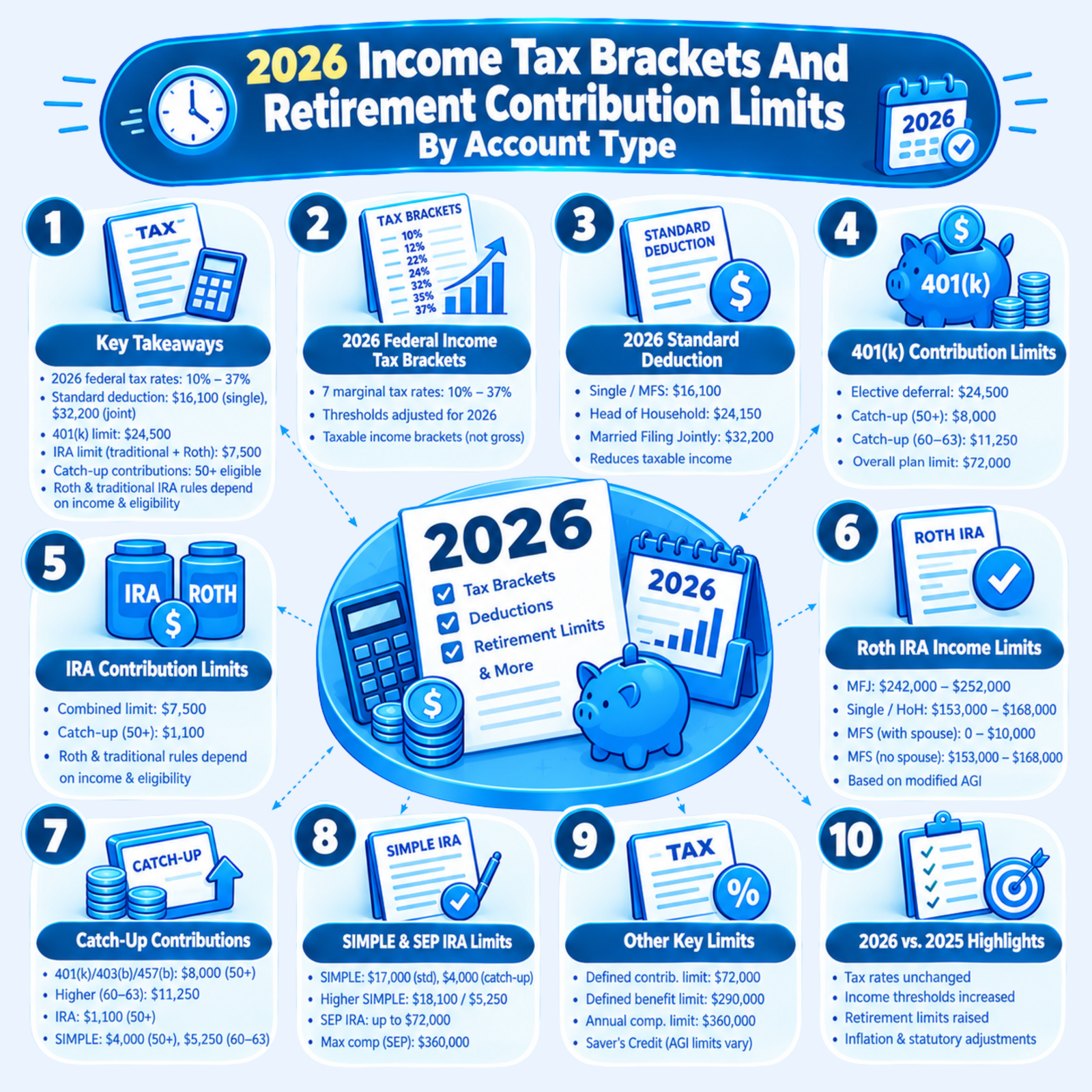
- 1 The 2026 federal tax rates range from 10% to 37%.
- 2 The standard deduction is $16,100 for single filers and $32,200 for joint filers.
- 3 The 401(k) contribution limit is $24,500 for 2026.
- 4 The traditional and Roth IRA contribution limit is $7,500 combined.
- 5 Eligible participants aged 50 and older can make extra catch-up contributions.
- 6 Roth IRA contributions and traditional IRA deductions depend on income and eligibility rules.
For tax year 2026, the federal income tax system continues to use seven marginal tax rates: 10%, 12%, 22%, 24%, 32%, 35%, and 37%. The IRS has also increased several retirement-plan contribution limits and income thresholds for 2026.
The 2026 standard deduction is $16,100 for single taxpayers and married individuals filing separately, $24,150 for heads of household, and $32,200 for married couples filing jointly and qualifying surviving spouses.
Retirement limits also increased in several areas. The employee contribution limit for most 401(k), 403(b), and governmental 457(b) plans is $24,500, while the annual IRA contribution limit is $7,500. Eligible participants age 50 and older can generally make additional catch-up contributions, while those who attain ages 60 through 63 during 2026 may qualify for a higher catch-up amount.
These figures apply for tax year 2026. Tax returns reporting 2026 income are generally filed in 2027. Contribution limits, income phase-outs, and tax-return deadlines are separate concepts and should not be confused.
2026 Federal Income Tax Brackets At A Glance
The federal income tax rates for 2026 are
| Tax Rate | Single | Married Filing Jointly | Married Filing Separately | Head of Household |
| 10% | 0-12,400 | 0-24,800 | 0-12,400 | 0-17,700 |
| 12% | 12,401–50,400 | 24,801–100,800 | 12,401–50,400 | 17,701–67,450 |
| 22% | 50,401–105,700 | 100,801–211,400 | 50,401–105,700 | 67,451–105,700 |
| 24% | 105,701–201,775 | 211,401–403,550 | 105,701–201,775 | 105,701–201,750 |
| 32% | 201,776–256,225 | 403,551–512,450 | 201,776–256,225 | 201,751–256,200 |
| 35% | 256,226–640,600 | 512,451–768,700 | 256,226–384,350 | 256,201–640,600 |
| 37% | Over $640,600 | Over $768,700 | Over $384,350 | Over $640,600 |
These are taxable-income brackets, not gross-income brackets.
The seven federal rates remain the same in 2026, but the income thresholds have been adjusted.
2026 Tax Brackets Explained
The US federal income tax system is marginal. That means moving into a higher tax bracket does not mean that all of your taxable income suddenly becomes subject to the higher rate.
Instead, different portions of taxable income are taxed at different rates.
For example, suppose a single taxpayer has $60,000 of taxable income in 2026.
The taxpayer does not pay 22% on the entire $60,000. The first portion is taxed at 10%, the next portion at 12%, and only the taxable income above the applicable 22% threshold is taxed at 22%.
This distinction is important when interpreting the 2026 tax brackets.
Taxable income Is Not The Same As Gross Income
Tax brackets apply to taxable income. A taxpayer’s taxable income can be lower than gross income because of deductions and other adjustments that apply under the tax rules.
For a taxpayer using the standard deduction, for example, the standard deduction generally reduces the amount of income that is subject to the federal income tax rates.
Example Of Marginal Taxation
Assume a single taxpayer has $60,000 of taxable income in 2026.
The taxpayer falls into the 22% marginal bracket because taxable income exceeds $50,400. However:
-
- The first $12,400 is taxed at 10%.
- The next portion, from $12,400 to $50,400, is taxed at 12%.
- Only the amount above $50,400 is taxed at 22%.
The taxpayer’s marginal rate is 22%, but the effective federal income tax rate on the entire taxable income is lower.
2026 Tax Rates For Each Filing Status
Single
For single taxpayers, the 2026 federal brackets begin at 10% on taxable income up to $12,400 and reach the 37% rate above $640,600.
The intermediate thresholds are
-
- 12% above $12,400
- 22% above $50,400
- 24% above $105,700
- 32% above $201,775
- 35% above $256,225
- 37% above $640,600
Married Filing Jointly
Married couples filing jointly have wider brackets than single taxpayers.
The 37% bracket begins above $768,700 of taxable income. The 10% bracket applies to taxable income up to $24,800.
Married Filing Separately
Married taxpayers filing separately generally use the same dollar thresholds as single taxpayers for the 10%, 12%, 22%, 24%, and 32% brackets.
The higher brackets diverge:
-
- 35% begins above $256,225.
- 37% begins above $384,350.
Head Of Household
Head-of-household taxpayers have different thresholds from both single filers and married couples filing jointly.
The 10% bracket extends to $17,700, while the 37% bracket begins above $640,600.
2026 Standard Deduction
The 2026 standard deduction amounts are
| Filing Status | 2026 Standard Deduction |
| Single | $16,100 |
| Married Filing Separately | $16,100 |
| Head of Household | $24,150 |
| Married Filing Jointly | $32,200 |
| Qualifying Surviving Spouse | $32,200 |
The standard deduction generally reduces taxable income for taxpayers who do not itemize their deductions.
For example, a single taxpayer with $70,000 of income who is eligible for the full $16,100 standard deduction would generally have less than $70,000 of taxable income before considering other applicable adjustments or deductions.
The standard deduction should therefore be considered when determining which 2026 tax bracket applies.
Certain taxpayers who are age 65 or older or blind may also qualify for an additional standard deduction amount.
2026 Tax Brackets vs. 2025 Tax Brackets
The federal tax rates themselves remain at 10%, 12%, 22%, 24%, 32%, 35%, and 37%, but the income thresholds increased for 2026.
| Filing Status / Provision | 2025 | 2026 |
| Single (10% bracket ends) | $11,925 | $12,400 |
| Single (12% bracket ends) | $48,475 | $50,400 |
| Single (22% bracket ends) | $103,350 | $105,700 |
| Single (24% bracket ends) | $197,300 | $201,775 |
| Single (32% bracket ends) | $250,525 | $256,225 |
| Single (35% bracket ends) | $626,350 | $640,600 |
| MFJ (10% bracket ends) | $23,850 | $24,800 |
| MFJ (12% bracket ends) | $96,950 | $100,800 |
| MFJ (22% bracket ends) | $206,700 | $211,400 |
| MFJ (24% bracket ends) | $394,600 | $403,550 |
| MFJ (32% bracket ends) | $501,050 | $512,450 |
| MFJ (35% bracket ends) | $751,600 | $768,700 |
| Standard deduction (Single/MFS) | $15,750 | $16,100 |
| Standard deduction (Head of Household) | $23,625 | $24,150 |
| Standard deduction (MFJ) | $31,500 | $32,200 |
The changes are primarily inflation adjustments and statutory changes incorporated into the 2026 tax rules. The tax-rate percentages themselves did not increase.
2026 Retirement Contribution Limits At A Glance
The most commonly used retirement-plan limits for 2026 are:
| Retirement Account / Plan | 2026 Contribution Limit | 2026 Catch-Up Limit | Notes |
| 401(k) | $24,500 | $8,000 generally; $11,250 for eligible ages 60-63 | Employer contributions are subject to separate overall limits |
| 403(b) | $24,500 | $8,000 generally; $11,250 for eligible ages 60-63 | Special 15-year rule may provide additional room |
| Governmental 457(b) | $24,500 | $8,000 generally; $11,250 for eligible ages 60-63 | Special 457 catch-up rules may apply |
| Traditional/Roth IRA | $7,500 combined | $1,100 | Contribution limit applies across traditional and Roth IRAs |
| SIMPLE IRA | $17,000 generally | $4,000 generally; $5,250 for eligible ages 60-63 | Higher limits can apply to certain SIMPLE plans |
| SEP IRA | Up to $72,000 | N/A | Generally limited to 25% of compensation, subject to the compensation cap |
The figures above represent the major 2026 federal limits. Individual plan documents can impose additional restrictions, and eligibility requirements differ by plan.
2026 401(k) Contribution Limit
The basic employee elective-deferral limit for a 401(k) plan is $24,500 in 2026.
This is the amount an eligible employee can generally defer from compensation into a 401(k), before considering catch-up contributions.
Age 50+ catch-up
Participants who are age 50 or older by the end of the applicable year can generally make an additional $8,000 catch-up contribution.
That means an eligible participant who is at least 50 can generally contribute up to:
$24,500 + $8,000 = $32,500
for 2026, subject to the plan’s terms and applicable rules.
Ages 60–63 special catch-up
SECURE 2.0 provides a higher catch-up limit for eligible participants who attain age 60, 61, 62, or 63 during 2026.
For these participants, the higher catch-up amount is $11,250.
The resulting maximum elective deferral including that catch-up can therefore reach:
$24,500 + $11,250 = $35,750
for an eligible participant.
The $72,000 Overall Limit Is Different
The $24,500 employee deferral limit should not be confused with the overall defined-contribution plan limit.
For 2026, the general defined-contribution annual additions limit is $72,000, excluding catch-up contributions.
This broader limit can include certain employer contributions and other amounts, depending on the plan.
2026 403(b) And 457(b) Limits
403(b)
The 2026 elective-deferral limit for a 403(b) is $24,500.
The standard age-50 catch-up is generally $8,000, and eligible participants ages 60–63 can generally use the higher $11,250 catch-up.
Certain 403(b) participants may also qualify for the special 15-year service rule.
Under that rule, eligible employees with at least 15 years of service with a qualifying organization may be able to contribute an additional amount under the plan’s special rules.
The 15-year rule is not automatically available to every 403(b) participant and requires specific eligibility calculations.
Governmental 457(b)
The 2026 elective-deferral limit for a governmental 457(b) plan is $24,500.
The standard age-50 catch-up rules can apply, as can the higher age 60–63 catch-up for eligible participants.
Governmental 457(b) plans may offer a separate special catch-up in the final three years before normal retirement age. This rule has different eligibility and calculation requirements, and the special catch-up generally cannot be combined with the age-50 catch-up in the same year.
2026 IRA Contribution Limit
The combined annual contribution limit for traditional and Roth IRAs is $7,500 in 2026.
For taxpayers age 50 or older, the IRA catch-up contribution is $1,100, making the potential total:
$7,500 + $1,100 = $8,600
The $7,500 limit is generally a combined limit across a taxpayer’s traditional and Roth IRAs.
For example, a taxpayer generally cannot contribute $7,500 to a traditional IRA and another $7,500 to a Roth IRA simply because the accounts are different.
The contribution limit is separate from the rules determining whether a traditional IRA contribution is deductible or whether a taxpayer is eligible to make a direct Roth IRA contribution.
2026 Traditional IRA Deduction Limits
The ability to contribute to a traditional IRA and the ability to deduct that contribution are separate questions.
If you or your spouse is covered by a workplace retirement plan, your traditional IRA deduction may be reduced or eliminated depending on modified adjusted gross income.
If The taxpayer Is Covered By A Workplace Plan
| Filing Status | Full Deduction | Partial Deduction | No Deduction |
| Single / Head of Household | $81,000 or less | More than $81,000 but less than $91,000 | $91,000 or more |
| Married Filing Jointly, contributor covered | $129,000 or less | More than $129,000 but less than $149,000 | $149,000 or more |
| Married Filing Separately, contributor covered | No full deduction under this phase-out range | MAGI above $0 but below $10,000 | $10,000 or more |
The married-filing-separately rule is unusual because its phase-out range is not adjusted in the same way as the other thresholds.
If The taxpayer Is Not Covered But The Spouse Is Covered
For a married taxpayer who is not covered by a workplace retirement plan but whose spouse is covered, the 2026 traditional IRA deduction phase-out is:
| Filing Status / Situation | 2026 Phase-Out |
| Married Filing Jointly; contributor not covered, spouse covered | 242,000–252,000 |
| Below phase-out | Full deduction generally available |
| At or above upper threshold | No deduction generally available |
The key point is that $7,500 is the contribution limit, not the income threshold for deductibility.
A taxpayer could potentially contribute $7,500 to a traditional IRA but receive only a partial deduction or no deduction depending on income and workplace-plan coverage.
2026 Roth IRA Income Limits
The Roth IRA contribution limit is subject to income-based phase-out rules.
For 2026:
| Filing Status | Full Contribution Generally Available Below | Phase-Out Range | No Direct Roth IRA Contribution at or Above |
| Married Filing Jointly / Qualifying Surviving Spouse | $242,000 | 242,000–252,000 | $252,000 |
| Single / Head of Household | $153,000 | 153,000–168,000 | $168,000 |
| Married Filing Separately, lived with spouse during year | – | 0–10,000 | $10,000 |
| Married Filing Separately, did not live with spouse during year | $153,000 | 153,000–168,000 | $168,000 |
These thresholds are based on modified adjusted gross income, not simply salary.
Roth contribution Limit vs. Roth income Limit
These two numbers answer different questions.
Roth IRA contribution limit:
How much you may contribute if you are eligible.
Roth IRA income phase-out:
Whether your income reduces or eliminates your ability to make a direct Roth IRA contribution.
For 2026, the contribution limit is $7,500, but taxpayers with sufficiently high modified AGI may be restricted from making the full contribution or from making a direct Roth IRA contribution altogether.
2026 Catch-Up Contribution Limits
Catch-up rules are particularly important in 2026 because several different limits apply depending on the account and the taxpayer’s age.
| Account / Plan | Standard 2026 Limit | Age 50+ Catch-Up | Ages 60–63 Special Catch-Up |
| 401(k), 403(b), governmental 457(b) | $24,500 | $8,000 | $11,250 |
| Traditional/Roth IRA | $7,500 | $1,100 | Not applicable |
| SIMPLE IRA / SIMPLE 401(k) | $17,000 | $4,000 generally | $5,250 |
The higher age 60–63 catch-up is not simply added to the standard age-50 catch-up. For an eligible participant, the higher applicable catch-up amount replaces the regular catch-up amount.
Age 50+ catch-up
For most applicable employer plans, the regular 2026 catch-up amount is $8,000.
For SIMPLE plans, the standard catch-up is generally $4,000.
For IRAs, the catch-up is $1,100.
Ages 60–63 catch-up
For eligible participants who attain age 60, 61, 62, or 63 during 2026:
-
- 401(k), 403(b), and governmental 457(b): $11,250
- SIMPLE IRA and SIMPLE 401(k): $5,250
These higher limits apply under specific SECURE 2.0 rules.
Roth catch-up requirement
Beginning in 2026, certain higher-paid employees who make catch-up contributions to applicable employer plans must make those catch-up contributions as Roth contributions if their prior-year wages from the plan sponsor exceeded the applicable threshold.
For 2026, the relevant prior-year wage threshold is $150,000.
This rule concerns the tax treatment of catch-up contributions; it does not increase the contribution limit itself.
2026 SIMPLE IRA Contribution Limits
The standard 2026 salary-reduction contribution limit for a SIMPLE IRA is $17,000.
Certain SIMPLE plans can have a higher salary-reduction limit of $18,100 under the special rules that apply to eligible plans.
SIMPLE IRA catch-up
The standard age-50 catch-up contribution is $4,000 for 2026.
Certain SIMPLE plans can use a different $3,850 catch-up amount under the applicable statutory rules.
For participants who attain age 60, 61, 62, or 63 during 2026, the higher catch-up limit is $5,250.
Because SIMPLE plans can be subject to several overlapping statutory provisions, the plan’s terms and applicable eligibility rules should be checked before determining the maximum contribution.
2026 SEP IRA Contribution Limits
For 2026, the maximum SEP contribution is $72,000.
However, $72,000 is not an automatic contribution amount.
SEP contributions for employees are generally limited to 25% of eligible compensation, subject to the annual compensation limit. Self-employed individuals use a separate calculation based on net earnings from self-employment, so their contribution limit is not simply 25% of business profit.
For 2026:
-
- Maximum compensation considered for applicable SEP calculations: $360,000
- Maximum contribution: $72,000
- General contribution formula: up to 25% of eligible employee compensation; self-employed
- Individuals must use the applicable self-employment calculation.
For example, a taxpayer cannot simply contribute $72,000 to a SEP IRA regardless of compensation.
The $72,000 figure is the maximum dollar amount under the applicable limit; the actual allowable contribution can be lower.
2026 Retirement Plan Compensation And Overall Contribution Limits
Several other figures help explain how employer retirement plans work.
| Retirement-Related Limit | 2025 | 2026 |
| Defined contribution annual additions limit | $70,000 | $72,000 |
| Defined benefit annual benefit limit | $280,000 | $290,000 |
| Annual compensation limit | $350,000 | $360,000 |
| Elective-deferral limit | $23,500 | $24,500 |
| General employer-plan catch-up | $7,500 | $8,000 |
| Age 60–63 employer-plan catch-up | $11,250 | $11,250 |
The $72,000 defined-contribution limit is different from the $24,500 employee elective-deferral limit.
The $24,500 figure generally describes employee elective deferrals. The $72,000 limit covers broader annual additions under a defined-contribution plan and can include employer contributions and other amounts under applicable rules.
Catch-up contributions are generally outside the $72,000 annual-additions limit.
2026 Saver’s Credit Income Limits
The Retirement Savings Contributions Credit, commonly called the Saver’s Credit, remains relevant for 2026 retirement contributions.
For 2026, the maximum AGI thresholds are:
| Filing Status | 2026 AGI Limit |
| Married Filing Jointly | $80,500 |
| Head of Household | $60,375 |
| Single, Married Filing Separately, or Qualifying Surviving Spouse | $40,250 |
The credit can be worth 50%, 20%, or 10% of eligible retirement contributions depending on income and filing status, subject to the credit’s other rules.
The maximum contribution amount used to calculate the credit is generally $2,000 per person, or $4,000 for a married couple filing jointly.
Eligibility also depends on requirements such as age, student status, dependency status, and the type of contribution.
An important 2026 distinction
The Saver’s Credit should not be confused with the Saver’s Match.
Under current IRS guidance, the Saver’s Match replaces the Saver’s Credit for qualifying retirement-plan and IRA contributions beginning with the 2027 tax year. Therefore, the 2026 tax year remains relevant to the Saver’s Credit rules.
2026 Retirement Limits: 2025 vs. 2026
The major retirement-related changes include:
| Limit | 2025 | 2026 | Change |
| IRA contribution limit | $7,000 | $7,500 | +$500 |
| IRA catch-up | $1,000 | $1,100 | +$100 |
| 401(k)/403(b)/457(b) elective deferral | $23,500 | $24,500 | +$1,000 |
| General employer-plan catch-up | $7,500 | $8,000 | +$500 |
| Age 60–63 employer-plan catch-up | $11,250 | $11,250 | No change |
| SIMPLE standard limit | $16,500 | $17,000 | +$500 |
| SIMPLE higher limit | $17,600 | $18,100 | +$500 |
| SIMPLE standard catch-up | $3,500 | $4,000 | +$500 |
| SIMPLE age 60–63 catch-up | $5,250 | $5,250 | No change |
| Defined contribution limit | $70,000 | $72,000 | +$2,000 |
| Defined benefit annual limit | $280,000 | $290,000 | +$10,000 |
| Annual compensation limit | $350,000 | $360,000 | +$10,000 |
| SEP maximum contribution | $70,000 | $72,000 | +$2,000 |
The Roth IRA and traditional IRA income thresholds also increased in several categories.
Which 2026 Retirement Limit Applies To You?
If you have a 401(k)
The main number is the $24,500 employee elective-deferral limit.
If you are at least 50, you may generally have an additional $8,000 catch-up. If you attain age 60 through 63 during 2026, the higher $11,250 catch-up may apply.
Employer contributions are subject to separate overall plan limits.
If you have a 403(b)
Start with the $24,500 elective-deferral limit.
If eligible, age-based catch-up rules can increase the amount. Certain long-service employees may also qualify for the 15-year 403(b) rule.
If you have a governmental 457(b)
The general elective-deferral limit is $24,500.
Age-based catch-up rules may apply. Some governmental 457(b) plans can also use the special three-year catch-up provision before normal retirement age.
If you have an IRA
The combined traditional and Roth IRA contribution limit is $7,500.
If you are age 50 or older, the IRA catch-up can increase the amount to $8,600.
Then check the separate income rules:
-
- Traditional IRA deduction phase-outs
- Roth IRA contribution phase-outs
If you are self-employed
SEP IRAs and SIMPLE IRAs can have substantially different limits from ordinary IRAs.
For 2026, a SEP IRA can permit contributions of up to $72,000 under the applicable compensation and percentage rules.
A SIMPLE IRA generally has a $17,000 salary-reduction limit, with special higher limits applying in certain plans.
These figures describe retirement-plan limits only and should not be treated as a complete explanation of self-employed tax rules.
Important Differences Between Contribution Limits And Income Limits
These terms are often confused, but they describe different restrictions.
| Term | What It Means |
| Contribution limit | The maximum amount that may generally be contributed to an account or plan under the applicable rule |
| Income limit | An income threshold that determines whether a taxpayer qualifies for a particular contribution, deduction, or credit |
| Income phase-out | A range over which eligibility or a tax benefit is gradually reduced |
| Deduction limit | A restriction on how much of a contribution can be deducted for tax purposes |
| Compensation limit | The maximum amount of compensation that can be considered when applying certain retirement-plan rules |
| Catch-up limit | An additional contribution amount available to eligible older participants |
For example, the 2026 IRA contribution limit is $7,500, but a taxpayer’s ability to deduct a traditional IRA contribution or make a direct Roth IRA contribution can depend on income and other circumstances.
The numbers should therefore never be interpreted in isolation.’
Official Resources:
IRS Tax Inflation Adjustments for 2026
IRS 401(k) Limit Increases to $24,500 for 2026, IRA Limit Increases to $7,500
IRS Retirement Plan Contribution Limits
IRS 401(k) and Profit-Sharing Plan Contribution Limits
IRS Cost-of-Living Adjustments for Retirement Plans
IRS Retirement Savings Contributions Credit (Saver’s Credit)
IRS Publication 571: Tax-Sheltered Annuity Plans (403(b) Plans)
Frequently Asked Questions
What are the federal tax brackets for 2026?
The 2026 federal income tax rates are 10%, 12%, 22%, 24%, 32%, 35%, and 37%. The income thresholds differ according to filing status, and the rates apply marginally to portions of taxable income.
What is the 2026 standard deduction?
The standard deduction is $16,100 for single taxpayers and married individuals filing separately, $24,150 for heads of household, and $32,200 for married couples filing jointly and qualifying surviving spouses.
What is the 401(k) contribution limit for 2026?
The 2026 401(k) employee elective-deferral limit is $24,500. Eligible participants age 50 and older can generally contribute an additional $8,000, while eligible participants who attain ages 60 through 63 during 2026 can generally use the higher $11,250 catch-up amount.
What is the IRA contribution limit for 2026?
The combined traditional and Roth IRA contribution limit is $7,500 for 2026. Taxpayers age 50 or older can generally contribute an additional $1,100.
What is the 2026 Roth IRA income limit?
For 2026, the Roth IRA contribution phase-out range is $153,000 to $168,000 for single taxpayers and heads of household, and $242,000 to $252,000 for married couples filing jointly. Married individuals filing separately generally have a 0-to-10,000 phase-out range when the applicable conditions are met.
What is the 2026 IRA catch-up contribution?
The 2026 IRA catch-up contribution is $1,100 for eligible taxpayers age 50 or older. This applies to the combined traditional and Roth IRA contribution limit.
What is the 2026 401(k) catch-up contribution?
The general 2026 401(k) catch-up contribution is $8,000 for eligible participants age 50 or older. The higher catch-up for eligible participants who attain age 60 through 63 during 2026 is $11,250.
What is the special age 60-63 catch-up limit for 2026?
The special catch-up limit is $11,250 for eligible participants in applicable 401(k), 403(b), and governmental 457(b) plans. For eligible participants in SIMPLE plans, the higher catch-up amount is $5,250.
What is the 2026 SIMPLE IRA contribution limit?
The standard SIMPLE IRA salary-reduction contribution limit is $17,000. A higher $18,100 limit can apply to certain SIMPLE plans. The standard age-50 catch-up is $4,000, while the special age 60–63 catch-up is $5,250.
What is the 2026 SEP IRA contribution limit?
The maximum SEP contribution for 2026 is $72,000, subject to the applicable compensation and percentage-of-compensation rules. The annual compensation limit used for these calculations is $360,000.

2026 Tax Brackets and Retirement Contribution Limits
Explore the 2026 federal income tax brackets, standard deductions, and retirement contribution limits for 401(k), IRA, Roth IRA, SIMPLE IRA, and SEP IRA accounts. Understand income phase-outs, catch-up contributions, and key tax rules.
Get 2026 Tax Guidance