







US LLC for Freelancers Abroad: Benefits, Costs, and Tax Considerations
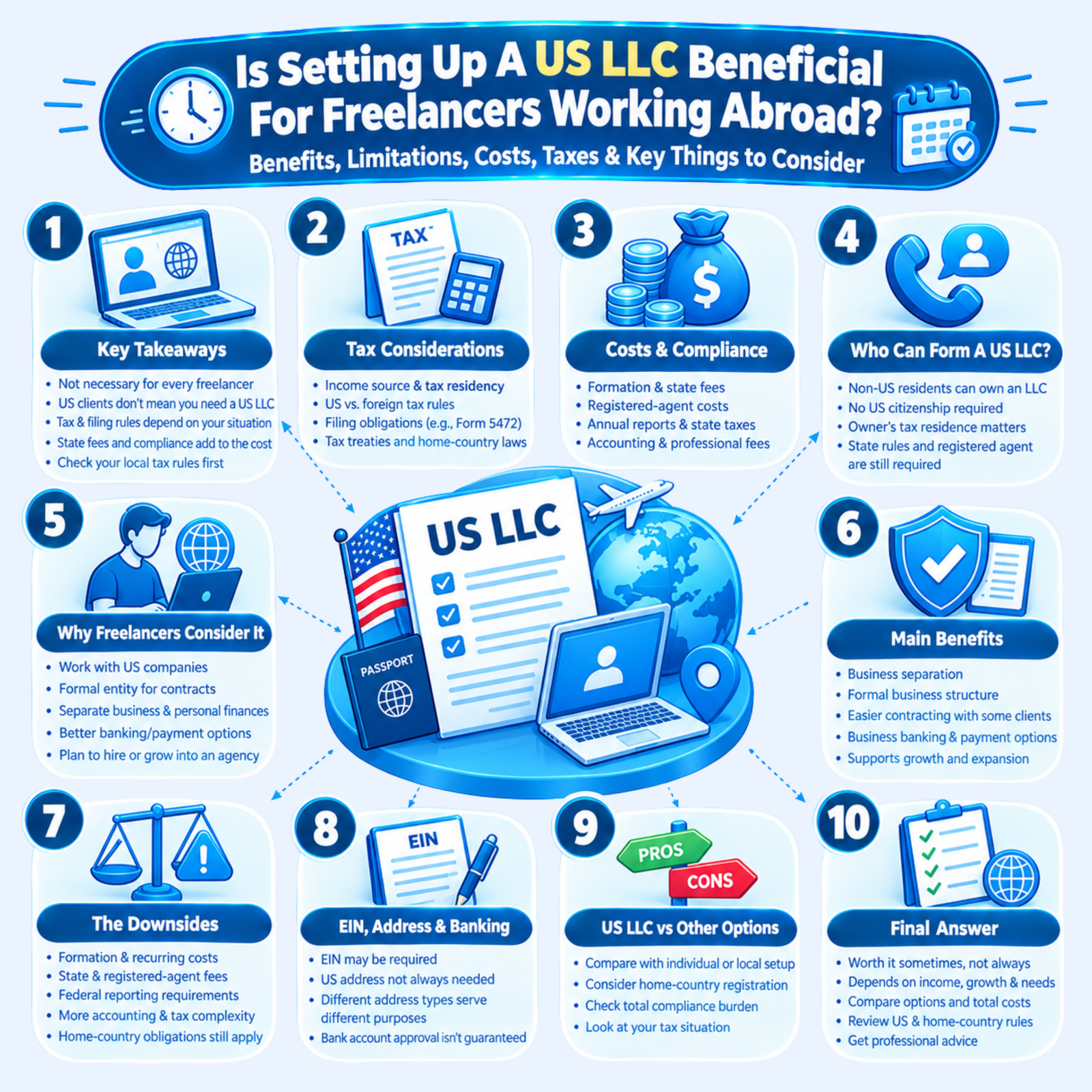
- 1 A US LLC is not necessary for every freelancer.
- 2 US clients do not mean you need a US LLC.
- 3 Tax and filing rules depend on your situation.
- 4 State fees and compliance add to the cost.
- 5 Check your local tax rules before forming an LLC.
A freelancer living outside the United States can have US clients, invoice in US dollars, and work entirely from another country. That combination can make a US LLC look attractive. But an LLC is not simply a payment shortcut or a way to make foreign freelance income tax-free.
A US LLC can create a formal business structure, separate business and personal finances, and in some situations make banking, contracting, or business expansion easier. It can also introduce state fees, registered-agent costs, federal reporting, accounting work, and potentially additional obligations in the freelancer’s country of residence.
So the useful question is not “Can a freelancer abroad form a US LLC?” The answer is generally yes. The more important question is “What problem would the LLC solve, and is that benefit worth the recurring cost and compliance?”
This article explains the potential benefits, limitations, tax considerations, costs, and practical factors a freelancer should evaluate before forming a US LLC.
Can A Freelancer Living Abroad Form A US LLC?
Generally, yes. A person does not ordinarily need to be a US citizen or US resident simply to own a US LLC.
However, forming the LLC and determining how the freelancer is allowed or required to operate the business are separate questions.
The LLC is created under state law. The owner’s tax residence remains outside the United States, and the freelancer may continue to have business registration, tax, foreign-exchange, or reporting obligations in their home country.
For example, a software developer who lives and works permanently in India could potentially own an LLC formed in a US state. The existence of that LLC does not by itself determine whether the developer has to register locally, pay Indian taxes, report foreign business interests, or comply with Indian foreign-exchange rules.
The US Small Business Administration notes that LLCs generally need to register in states where they conduct applicable business activities and that an LLC needs a registered agent in its formation state.
The key distinction is:
Owning a US LLC does not automatically move the freelancer’s business activities to the United States.
Where the owner lives, where services are performed, where the business operates, and how the entity is classified for tax purposes can all matter.
Why Are Freelancers Abroad Interested In A US LLC?
Foreign freelancers usually consider a US LLC for a practical reason rather than because the LLC itself is inherently better than working as an individual.
Common reasons include:
-
- Working with US companies
- Wanting a formal business entity for contracts
- Separating business and personal finances
- Seeking business banking or payment options that fit their business model
- Building a more formal freelance operation
- Planning to hire contractors
- Moving from solo freelancing toward an agency
- Creating a business that can continue operating as the freelancer expands internationally.
There can also be a perception that a US company automatically looks more credible to American clients. That can sometimes be true in a particular business relationship, but it should not be overstated. Many US companies hire foreign freelancers and contractors directly without requiring them to own a US LLC.
Similarly, having a US LLC does not guarantee access to every US bank, payment processor, or financial product. Providers have their own eligibility, identity verification, country, and compliance requirements.
The strongest reason to form the LLC is therefore not “US clients like US companies.”
It is:
“This entity solves a specific business problem that I actually have.”
Is A US LLC Actually Worth It For A Freelancer Living Abroad?
There is no universal yes or no.
For one freelancer, the LLC may be a useful business structure. For another, it may add several layers of administration without providing enough value to justify them.
A practical decision should consider:
-
- Annual freelance revenue
- Revenue stability
- Number and location of clients
- How clients pay
- Where the freelancer physically performs the work
- Country of tax residence
- Local business registration requirements
- Local tax treatment of foreign-owned businesses
- US federal reporting
- State-level obligations
- Banking requirements
- Liability concerns
- Plans to hire people or build an agency
- The total annual cost of maintaining the LLC
A US LLC may make more sense when:
-
- The freelancer has stable, recurring revenue.
- The business works with multiple international or US clients.
- A formal legal entity solves a real contracting or operational requirement.
- The freelancer needs business infrastructure that is genuinely available to the LLC.
- The business is becoming an agency rather than remaining occasional freelance work.
- The owner plans to hire contractors or employees.
- The owner is prepared to maintain U.S. and potentially foreign compliance.
- The cost of the LLC is small relative to the business’s revenue and the value it provides.
It may not make sense when:
-
- Freelance income is very low or highly irregular.
- The freelancer can operate easily through an individual or local business structure.
- There is no genuine need for a US entity.
- The LLC is being formed primarily because someone promised “zero US tax.”
- The freelancer does not actually need US-based banking or payment infrastructure.
- US reporting costs more in time and professional fees than the LLC is worth.
- The freelancer has not checked the tax & business rules of their country of residence.
A useful rule is to start with the business problem, not the LLC.
If the problem can be solved more simply through the freelancer’s existing structure, a US LLC may not add enough value.
What Are The Main Benefits Of A US LLC For A Foreign Freelancer?
- Business separation
An LLC provides a formal entity through which the freelancer can conduct business.
That can make it easier to maintain separate business records, contracts, invoices, expenses, and accounts rather than mixing everything with personal finances.
The separation is useful for administration even though it does not eliminate the owner’s tax obligations.
- A formal business structure
A freelancer working with larger organizations may sometimes prefer to contract through a legal entity.
For example, an SEO consultant who starts as an individual freelancer may later begin working with several clients, subcontracting design work, and signing larger service agreements. A formal entity can fit that operating model better than an informal freelance arrangement.
That does not mean a US LLC is required. It means the entity can become more useful as the business becomes more structured.
- US Client Relationships
A US LLC can make contracting with some US businesses more straightforward from an administrative perspective.
But US clients do not generally require every overseas freelancer to have a US LLC. A US company can work with an independent contractor located abroad without that contractor forming a US entity.
Therefore, “I have American clients” is not, by itself, a strong reason to form an LLC.
- Payment Infrastructure
Some freelancers are interested in an LLC because they want business payment options associated with US businesses.
That can be useful in some cases, but the LLC does not guarantee approval.
Payment providers can consider:
-
- Country of residence
- Business location
- Ownership
- Business activity
- Customer location
- Identity documents
- Tax information
- Banking details
- Provider-specific restrictions
A freelancer should confirm eligibility before forming an LLC solely for a particular payment service.
- Business Banking
A separate business account can make bookkeeping and financial records cleaner.
It can also help distinguish:
-
- Client payments
- Business expenses
- Contractor payments
- Owner transfers
- Taxes
- Personal spending
However, forming an LLC does not guarantee that a nonresident owner will be approved for a US business bank account.
- Limited-liability Structure
An LLC is designed to separate the business entity from its owners for liability purposes under state law.
That can be valuable if the business enters contracts, carries meaningful business risk, or eventually employs or contracts with other people.
But limited liability is not absolute. Personal guarantees, fraud, certain taxes, misconduct, commingling of funds, and other circumstances can create personal exposure.
An LLC should therefore not be marketed as a complete personal-liability shield.
- Future Growth
The value proposition can change as a freelance business grows.
A graphic designer earning occasional project income may gain little from a US LLC.
A software developer who has recurring contracts, several subcontractors, international clients, and plans to build an agency may have more reason to consider a formal entity.
What Are The Downsides Of A US LLC For Freelancers Living Abroad?
The main disadvantage is that the LLC creates another compliance system to manage.
Formation costs
The state charges a fee to create an LLC, and the amount depends on the state.
Registered-agent costs
An LLC generally needs a registered agent in its formation state. A freelancer living abroad will often need to use a professional registered-agent service rather than serve as their own agent.
Ongoing state obligations
Depending on the state, an LLC may have annual reports, annual taxes, franchise taxes, business licenses, or other requirements.
The obligation does not disappear because the owner lives abroad.
Federal reporting
A foreign-owned LLC can have US federal reporting requirements even where the owner’s circumstances mean there is little or no US federal income tax to pay.
This distinction is important.
A filing obligation and a tax liability are not the same thing.
For example, a foreign-owned US disregarded entity may be subject to special information-reporting rules under section 6038A. When the applicable filing requirements and reportable-transaction rules are met, the entity generally must file Form 5472 attached to a pro forma Form 1120. The filing requirement should be checked against the IRS instructions rather than assumed to apply or not apply to every foreign-owned LLC.
Accounting and tax-adviser costs
Cross-border businesses can need more specialized accounting than ordinary local freelance businesses.
A freelancer may need professional help understanding:
-
- US federal filings
- State requirements
- Foreign tax treatment
- Foreign-business reporting
- Tax treaties
- Currency records
- Related-party transactions
Those professional costs can make a low-revenue LLC unattractive.
Home-country Obligations
The US LLC does not replace the laws of the country where the freelancer lives.
The freelancer may have to report foreign income, foreign business ownership, overseas accounts, or business activity to the local authorities.
The exact requirements depend on the country.
Banking and payment restrictions
An LLC can exist legally while the owner is still unable to obtain a particular bank account or payment account.
This is one reason to avoid forming an LLC based solely on an advertisement promising access to a specific financial service.
How Much Does A US LLC Cost For A Freelancer Living Abroad?
There is no single “cost of a US LLC.”
The real cost consists of several categories, and some are recurring.
| Expense | What It Covers | Is It Always Required? |
| State formation fee | Creating the LLC | Varies by state |
| Registered agent | Required registered-agent service/address | Generally required in the formation state |
| Annual report/state fee | Ongoing state compliance | Varies |
| State taxes | State-specific taxes or fees | Depends on state and circumstances |
| EIN | Federal tax identification number | Depends on circumstances |
| Business banking | Account/service costs | Depends on provider |
| Accounting | Bookkeeping and professional support | Depends |
| U.S. tax filing | Federal reporting and tax preparation | Depends |
| Foreign tax filing | Reporting in country of residence | Depends |
| Business address | Mailing or operational needs | Depends |
For example, Delaware currently imposes a $300 annual tax on domestic LLCs. That is one reason a freelancer should compare the actual recurring obligations of a state rather than choosing a state based only on its reputation.
The correct approach is to calculate:
formation costs + annual state costs + registered agent + accounting/tax compliance + banking/payment costs + foreign-country compliance
That is the number worth comparing with the value the LLC provides.
Do Freelancers Living Abroad Have to Pay US Taxes on Their LLC Income?
Not automatically.
The LLC itself does not determine whether the owner’s freelance income is subject to US federal income tax.
The analysis can involve:
-
- LLC tax classification
- Type of income
- Where the services are performed
- Whether the owner is a US tax resident
- Whether the owner is engaged in a US trade or business
- US-source versus foreign-source income
- Tax treaties
- State rules
- The owner’s home-country tax rules
For personal services, the IRS generally looks to where the services are performed when determining the source of the income. IRS guidance states that compensation for personal services is generally sourced to the place where the services are performed.
That means a freelancer who lives abroad and performs all personal services abroad generally does not earn US-source personal-service income solely because the client is American. However, the LLC’s tax classification, the nature of the income, other US business activities & applicable tax rules must still be considered before determining whether any US tax or filing obligation applies.
But that does not mean the freelancer can assume there are no US tax or reporting obligations.
The broader US tax analysis can depend on the facts, including whether the freelancer performs any services in the United States, has US business activities, has effectively connected income, or falls under other applicable rules.
State taxation is a separate issue and can differ from federal treatment.
The safest conclusion is:
A US LLC does not automatically create US income tax, and it does not automatically eliminate US tax or reporting obligations.
What Is A Foreign-Owned Single-Member LLC?
A foreign-owned single-member LLC is, in simple terms, an LLC formed in the United States that has one owner who is a foreign person.
For federal income-tax purposes, a single-member LLC commonly has default disregarded entity treatment unless it elects to be treated differently.
“Disregarded” does not mean “ignored for every legal and tax purpose.”
It means that, for federal income-tax classification, the entity is generally not treated as separate from its owner.
The IRS recognizes that a foreign-owned US disregarded entity is treated separately for certain information-reporting purposes under section 6038A.
Where the applicable requirements are met, the entity may need to file:
-
- Form 5472, and
- a pro forma Form 1120
even though the disregarded entity itself generally does not file a regular US income-tax return as a separate taxpayer.
This is one of the most important concepts for foreign freelancers to understand:
“I do not owe US federal income tax” and “I have no US filing obligations” are two different statements.
The reporting rules can be technical, so a foreign-owned LLC should not be operated on the assumption that an online formation service’s statement about “zero tax” covers every filing obligation.
Do You Need An EIN For A US LLC As A Freelancer Abroad?
An Employer Identification Number (EIN) is a federal tax identification number issued by the IRS.
An EIN and an ITIN are not the same thing.
-
- EIN: identifies a business or other entity for federal tax purposes.
- ITIN: identifies an individual who needs a U.S. taxpayer identification number but is not eligible for an SSN.
A foreign-owned LLC may need an EIN for reasons including federal reporting, banking, hiring employees, or other tax-related purposes.
The IRS’s current Form SS-4 instructions specifically address foreign-owned US disregarded entities that need an EIN for Form 5472 reporting.
For an applicant outside the United States or its territories with no US legal residence, principal place of business, or principal office or agency, the IRS says the online EIN application is not available. International applicants can apply by telephone, fax, or mail under the applicable procedures.
An overseas applicant should use the current IRS instructions rather than an old third-party tutorial because application procedures can change.
Do You Need A US Address To Form An LLC?
Not necessarily.
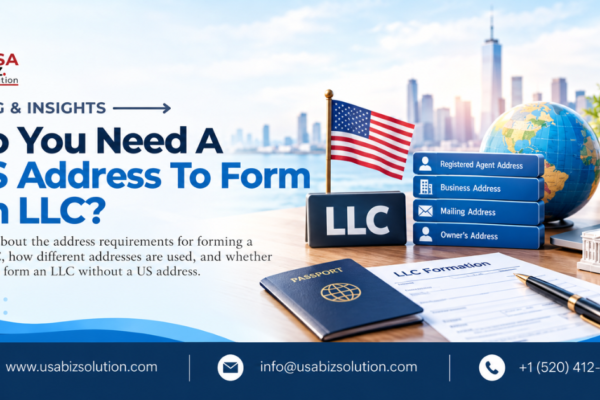
Several different types of addresses can be involved:
| Address Type | Purpose |
| Registered-agent address | Receives official legal/state documents |
| Principal business address | Identifies where the business is actually based |
| Mailing address | Used for correspondence |
| Owner’s residential address | Identifies the owner’s actual residence |
| U.S. business address | May be used for certain business services |
| Virtual address | Commercial mail/address service |
These addresses are not interchangeable.
A foreign freelancer may use a registered agent in the state where the LLC is formed while living and performing freelance services abroad.
The IRS’s current Form SS-4 instructions specifically allow foreign addresses in the appropriate circumstances and instruct applicants without a US residence or principal business location to provide their foreign address information.
A virtual address also does not automatically satisfy every bank, payment processor, tax authority, or state requirement.
The correct address depends on the purpose for which the address is being requested.
Do You Need A US LLC If Most Of Your Clients Are American?
No.
Having American clients does not mean that a freelancer needs a US LLC.
Consider two freelancers:
Freelancer A lives in India, has two US clients, sends invoices from India, receives international payments, and has no difficulty operating through an individual or Indian business structure.
Freelancer B lives abroad, has ten recurring corporate clients, plans to build an agency, needs a formal entity for contracts, and has a genuine operational reason for a US business structure.
The second freelancer has a stronger reason to investigate an LLC.
The difference is not simply the location of the clients.
It is whether the LLC solves a genuine business requirement.
US LLC vs Freelancing as an Individual
| Factor | Individual Freelancer | US LLC |
| Formation | Usually simpler | Requires state formation |
| Ongoing compliance | Primarily depends on home country | US + potentially foreign |
| Liability structure | Personal | Separate LLC structure, subject to limitations |
| Business banking | Varies | Business account may be available |
| U.S. client perception | Often sufficient | May provide a formal entity |
| Tax complexity | Depends on country | Potentially higher |
| Cost | Often lower | Higher |
| Administrative burden | Usually lower | Higher |
| Growth into an agency | Can work | May provide a useful formal structure |
| Federal reporting | Depends on circumstances | May create additional U.S. reporting |
For a freelancer earning modest, irregular income, simplicity can be more valuable than an additional entity.
For a growing business, the calculation can be different.
US LLC vs Registering a Business in Your Home Country
A foreign freelancer should not compare only “US LLC versus nothing.”
There may be a third option: registering a business in the country where the freelancer actually lives and works.
Depending on the jurisdiction, options may include:
-
- Sole proprietorship
- Self-employment registration
- Local company
- Partnership
- Professional business registration
- Local agency structure
The home-country system may also impose:
-
- Income tax
- Self-employment or social contributions
- VAT/GST
- Local invoicing requirements
- Foreign-business reporting
- Foreign-exchange rules
- Reporting of foreign bank accounts or assets
A US LLC does not automatically cancel those requirements.
The freelancer should compare the total compliance burden, not simply the incorporation fee.
What Taxes Could Apply In The Freelancer’s Home Country?
This depends entirely on the country.
A freelancer may need to consider:
-
- Tax residency
- Worldwide-income rules
- Self-employment taxes or social contributions
- VAT/GST
- Foreign-asset reporting
- Foreign-business ownership
- Foreign-exchange rules
- Local business registration
For example, the fact that an Indian freelancer owns a US LLC does not mean US tax rules are the only rules that matter. The freelancer’s Indian tax residence and Indian reporting obligations must be analyzed separately.
The same principle applies to a freelancer living in Pakistan, Bangladesh, the Philippines, the United Kingdom, Germany, Brazil, or another country.
There is no single home-country tax answer for “foreign freelancers.”
Country-specific advice should come from a professional who understands both the local rules and the U.S. side of the structure.
Does A US LLC Give a Freelancer Any US Immigration Benefits?
No!
Owning a US LLC does not automatically provide:
-
- A US visa
- US work authorization
- Permanent residence
- Citizenship
- Permission to physically work in the United States
Business ownership and immigration status are separate matters.
A freelancer who plans to travel to the United States and physically perform services there needs to consider the immigration rules that apply to that activity.
Do You Need To Live In The US To Operate Your LLC?
No, a person can potentially own and manage a US LLC while living abroad.
But several different activities should not be treated as the same thing:
-
- Owning a US LLC
- Managing the LLC from abroad
- Performing freelance services from abroad
- Traveling to the United States
- Performing services while physically in the United States
The tax and immigration consequences can differ.
A freelancer should not assume that because they can legally own the LLC from abroad, they automatically have permission to work physically in the United States.
Does The State You Choose Matter For A Freelancer Abroad?
Yes! State selection can affect:
-
- Formation fees
- Annual taxes
- Annual reports
- Registered-agent requirements
- State income or franchise taxes
- Business licensing
- Privacy rules
- Foreign qualification
- Where the business is considered active
The SBA explains that businesses may need to register in states where they conduct applicable business activities, and an LLC needs a registered agent in its state of registration.
This is why “just choose Wyoming” or “just choose Delaware” is poor advice without considering the freelancer’s actual situation.
When Does A US LLC Make Sense For A Freelancer Abroad?
A US LLC deserves serious consideration when several of these conditions are true:
-
- The freelancer has consistent revenue.
- The business has multiple recurring clients.
- There is a genuine need for a formal business entity.
- The freelancer expects the business to grow.
- Contractors or employees may be added.
- The freelancer wants clearer separation between personal and business finances.
- A particular U.S. business service is genuinely needed and available to the owner.
- The freelancer understands the state and federal compliance requirements.
- The freelancer has reviewed home-country obligations.
- The annual cost is small compared with the business’s value and revenue.
It can be particularly relevant when a solo freelancer is becoming an agency or consulting business.
When Is A US LLC Probably Not Worth It?
A US LLC is often harder to justify when:
-
- Income is very low.
- Freelance work is occasional.
- There are only a few small clients.
- The freelancer already has an inexpensive and suitable local business structure.
- There is no genuine US.-specific operational requirement.
- The only motivation is “zero US tax.”
- The freelancer does not need a US bank or payment infrastructure.
- Annual compliance costs are disproportionate to revenue.
- The freelancer has not investigated home-country tax consequences.
For a freelancer earning modest income from several overseas clients, adding another jurisdiction may simply create another set of forms, fees, records, and deadlines.
Example: A Freelancer Living Abroad With US Clients
Hypothetical example:
A software developer lives permanently outside the United States. She works from her home country and has four recurring US clients. She earns consistent income and plans to hire two developers and a designer within the next year.
She is considering a US LLC.
Why she might consider it
A formal entity could make sense as the business grows. She may want clearer business separation, formal contracts, and an entity through which she can build an agency.
What the LLC could solve
It could provide a formal US business structure and may make certain business arrangements more suitable for the growing agency.
What it would not solve
The LLC would not automatically:
-
- Eliminate her home-country taxes
- Guarantee a US bank account
- Guarantee access to payment platforms
- Give her US immigration status
- Automatically eliminate US reporting
- Automatically make all income US-taxable or US-tax-free
What she should investigate
Before forming the LLC, she should determine:
-
- Her country of tax residence
- Where she physically performs the services
- The LLC’s federal tax classification
- US filing and reporting requirements
- State fees and annual obligations
- Her country’s treatment of foreign-owned businesses
- Foreign-exchange and foreign-asset rules
- Whether the planned banking/payment provider accepts her
- Whether the business structure will still work when she hires people
The decision should be based on the complete picture, not the LLC formation fee alone.
US LLC for Freelancers Abroad: Pros and Cons
| Pros | Cons |
| Formal business structure | Formation costs |
| Business/personal financial separation | Registered-agent costs |
| Potentially useful for certain contracts | Annual state obligations |
| May support certain banking/payment arrangements | Federal reporting may apply |
| Can support business growth | Potentially greater tax complexity |
| Limited-liability structure | Accounting and professional fees |
| May fit an international agency model | Home-country reporting may still apply |
| Can provide a formal entity for business operations | Not necessary for every freelancer |
The important point is that the benefits are situational while many of the costs are recurring.
Final Answer: Is A US LLC Worth It For A Freelancer Living Abroad?
Sometimes, but not simply because the freelancer has US clients.
A US LLC is more likely to make sense when the freelancer has a genuine business reason for a US entity, stable revenue, plans for growth, and a need for formal business infrastructure.
It is less attractive when the freelancer has modest income, can operate easily through a local structure, and is forming the LLC primarily because of claims about “zero US tax.”
The biggest mistake is treating LLC formation as the decision itself.
The better sequence is:
Identify the business problem → compare individual/local/US structures → calculate total annual costs → review US reporting → review home-country tax rules → then decide whether the LLC adds enough value.
For a foreign freelancer, the most important professional advice is usually not simply “form an LLC” or “don’t form one.” It is to have the proposed structure reviewed in light of both US rules and the laws of the country where the freelancer actually lives and works.
Official Resources:
US Small Business Administration (SBA) Launch Your Business
Internal Revenue Service (IRS) Source of Income: Personal Service Income
IRS: Instructions for Form 5472
IRS: Instructions for Form SS-4
US Small Business Administration: State Registration Lookup
Internal Revenue Service (IRS): International Taxpayers
Frequently Asked Questions
Is a US LLC worth it for a freelancer living abroad?
It can be, but there is no universal answer. A US LLC may be useful when a freelancer needs a formal US business structure, has stable revenue, plans to grow into an agency, or has a genuine operational need for US business infrastructure. It may be unnecessary when the freelancer has low or irregular income and can operate more simply through an individual or local business structure.
Can a non-US resident own a US LLC?
Generally, yes. US citizenship or US residency is not ordinarily required simply to own an LLC. However, ownership does not determine every tax, banking, immigration, or foreign-country obligation. The owner’s country of residence and the LLC’s tax classification remain important.
Do foreign freelancers pay US taxes on LLC income?
Not automatically! For personal services, US tax sourcing generally looks at where the services are performed, rather than simply where the client is located. However, other facts can affect US tax and filing obligations. A foreign-owned LLC can also have information-reporting requirements even when there is no US income-tax liability.
Can I form a US LLC without living in America?
Generally, yes. A person can potentially form and own a US LLC while living abroad. The LLC still needs to meet the requirements of the state where it is formed, including having a registered agent. Living abroad does not automatically remove the owner’s tax or reporting obligations in their country of residence.
Do I need an EIN for my foreign-owned LLC?
An EIN may be required depending on the LLC’s circumstances, including certain federal reporting requirements. IRS instructions specifically address EIN applications for foreign-owned US disregarded entities that need an EIN for Form 5472 purposes. International applicants without a U.S. residence or principal business location can use the IRS’s international application procedures.
Do I need a US address to form an LLC?
You generally do not need to live in a US home or maintain a US office simply to own a US LLC. However, the registered-agent address, principal business address, mailing address, and banking address can serve different purposes. A virtual address does not automatically satisfy every requirement imposed by a state, bank, payment processor, or tax authority.
Can I open a US business bank account from abroad?
Possibly, but approval is not guaranteed. Banks and financial providers can have different rules for nonresident owners, including requirements for identification, business documents, addresses, tax information, and sometimes in-person verification. Forming an LLC alone does not guarantee a US business bank account.
Do US clients require freelancers to have an LLC?
Usually, no. Many US businesses work directly with independent contractors located outside the United States. Whether a particular client requires an entity depends on its procurement, legal, payment, and compliance policies. Having US clients is therefore not, by itself, a reason to create a US LLC.

Is a US LLC Worth It for Freelancers Working Abroad?
Explore the benefits, costs, tax implications, and compliance requirements of forming a US LLC as a freelancer abroad. Learn when an LLC makes sense and when individual or local business structures may be more practical.
Get US LLC Guidance