






Taxpayer Identification Number (TIN): Meaning, Types, And Uses
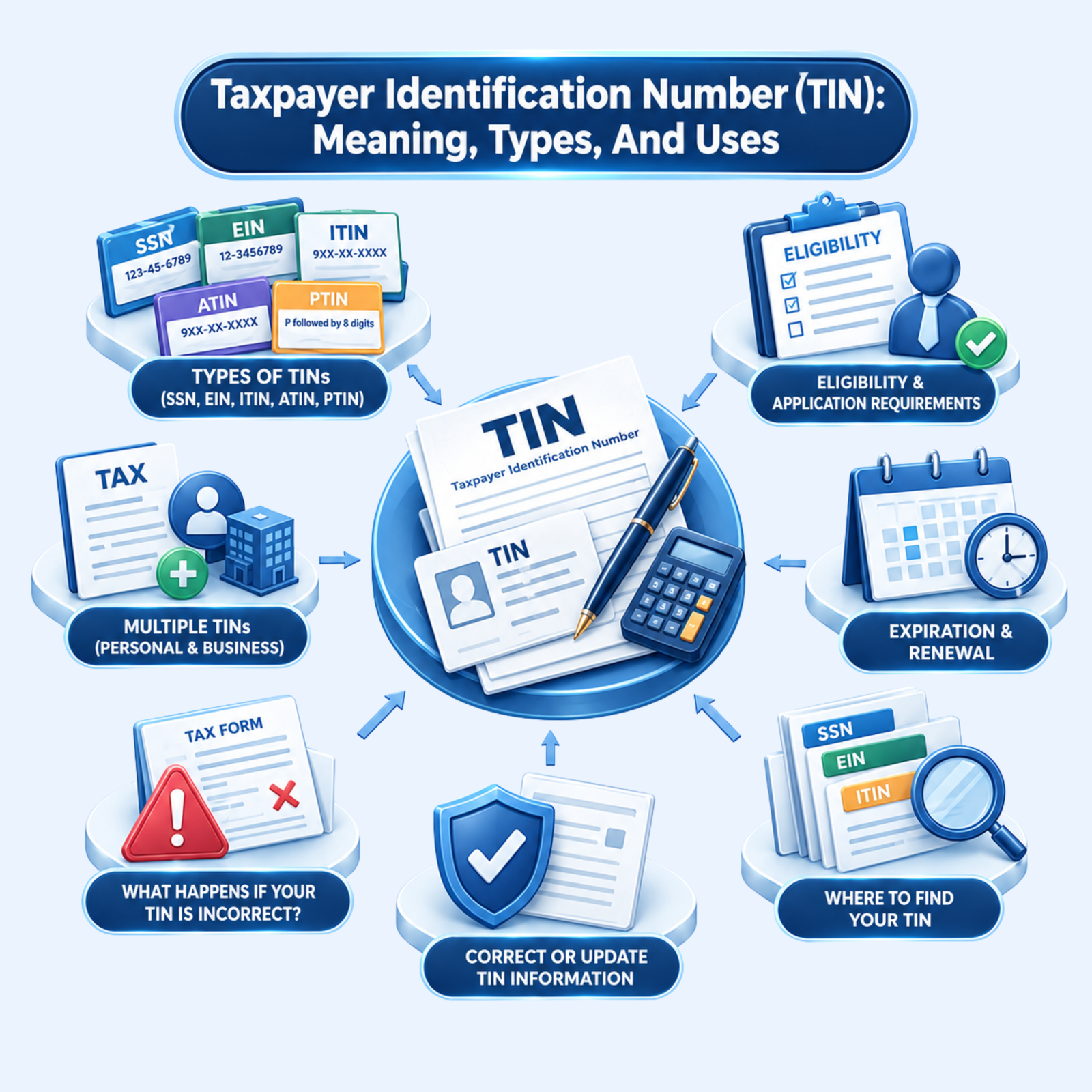
- 1 A TIN number is used for different types of tax ID numbers.
- 2 All SSN, EIN, ITIN, ATIN, or PTIN are under TIN.
- 3 The TIN you need depends on your tax situation.
- 4 Eligibility and application requirements vary by TIN type.
- 5 More than one TIN can apply to you for separate purposes.
- 6 Some TINs expire or have to be renewed.
- 7 Double-check your TIN before you put it on a tax form.
The US government uses a TIN (Taxpayer Identification Number) to identify taxpayers for federal tax purposes. The term covers more than one type of tax identification number, so the number used on a tax form depends on the person, business, or tax-related situation involved.
An individual may use an SSN or ITIN, while a business may have an EIN. The IRS also issues an ATIN for certain pending US adoption cases and a PTIN for paid federal tax return preparers. Each number has its purpose, eligibility rules and application process.
Using the right TIN number matters when filing tax returns, submitting forms or providing taxpayer information to a business or government agency. An incorrect or outdated number can also create problems with tax records & information reporting.
What Is A TIN Number?
A Taxpayer Identification Number (TIN) is a number used by the US government to identify a taxpayer for federal tax purposes. You may need to provide it when filing a tax return or filling out a form that asks for your taxpayer identification details.
TIN does not mean there is one separate number called a “TIN.” It is a general term used for different tax identification numbers. The IRS recognizes five main types: SSN, EIN, ITIN, ATIN and PTIN.
The number you use depends on your situation. An individual may use an SSN or ITIN, a business may use an EIN & certain other tax situations call for an ATIN or PTIN. Each type has its purpose & rules.
What Does A TIN Number Look Like?
A TIN does not follow one single format. The way your number appears depends on which type of TIN you have.
| TIN Type | Common Format | Issued By |
| SSN | 123-45-6789 | Social Security Administration |
| EIN | 12-3456789 | IRS |
| ITIN | 9XX-XX-XXXX | IRS |
| ATIN | 9XX-XX-XXXX | IRS |
| PTIN | P followed by 8 digits | IRS |
An SSN, ITIN, and ATIN each contain nine digits & are generally shown in the format 123-45-6789. An EIN also has nine digits but uses the format 12-3456789. A PTIN consists of the letter P followed by eight digits & is issued to paid federal tax return preparers.
What Are The Different Types Of TINs?
The IRS recognizes five main types of taxpayer identification numbers. The one you need depends on your tax or professional situation.
| TIN Type | Who Uses It | Main Purpose |
| SSN | Eligible individuals | Identifies individuals for Social Security and federal tax purposes |
| EIN | Businesses and certain other entities | Identifies a business or entity for federal tax purposes |
| ITIN | Certain individuals who cannot get an SSN | Provides taxpayer identification for federal tax purposes |
| ATIN | Certain individuals involved in a pending US adoption | Provides temporary taxpayer identification for a qualifying adopted child |
| PTIN | Paid federal tax return preparers | Identifies paid preparers on federal tax returns |
Who Needs A TIN?
A TIN is needed when the IRS requires a taxpayer identification number for a federal tax matter. For many individuals, that number is an SSN. Someone who cannot get an SSN may use an ITIN if they have a valid federal tax reason. Businesses & other entities generally use an EIN.
| Situation | TIN Used |
| Individual with an SSN | SSN |
| Individual who cannot qualify for an SSN but needs a taxpayer identification number for a federal tax purpose | ITIN |
| Business or other entity that needs a federal tax identification number | EIN |
| Certain pending US adoption cases | ATIN |
| Paid federal tax return preparer | PTIN |
The TIN you need depends on why you are required to provide a taxpayer identification number & the IRS rules that apply to your situation.
How Do You Get A TIN?
You do not apply for a general TIN. The process starts with choosing the type of taxpayer identification number you need.
| TIN Type | Where to Apply and What to Do |
| SSN | You can apply through the Social Security Administration (SSA). You will need to qualify for an SSN and submit the documents the SSA asks for. |
| ITIN | Form W-7 is used to request an ITIN from the IRS. You generally send the form with supporting documents and a federal tax return, unless an exception allows you to apply without one. |
| EIN | The IRS issues EINs to businesses, organizations, and other entities that meet the requirements. The IRS offers an online application for eligible applicants. |
| ATIN | Form W-7A is used to request an ATIN for a child involved in a qualifying pending US adoption. |
| PTIN | Paid tax return preparers who are required to have one can obtain a PTIN through the IRS online PTIN system. |
Each type has its eligibility rules and application requirements. Make sure you apply for the number that fits your tax situation rather than looking for a separate application called a “TIN application.”
Where Can You Find Your TIN?
The place where you can find your TIN depends on the type of number you have. Check the records connected to that number:
| TIN Type | Where to Look |
| SSN | Your Social Security card and other official records that show your SSN |
| EIN | The IRS notice issued when your EIN was assigned and your business tax records |
| ITIN | The IRS notice that assigned your ITIN and federal tax records where you previously used it |
| ATIN | IRS records or documents related to the ATIN |
| PTIN | Your IRS PTIN account and records related to your PTIN |
If you cannot locate the number, check your existing IRS or Social Security records rather than guessing it or applying for a new number.
What Happens If Your TIN Is Incorrect?
A wrong TIN can cause problems if your tax information is reported under the wrong number or does not match IRS records. You could then receive a notice asking you to correct the information.
Check the TIN against the original document where it was issued. If you have already submitted the wrong number, the way to fix it will depend on the form or record where the mistake appears.
Can A TIN Expire?
Some types of TINs can expire or want renewal, while others generally remain valid. An SSN & EIN normally do not expire. An ITIN expires after three continuous tax years of non-use on a US federal income tax return, an ATIN is temporary and a PTIN is valid for one calendar year & must be renewed annually.
An ITIN expires on December 31 after the third consecutive tax year in which it was not used on a US federal income tax return. If you need to use an expired ITIN on a federal tax return, you generally need to renew it. If an ITIN is only used on information returns, such as Form 1099, it does not need to be renewed until it is necessary for a federal tax return.
An ATIN is temporary & is generally valid for two years. A PTIN expires on December 31 of each year & must be renewed to remain current and active.
Can You Have More Than One TIN?
Yes!
You can have more than one TIN. An SSN can be used for your individual tax matters, while an EIN can be used for a business you own or operate. Each number serves a separate tax purpose.
Having more than one TIN does not mean you can use them flexibly. Use the number requested for the particular tax form or transaction. If you are eligible for an SSN, you generally should not use an ITIN instead.
An ATIN & PTIN serve specific purposes. An ATIN is used in certain pending adoption cases, while a PTIN is used by paid tax return preparers who are required to have one.
How Do You Correct Or Update TIN Information?
1. Check the mistake
Compare the TIN and taxpayer name with the original record issued by the Social Security Administration or IRS.
2. Identify where the error occurred
The correction process depends on whether the error is in your IRS or Social Security record, a tax return or an information return such as Form 1099.
3. Contact the appropriate agency or requester
The Social Security Administration generally handles SSN-related records, while the IRS handles EIN & ITIN matters. If a business or other payer reported an incorrect TIN, you may also need to provide the correct information to that requester.
4. Correct the tax or information return when required
If an incorrect TIN has already been reported to the IRS, the payer or filer may need to submit a corrected information return using the applicable IRS correction procedures.
5. Keep the corrected record
Save updated notices, corrected forms or other confirmation with your tax records. Use the corrected information on future tax forms and filings.
Frequently Asked Questions
Which TIN should you use on a tax form?
Use the TIN that belongs to the taxpayer named on the form. Most individuals use their SSN. Someone who needs a federal tax ID but is not eligible for an SSN may use an ITIN. Businesses generally use an EIN.
Where can you find your TIN?
Your TIN is usually listed on the paperwork you received when the number was issued. An SSN is on your Social Security card, while an EIN is on the IRS notice for the business. You can also find these numbers on earlier tax documents.
What happens if your TIN is incorrect?
A wrong TIN can prevent the IRS from matching the information with its records. Check the number against the original document before you submit the form. When an incorrect number has already been reported, a correction to the related return may be necessary.
Can you have more than one TIN?
Yes. You can have more than one TIN. For example, you may have an SSN for your personal taxes and an EIN for your business. Use the number that was issued for the specific tax matter.
Can a TIN expire?
Some TINs can expire while others generally remain valid. An ITIN expires on December 31 after three consecutive tax years in which it was not used on a U.S. federal income tax return. A PTIN expires on December 31 of each year and must be renewed to remain current and active. SSNs and EINs generally do not expire.
Can you get an ITIN if you qualify for an SSN?
No, an ITIN is for individuals who need a federal tax identification number but are not eligible for an SSN. If you receive an SSN after having an ITIN, you must stop using the ITIN for tax purposes and notify the IRS so that your tax records can be combined with your SSN.
Do you apply for a general TIN?
No, there is no separate number called a “general TIN.” TIN is the term used for several types of tax identification numbers. You apply for the specific one that applies to your situation, and the process varies depending on the type.

What Is a TIN? Types, Uses & Tax Guide
Understand the different types of TINs, who needs them, how to apply, find, update, and use the correct taxpayer identification number for federal tax purposes.
Get Expert TIN Guidance