






How To Form A US LLC From Pakistan: Step-by-Step Guide
- 1 You can open a US LLC while living in Pakistan.
- 2 Each state has its own fees and filing rules.
- 3 An SSN is not always needed for an EIN.
- 4 Your LLC may need to file Form 5472 and Form 1120.
- 5 You may still owe taxes or file returns in Pakistan.
- 6 Owning an LLC does not give you a US visa.
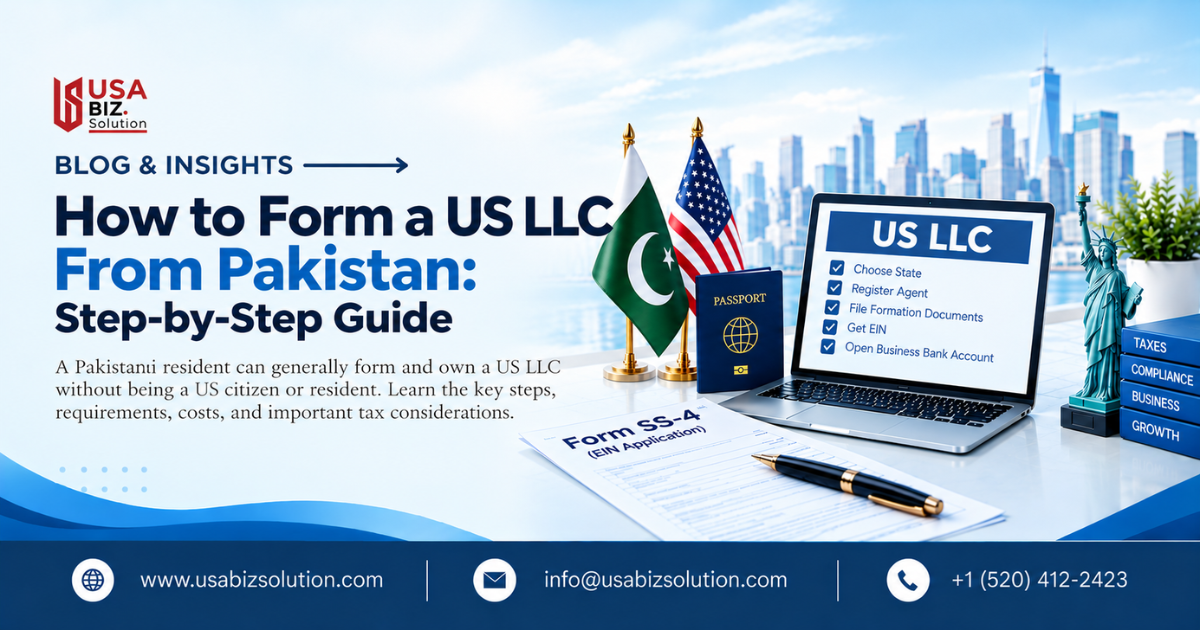
A person living in Pakistan can generally form and own a US
LLC without becoming a US citizen or US resident. US state law governs the creation of the LLC, while federal rules determine matters such as its tax classification and IRS reporting. The fact that the owner lives in Pakistan does not, by itself, prevent ownership of a US LLC.
The more difficult part comes after formation. A Pakistani owner may need to deal with a registered agent, EIN application, business banking, payment-provider verification, federal information returns, state compliance, and Pakistani tax and foreign-exchange rules. The result can be very different depending on whether the LLC has one owner or several, where the business activity takes place, whether the owner performs services in the United States, and how the LLC is taxed.
This distinction matters: forming a US LLC and determining how that LLC is taxed are separate steps. A US LLC is also not a visa, immigration route, or authorization to work physically in the United States.
Can You Form A US LLC From Pakistan?
Yes! A Pakistani citizen or resident can generally own a US LLC, and US citizenship is not a general requirement for LLC ownership.
The LLC is created under the law of the state where it is formed. The US Small Business Administration explains that LLCs generally register with the relevant state authority and need a registered agent located in that state.
You do not normally need to live in the United States simply to own the company. Likewise, owning the LLC does not automatically need the owner to have a US visa.
There are, however, several different concepts that should not be mixed together:
- LLC ownership: holding an ownership interest in a US business.
- US immigration status: permission to enter or remain in the United States.
- US work authorization: permission to perform work in the United States.
- US tax residence: a separate tax concept determined under applicable rules.
A Pakistani entrepreneur can therefore own a US LLC while continuing to live and work in Pakistan. That does not, by itself, give the person US residency, citizenship, a visa, or US work authorization.
Where the owner actually performs the business activity can also matter for tax purposes. For personal services, the IRS generally looks at where the services are physically performed to determine their source.
What Do You Need To Form A US LLC From Pakistan?
Before filing, prepare the following information and documents.
| Requirement | What It Is Used For | Usually Required? |
| LLC name | Identifies the legal entity | Yes |
| State of formation | Determines the LLC’s state law and state compliance | Yes |
| Registered agent | Receives official legal and state notices | Yes |
| Formation document | Legally creates the LLC | Yes |
| Owner/member information | Identifies ownership where required by the state | Depends on state |
| Mailing/physical address | State and administrative correspondence | Depends on state |
| Identification documents | Bank, payment provider, professional-service and verification purposes | Commonly requested |
| Operating agreement | Records ownership and internal operating rules | Strongly recommended |
| EIN | Federal business identification and tax reporting | Commonly needed |
| State filing fee | Payment for creating the LLC | Yes |
| Banking documents | Used when applying for business banking | Bank-specific |
| Tax records | Support federal and state compliance | Yes for applicable obligations |
The important distinction is that not everything requested during the setup process is a government formation requirement. A bank may request documents that the Secretary of State does not require. A payment processor may impose its own verification rules. A formation company may recommend optional services.
The actual state filing requirements should therefore be checked against the state government’s current instructions.
How To Choose The Best State For Your US LLC
There is no single state that is automatically the best for every Pakistani business owner.
The right state depends partly on where the business actually operates. The SBA notes that a business may need to register in states where it conducts business activities and may need foreign qualification if it operates in additional states.
Consider:
- where the owner performs the business activity
- whether the LLC has US employees
- whether the company has a US office
- whether it owns US property
- where substantial business activity occurs
- state formation fees
- annual reports
- franchise or annual taxes
- registered-agent costs
- state income or other business taxes
- foreign-qualification requirements
Wyoming
Wyoming is frequently considered by non-US. founders because of its relatively low formation and annual compliance costs. Current 2026 information indicates a $100 state filing fee for Articles of Organization and a minimum annual license tax of $60, subject to the state’s calculation rules.
That does not make Wyoming automatically appropriate. If the business is actually operating in another state, forming in Wyoming may result in an additional foreign-qualification requirement elsewhere.
Delaware
Delaware is particularly prominent in US corporate law, but that does not mean every small online business should form there.
Delaware’s official LLC formation document is a Certificate of Formation. The current state form lists a $110 filing fee and a $300 annual tax for an LLC, with the annual tax due by June 1.
For a small single-owner service business with no Delaware operations, those ongoing costs may be difficult to justify compared with another state.
New Mexico
New Mexico is another state considered by non-US owners. Current information indicates a $50 filing fee for LLC Articles of Organization, and New Mexico LLCs generally do not file a Secretary of State annual report.
The absence of an annual Secretary of State report does not mean the company is exempt from all tax, licensing, federal, or other compliance requirements.
The practical rule: choose the state based on the business’s actual circumstances, not simply on a list claiming that one state is the “best LLC state.”
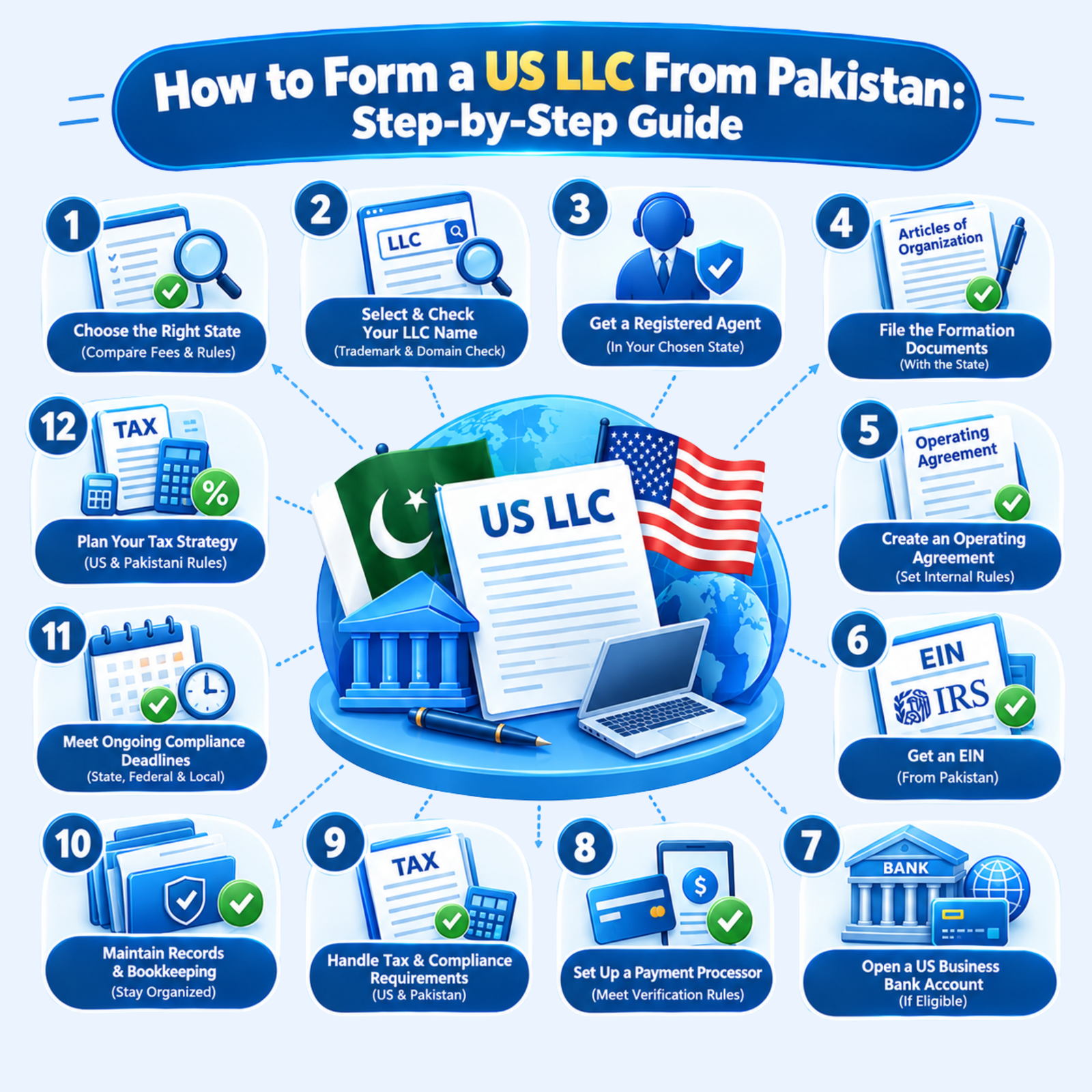
Choose And Check Your LLC Name
Your proposed name must satisfy the naming rules of the state where you form the LLC.
Before filing:
- Search the state’s business entity database.
- Confirm that the name is distinguishable from existing entities where required.
- Check whether the name requires an LLC designator.
- Review restricted or regulated words under state law.
- Search the US trademark database for potential conflicts.
- Check whether a suitable domain name is available.
A state accepting your LLC name does not mean that the name is automatically clear from trademark claims. State entity-name approval and trademark protection are separate issues.
You may also operate under a DBA or trade name if the relevant state and business circumstances permit it. A DBA is not a replacement for the LLC’s legal name.
Get A Registered Agent
A registered agent is the person or service designated to receive official legal documents and certain state notices for the LLC.
The SBA states that an LLC needs a registered agent in the state where it registers and that the registered agent must be located in that state.
For someone living in Pakistan, a commercial registered-agent service is often the practical choice.
Do not confuse the following:
- Registered-agent address: used for official service of process and qualifying state notices.
- Business address: where the business is actually located or operates.
- Mailing address: where correspondence is received.
- Virtual mailbox: a mail-handling service that may not satisfy every government, bank, or payment-provider requirement.
- Bank address: an address requested by a financial institution under its own verification policies.
A registered-agent address should not automatically be presented as the company’s physical operating location.
File The LLC Formation Documents
Once the state is selected and the name is available, the basic process is
1. Go to the official state filing website
Use the Secretary of State or equivalent state agency rather than relying exclusively on a third-party formation website.
2. Select the correct LLC formation document
The name varies by state. Delaware, for example, uses a Certificate of Formation, while Wyoming and New Mexico use Articles of Organization.
3. Provide the required information
Depending on the state, this can include the LLC’s name, registered agent, registered office, organizer information, management information, and address details.
4. Submit the filing
Pay the applicable state filing fee.
5. Wait for approval
Processing procedures and times vary by state.
6. Save the approved documents
Keep the filed formation document, approval confirmation, state identification number, and other state correspondence with the company’s permanent records.
The exact form, information requested, filing method, and fee depend on the state. Do not assume that a Wyoming filing can be completed in exactly the same way as a Delaware or New Mexico filing.
Create An LLC Operating Agreement
An operating agreement sets out how the LLC is owned and managed.
For a single-member LLC, it can document:
- the owner’s identity
- ownership percentage
- capital contributions
- management authority
- distributions
- business decision-making
- treatment of company property
- procedures for changes in ownership
- separation between the LLC and its owner
For a multi-member LLC, the agreement becomes even more important because it can establish voting rights, profit allocations, responsibilities, member admissions, transfers, and procedures for disputes or departures.
An operating agreement is not the same thing as the formation document. The formation document creates the entity under state law; the operating agreement establishes internal rules between the owners and the company.
Do not assume that every state needs an operating agreement to be filed with the Secretary of State.
How To Get An EIN From Pakistan
An Employer Identification Number (EIN) is the federal tax identification number issued by the IRS to qualifying businesses and other entities.
The IRS’s current Form SS-4 instructions are particularly important for a Pakistani owner because they address foreign addresses and foreign responsible parties directly. If an entity has no US legal residence, principal place of business, or principal office or agency, it cannot use the IRS online EIN application.
Who Is The responsible party?
For most applicants, the responsible party is the individual who ultimately owns or controls the entity.
The current Form SS-4 instructions say that the responsible party generally must be an individual and must provide an SSN or ITIN on line 7b. If the responsible party does not have and is ineligible to obtain an SSN or ITIN, the instructions allow the applicant to enter “foreign” or “N/A” on line 7b.
This is an important correction to a common misconception: a foreign owner is not automatically required to obtain an SSN simply to obtain an EIN.
How can an international applicant apply?
The IRS currently provides non-online options for applicants without a US legal residence, principal business location, or principal office.
International applicants can apply by:
- telephone
- fax
The IRS identifies 267-941-1099 as the international EIN telephone number. International applicants may also fax Form SS-4 using the applicable international fax instructions.
Before contacting the IRS, complete Form SS-4 carefully so the information about the LLC, responsible party, business activity, address, and tax classification is consistent.
Do not create a second EIN application simply because an earlier application is taking time. The IRS limits EIN issuance to one per responsible party per day.
Do You Need An SSN Or ITIN To Form A US LLC From Pakistan?
These three numbers serve different purposes.
SSN
A Social Security number is generally associated with US Social Security administration and taxpayer identification for individuals who qualify.
A Pakistani resident does not automatically need an SSN merely because they own a US LLC.
ITIN
An Individual Taxpayer Identification Number is a US tax-processing number for individuals who need a US taxpayer identification number but are not eligible for an SSN.
An ITIN should not be treated as a substitute for an EIN.
EIN
The EIN identifies the business entity for federal tax and reporting purposes.
For a foreign responsible party who has neither an SSN nor ITIN and is not eligible to obtain either, the current Form SS-4 instructions specifically provide for “foreign” or “N/A” on the responsible-party identification line.
Whether an individual later needs an ITIN depends on the person’s actual US tax filing circumstances. There is no general rule that every Pakistani owner of a US LLC must obtain one.
How To Open A US Business Bank Account From Pakistan
Having a US LLC does not guarantee approval for a US business bank account.
A bank or financial institution may ask for:
- approved formation documents
- EIN confirmation
- operating agreement
- passport or other identification
- residential address
- business address
- information about the company’s activities
- expected transaction volume
- customer and supplier information
- ownership information
- tax information
The exact requirements depend on the institution.
For a Pakistani owner, the bank may also conduct enhanced identity and compliance checks because the owner is located outside the United States.
A registered-agent address should not be assumed to satisfy a bank’s physical-address requirement. Financial institutions may distinguish between the company’s registered-agent address, actual operating location, and owner’s residential address.
The sensible approach is to check the institution’s eligibility requirements before forming the LLC solely for the purpose of opening an account.
Can You Use A Payment Processor For A US LLC From Pakistan?
A US LLC may be able to use payment processors, merchant services, invoicing platforms, or other payment infrastructure, but LLC formation alone does not guarantee approval.
A payment provider may review:
- company formation information
- EIN
- owner’s identity
- owner’s country of residence
- business address
- bank account
- website
- products or services
- expected transaction volume
- customer locations
- chargeback risk
- prohibited-business policies
A software company operating from Pakistan may therefore receive a different eligibility decision from a business selling regulated products, financial services, or other higher-risk activities.
Do not select a payment provider solely because another US LLC owner was approved by it. Policies can change and eligibility is assessed individually.
How Much Does It Cost To Form A US LLC From Pakistan?
There is no single nationwide LLC formation price.
One-time costs
- state formation fee
- optional name reservation
- registered-agent setup
- optional legal or tax advice
- optional formation-service fee
- certified copies or expedited services, if requested
Recurring costs
- registered-agent fee
- annual or biennial state filings
- franchise or annual taxes
- accounting
- tax preparation
- business banking fees
- payment-processing fees
- licenses or permits where applicable
| Expense | What It Covers | Mandatory or Optional |
| State formation fee | Creates the LLC | Mandatory |
| Registered agent | Maintains required state representation | Mandatory |
| EIN | Federal business identification | Commonly required depending on circumstances |
| Operating agreement | Internal company rules | Recommended |
| Tax preparation | Federal/state compliance | Depends on filing obligations |
| Accounting/bookkeeping | Financial records | Depends on business needs |
| Business bank account | Business finances | Not universally required by LLC formation law |
| Payment processor | Customer payments | Optional, depending on business model |
| Legal/tax advice | Professional assistance | Optional but useful for complex structures |
For illustration, current state information shows substantial differences. Delaware lists a $110 LLC formation fee and $300 annual tax, while Wyoming lists a $100 formation fee and a minimum $60 annual license tax. New Mexico lists a $50 LLC formation fee and no general Secretary of State annual report for its LLCs.
These figures should be rechecked immediately before filing because state fee schedules can change.
The cost of a US LLC should therefore be evaluated as formation cost + recurring state cost + registered-agent cost + tax/accounting cost + banking/payment cost, rather than as a single filing fee.
How Is A US LLC Owned by Someone In Pakistan Taxed?
The tax answer cannot be determined simply by asking, “Is the owner Pakistani?”
Several separate questions matter:
- Is the LLC single-member or multi-member?
- What is its US federal tax classification?
- Has the LLC made a tax election?
- Where are services physically performed?
- Does the business have a US trade or business?
- Does it have US employees or an office?
- Does it own US property?
- What type of income does it earn?
- Does it have US-source income?
- Are there related-party transactions?
- What state-level tax rules apply?
- What Pakistani tax rules apply to the owner?
The IRS explains that nonresident aliens are generally taxed on US-source income and certain income connected with a US trade or business. For personal services, the place where you perform them is generally the key sourcing factor.
That means a US customer does not, by itself, answer the US income-tax question.
For example, a software developer who lives in Pakistan and performs development work from Pakistan for US customers has a different fact pattern from an owner who travels to the United States and personally performs services there.
The US LLC’s place of registration and the physical location of the owner’s work are separate questions.
US-Pakistan tax treaty
There is a US-Pakistan income tax convention. The IRS lists Pakistan among the countries with which the United States has an income tax treaty and the IRS publishes the Pakistan treaty documents.
That does not mean every Pakistani-owned LLC automatically receives treaty relief.
Treaty provisions apply according to their wording and the taxpayer’s facts. The treaty should therefore be examined alongside domestic US and Pakistani rules rather than treated as a blanket exemption.
Foreign-Owned Single-Member US LLC Tax Filing Requirements
This is one of the areas where foreign owners most often underestimate their compliance obligations.
A domestic US LLC with one owner is generally treated as a disregarded entity for US federal income-tax purposes unless an election is made to change its classification. The IRS’s current Form SS-4 instructions confirm the default federal treatment for a domestic single-member LLC.
A foreign-owned US disregarded entity has an additional reporting regime.
For purposes of certain information-reporting rules under section 6038A, a foreign-owned domestic disregarded entity is treated separately from its foreign owner. The IRS states that such an entity generally must file a pro forma Form 1120 with Form 5472 attached when the applicable reporting requirements are triggered.
What is Form 5472?
Form 5472 is an information return concerning a 25%-foreign-owned US corporation or a foreign-owned US disregarded entity covered by the rules.
The filing obligation focuses on reportable transactions with related parties. The IRS’s Form 5472 instructions specifically include foreign-owned US disregarded entities in the reporting framework.
Transactions can include matters involving the foreign owner, such as contributions or distributions, depending on the facts and the applicable reporting rules.
This is why a foreign-owned single-member LLC should not be treated as “no US filing required” simply because it is disregarded for federal income-tax purposes.
The reporting position should be reviewed every year, particularly if:
- The owner contributes money to the LLC
- The owner takes money out
- The owner pays company expenses personally
- The company reimburses the owner
- The LLC makes related-party payments
- The LLC acquires assets from a related person
- The ownership structure changes
Recordkeeping matters because the information return is not simply a tax calculation; it is an information-reporting requirement.
Does A US LLC From Pakistan Need To File A BOI Report?
For a US-created LLC, the current answer is generally no.
This is an area where many older articles are now inaccurate.
FinCEN’s current BOI guidance, updated after its August 11, 2026 final rule, states that US companies are exempt from BOI reporting requirements. The final rule became effective August 14, 2026.
The current rule distinguishes US-created entities from certain entities formed under foreign law and subsequently registered to do business in the United States.
Therefore:
A Pakistani entrepreneur who forms a new LLC under the law of a US state is dealing with a US-created domestic entity, which is currently exempt from the FinCEN BOI reporting requirement.
That is different from a Pakistani company that was formed in Pakistan and later registers to conduct business in the United States. Certain foreign-formed entities can fall within the current BOI reporting framework.
Because FinCEN’s rules have changed substantially recently, BOI guidance should always be checked against the current FinCEN website rather than copied from an older LLC article.
Pakistan Tax Considerations For A US LLC Owner
Forming a US LLC does not automatically remove Pakistani tax obligations.
A Pakistani resident’s tax position can depend on matters such as
- tax residency
- nature of income
- ownership structure
- where the business is actually operated
- where services are performed
- how income is received
- whether foreign asset or income reporting thresholds apply
- applicable Pakistani income-tax provisions
- foreign-exchange requirements
Pakistan’s FBR publishes rules dealing with resident and non-resident individuals. Its current tax information also includes specific provisions concerning foreign income and foreign assets.
For example, section 116A of the Income Tax Ordinance provides a foreign income and assets statement requirement for a resident individual who meets specified foreign-income or foreign-asset thresholds. The current FBR text refers to foreign income of at least US$10,000 or to foreign assets valued at least US$100,000.
That does not mean every Pakistani LLC owner automatically has to file that statement. The provision applies according to the statutory conditions.
Pakistan also has provisions dealing with relief from international double taxation. FBR’s current section 103 provides a foreign tax credit mechanism for qualifying resident taxpayers who derive foreign-source income & have paid foreign income tax, subject to the statutory limits.
The actual treatment of money earned through a US LLC can therefore require an analysis of both the LLC’s US tax classification and the owner’s Pakistani tax position.
Foreign assets and accounts
The fact that an asset or account is connected with a US LLC does not make it irrelevant for Pakistani tax purposes.
A resident Pakistani owner should keep records showing:
- ownership of the LLC
- capital contributed
- business income
- distributions
- foreign bank balances
- business expenses
- foreign taxes paid
- exchange rates used
- transfers between personal and business accounts
Do not assume that moving money between a US account and Pakistan is simply a personal remittance with no tax or reporting implications.
US LLC vs Pakistani Business Registration
These are separate questions.
| Area | US Consideration | Pakistan Consideration |
| Company formation | Form LLC under a US state’s law | Determine whether Pakistani registration applies to the local activity |
| Federal tax | IRS classification and reporting | FBR tax treatment of the owner’s income and assets |
| State compliance | State reports, taxes and licenses | Pakistani provincial/federal regulatory requirements where applicable |
| Banking | US bank or financial institution requirements | Pakistani banking and foreign-exchange rules |
| Income | US source and US trade/business rules | Pakistani source/residency and foreign-income rules |
| Foreign assets | US reporting where applicable | Pakistani foreign-asset reporting where applicable |
| Business activity | US nexus and state requirements | Where the business is actually managed and operated |
SECP provides a separate framework for companies and foreign companies operating in Pakistan. Its current company-registration material should be consulted if the US LLC will establish a place of business or otherwise carry on activities in Pakistan that trigger local registration requirements.
That does not mean every Pakistani resident who owns a US LLC must automatically create a Pakistani company. The answer depends on what the person is actually doing in Pakistan and the applicable law.
Do You Need A US Address?
Not necessarily for every purpose.
The following addresses can have different functions:
- Registered-agent address
Used for receiving qualifying official notices and legal service.
- Business address
Represents where the company operates or conducts business.
- Mailing address
Used to receive correspondence.
- Owner’s residential address
The physical home address of the Pakistani owner.
- Bank address
A bank may request a physical residential or business address under its own customer-verification policies.
Payment-provider address
A payment processor may have separate address & country eligibility requirements.
The IRS’s current Form SS-4 instructions expressly allow an entity to use a foreign mailing or physical address where applicable and require the foreign country to be identified.
Therefore, a Pakistani owner should not assume that a rented US mailing address is necessary simply because the company is American.
At the same time, a virtual address should not be presented as a universal substitute for a physical operating address. Different organizations can apply different rules.
Can You Run A US LLC From Pakistan?
Yes, a person can manage a US LLC while physically living in Pakistan. The tax and regulatory consequences depend on what the person actually does.
For example, a Pakistani software developer may:
- Own the US LLC
- Manage contracts from Pakistan
- Perform development work from Pakistan
- Serve US clients
- Use a US business account where eligible
- Receive customer payments through an approved processor
But this structure does not automatically mean the income is US taxable simply because customers are American.
For personal services, the IRS generally sources compensation based on where the services are performed.
The analysis can change if the owner:
- performs services while physically in the United States
- maintains a US office
- hires US employees
- operates from US premises
- owns US business property
- conducts other activities that create US tax or state obligations
Pakistan-side rules remain relevant while the owner operates the business from Pakistan.
Annual Compliance After Forming A US LLC
Formation is not the end of the process.
Depending on the LLC’s state, tax classification, activities and ownership, ongoing compliance may include:
- state annual or biennial reports
- annual or franchise taxes
- registered-agent maintenance
- federal income-tax returns where applicable
- Form 5472
- pro forma Form 1120
- partnership returns for qualifying multi-member LLCs
- corporate returns where an election or classification requires one
- bookkeeping
- supporting records
- state tax filings
- business licenses
- foreign qualification
- updates to ownership information
- updates to responsible-party information
- address changes
- Pakistan tax filings
- Pakistan foreign-income/asset reporting where applicable
The IRS also requires entities with EINs to report certain changes to responsible-party information, generally using Form 8822-B. The current Form SS-4 instructions state that responsible-party changes must be reported within 60 days.
Not every LLC has every obligation. The correct compliance calendar should be built from the LLC’s state, tax classification and actual transactions.
Example (A Pakistani Freelancer Forming A US LLC)
Consider a software developer who lives in Pakistan and provides development services to US clients.
The developer decides that a US LLC fits the commercial structure and selects a state after comparing its actual requirements and ongoing costs.
The developer then:
- Checks the proposed company name
- Appoints a registered agent
- Files the state’s LLC formation document
- Receives the approved formation documents
- Prepares an operating agreement
- Applies to the IRS for an EIN
- Approaches a suitable financial institution
- Applies for a payment solution that accepts the business and owner profile
- Keeps business and personal finances separate
- Maintains invoices and contracts
- Reviews the LLC’s federal filing obligations
- Reviews Pakistan-side tax and foreign-income considerations
The important tax point is that the developer is performing the work in Pakistan. The fact that customers are located in the United States does not by itself establish the source of personal-service income. The IRS generally looks to where the services are performed for sourcing purposes.
At the same time, the foreign-owned LLC can have separate US information-reporting obligations, including the Form 5472/pro forma Form 1120 regime where applicable.
On the Pakistan side, the developer must determine the applicable tax and reporting treatment based on tax residency, income, foreign assets and the way the business is structured and operated. FBR’s current rules include foreign-income and foreign-assets reporting provisions for qualifying resident individuals.
This is an illustrative example, not individualized legal or tax advice.
When Should You Speak With a Tax Professional or Attorney?
Professional advice is particularly useful when the structure is more complicated than a straightforward single-owner online business.
Consider getting advice before filing if you have:
- Multiple LLC members
- US employees
- A US office
- US property
- Substantial US business activity
- Operations in multiple states
- Significant revenue
- Related-party transactions
- Plans to elect corporate taxation
- Questions about Form 5472
- Uncertainty about U.S.-source income
- Significant Pakistan-side tax exposure
- Foreign-exchange questions
- Uncertainty about Pakistani business registration
The best time to obtain advice is often before choosing the entity and state, rather than after an avoidable filing or tax problem has already occurred.
Official Resources:
US Small Business Administration (SBA) Launch Your Business
Internal Revenue Service (IRS) Instructions for Form SS-4
Internal Revenue Service (IRS) Instructions for Form 5472
Internal Revenue Service (IRS) Source of Income: Personal Service Income
Internal Revenue Service (IRS) USTax Treaties, Publication 901
Frequently Asked Questions
Can a Pakistani citizen form an LLC in the USA?
Yes! US citizenship is not generally required to own a US LLC. The LLC must comply with the law of the state where it is formed, while federal tax and reporting rules apply separately.
Can I form a US LLC while living in Pakistan?
Yes! A person can generally establish and own a US LLC while living in Pakistan. The owner does not automatically become a US resident and does not receive US immigration or work authorization merely from owning the LLC.
Do I need a US address to form an LLC?
Not necessarily. A registered agent must generally have an address in the formation state, but the LLC’s owner can have a foreign residential address. Banks, payment processors and other organizations can impose separate address requirements.
Can I get an EIN without an SSN?
Yes, a foreign applicant may be able to obtain an EIN without an SSN. Current IRS Form SS-4 instructions provide that a responsible party who has no SSN or ITIN and is ineligible to obtain one can enter “foreign” or “N/A” on the responsible-party identification line.
Do Pakistani residents need an ITIN to own a US LLC?
No! Owning a US LLC does not automatically require an ITIN. An ITIN may become relevant if the individual has a US tax filing or identification requirement for which an ITIN is appropriate.
How much does it cost to form a US LLC from Pakistan?
There is no universal cost. State filing fees vary, and you may also pay for a registered agent, annual state compliance, tax preparation, banking and other services. For example, current published state information shows $50 for a New Mexico LLC, $100 for a Wyoming LLC and $110 for a Delaware LLC formation filing.
Does a foreign-owned US LLC have to pay US taxes?
Not every foreign-owned LLC has the same US tax liability. The answer depends on tax classification, income type, where services are performed, US trade or business, US-source income, state rules and other facts. A foreign-owned LLC can also have US information-reporting requirements even when it does not owe federal income tax.
Does a Pakistani-owned single-member LLC need Form 5472?
A foreign-owned domestic disregarded entity can fall under the Form 5472 reporting rules when it has reportable transactions. The IRS requires qualifying foreign-owned domestic disregarded entities to attach Form 5472 to a pro forma Form 1120.
Can I open a US business bank account from Pakistan?
Possibly. The financial institution will make its own eligibility and compliance decision. Formation documents, EIN, identification, address information, operating agreement and business details may be requested.
Does owning a US LLC give me a US visa?
No! An LLC does not automatically provide a US visa, immigration status, citizenship, residency or work authorization. Immigration eligibility is governed separately under US immigration law.

How to Form a US LLC From Pakistan
Learn how to form and manage a US LLC from Pakistan, including state selection, registered agents, EIN applications, business banking, US tax filings, Form 5472 requirements, and Pakistani tax considerations.
Get US LLC Formation Guidance