







What Is Form W-9 For Contractors, Freelancers, And LLCs?
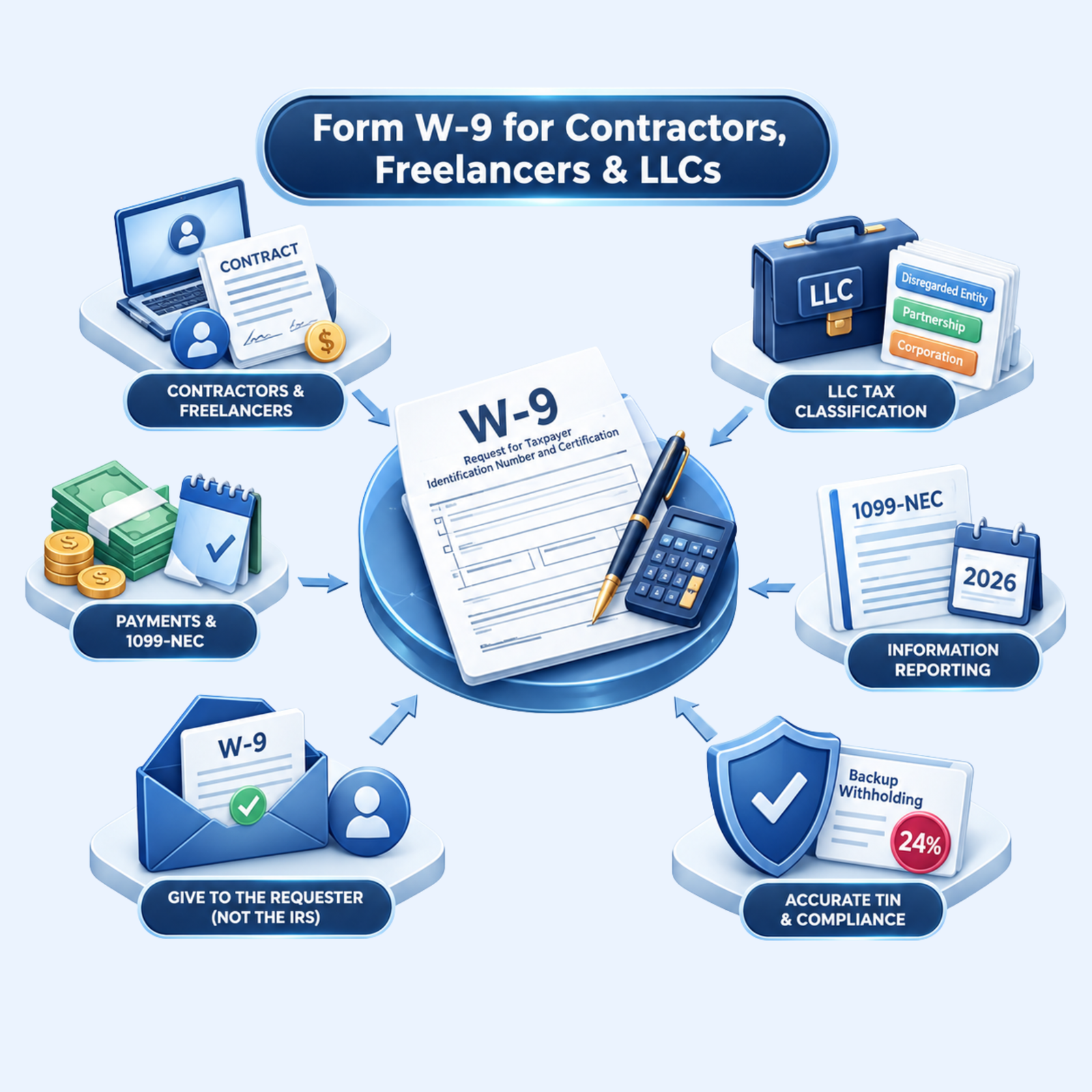
- 1 A Form W-9 provides the payer with your correct tax identification information.
- 2 Independent contractors, freelancers, and sole proprietors are routinely asked to complete this form.
- 3 The name and Taxpayer Identification Number (TIN) provided must match the entity being reported on tax returns.
- 4 An LLC’s specific tax classification directly affects how its W-9 should be completed.
- 5 The completed W-9 is submitted directly to the requester or client, not to the IRS.
- 6 The information collected is used by businesses to issue Form 1099-NEC when annual payment thresholds are met.
- 7 Providing missing or incorrect TIN details on the form may subject your payments to IRS backup withholding.
When a client sends you Form W-9, the first thing you may ask is why they need your tax information. The form is not long, but filling in the name, TIN, and tax classification can get puzzling. This is especially true if you work independently or have an LLC.
For LLC owners, the name and TIN used on Form W-9 depend on how the LLC is treated for federal tax purposes. The information may differ from the business name and tax details you normally use in other records.
It is worth checking these details before you complete the form. This way, you can enter the information that applies to your business and see how the client will use it.
What Is A Form W-9?
Form W-9 is an IRS form used to collect a taxpayer’s name and Taxpayer Identification Number (TIN). A payer may ask you to complete it when they need your information for tax reporting.
Clients often ask independent contractors to complete a W-9 before making payments. An LLC may also be asked for a W-9, but the way the form is completed depends on the LLC’s federal tax classification. W-9 forms are also used for other payments and transactions when the payer needs the information for tax reporting.
After you complete the form, give it to the person or business that requested it. Do not mail the W-9 to the IRS. The requester uses the information to prepare the required tax forms, such as Form 1099-NEC when applicable.
What Is Form W-9 Used For?
Form W-9 gives a payer the tax information they need when they make certain payments to you. The information can then be used for reporting those payments to the IRS when required.
- Form W-9 is used to provide your name and Taxpayer Identification Number (TIN).
- It gives the payer the information needed for tax reporting.
- Clients ask freelancers or independent contractors to complete the W-9 form before payment.
- The information may be used to prepare Form 1099-NEC or another required information return.
- You normally give the completed form to the requester instead of sending it to the IRS.
Who Needs To Fill Out Form W-9?
Form W-9 is generally used by U.S. individuals who receive payments or other amounts that are subject to information reporting.
Depending on the situation, the requester may ask for:
- Independent contractor
- Freelancer
- Sole proprietor
- Single-member LLC
- Multi-member LLC
- Partnership
- Corporation
- Other U.S. payee
For an independent contractor, the IRS describes Form W-9 as the first step after the payer has determined that the person being paid is an independent contractor.
*Note: If you are a foreign person, Form W-9 generally is not the right form. Different documentation and withholding rules may apply to foreign individuals.
When Does An Independent Contractor Need A W-9?
An independent contractor may be asked to complete Form W-9 when a client needs their tax information for reporting purposes. The client may need the contractor’s taxpayer information for tax reporting. A W-9 may be requested when the contractor starts working with a new client or before the client makes reportable payments for services.
For example, a client may request a W-9 from someone providing writing, marketing, consulting, design, IT, or similar services. The form provides the contractor’s name and TIN so the business has the information needed for its tax reporting. Getting a W-9 request does not decide whether a worker is an employee or an independent contractor. That classification is determined separately under the applicable tax rules.
For 2026 payments, the general reporting threshold for qualifying nonemployee compensation is $2,000. The threshold was generally $600 for payments made before 2026, and it will be adjusted for inflation in later years as required by the tax rules.
What Information Is Required On Form W-9?
The information requested on Form W-9 includes:
- Your name
- Business or disregarded-entity name, when applicable
- Federal tax classification
- Applicable exemption information
- Address
- Account number, if applicable
- Taxpayer Identification Number
- Certification
- Signature and date
The name and TIN need to correspond to the taxpayer whose information is being provided.
This becomes particularly important when you operate an LLC. An LLC’s state registration does not, by itself, tell you which taxpayer information belongs on the W-9. You need to consider the LLC’s federal tax classification.
Before submitting the form, check that the name and TIN belong to the same taxpayer. A business name that appears on your invoices may not always be the name that should be entered on Line 1.
How Do You Fill Out Form W-9 As An Independent Contractor?
If you work as an independent contractor without an LLC, you normally provide your tax information on Form W-9.
- Line 1: Enter your individual name.
- Line 2: If you use a DBA or business name, enter it here. Keep your individual name on Line 1.
- Line 3a: Select “Individual/sole proprietor.”
- Part I: Provide your TIN. A sole proprietor generally uses an SSN, although an EIN may be used when the applicable IRS rules allow or require one.
- Part II: Sign and date the form to complete the certification.
Check your name and TIN before handing over the W-9. The details should match the taxpayer information the payer will report.
How Do You Fill Out Form W-9 for An LLC?
An LLC does not use the same W-9 information in every situation. The way you complete the form depends on how the LLC is treated for federal tax purposes.
The IRS generally recognizes these three tax treatments:
- Disregarded entity: A domestic LLC with one owner is normally treated as a disregarded entity unless the owner elects corporate tax treatment.
- Partnership: A domestic LLC with two or more members is generally treated as a partnership unless it chooses corporate tax treatment.
- Corporation: An LLC can elect to be taxed as a C corporation or an S corporation.
The federal tax classification determines the name, tax classification, and TIN used on the W-9. Being registered as an LLC under state law does not by itself determine what goes on the form.
How Does A Single-Member LLC Complete Form W-9?
A domestic LLC with one owner is normally treated as a disregarded entity for federal income tax purposes unless it has elected corporate tax treatment. When the LLC is disregarded, the owner’s information is used for federal income tax reporting.
An individual owner would enter the following information:
- Line 1: Enter the owner’s individual name.
- Line 2: Enter the LLC’s name.
- Line 3a: Select “Individual/sole proprietor.”
- Part I: Enter the owner’s applicable SSN or EIN. The separate EIN of a disregarded LLC is generally not used for this income-tax reporting.
- Part II: Sign and date the form.
For example, if John owns ABC Consulting LLC and the LLC is treated as a disregarded entity, John would put his name on Line 1 and ABC Consulting LLC on Line 2. The TIN would generally be the owner’s applicable SSN or EIN, rather than the separate EIN of the disregarded LLC.
If the LLC later changes its federal tax classification or ownership structure, review the W-9 information again instead of continuing to use an older form.
How Does A Multi-Member LLC Complete Form W-9?
A domestic LLC with two or more members is generally treated as a partnership for federal income tax purposes unless it has elected corporate tax treatment.
If the LLC is taxed as a partnership, the W-9 includes the following:
- Line 1: Enter the LLC’s name associated with its TIN.
- Line 2: Enter a different business name if the LLC uses one.
- Line 3a: Select “LLC” and enter “P” for partnership.
- Line 3b: Complete this box only when the conditions in the W-9 instructions apply.
- Part I: Enter the LLC’s EIN.
- Part II: Sign and date the form.
If the LLC has elected C corporation or S corporation treatment, it should use the applicable corporate classification instead of “P” for partnership.
How Does An LLC Taxed As A Corporation Complete Form W-9?
If an LLC has elected to be taxed as a corporation, it completes Form W-9 according to its corporate tax status:
- Line 1: Write the LLC’s name that is associated with its TIN.
- Line 2: Write the business or trade name if it is different from the name on Line 1. Otherwise, leave it blank.
- Line 3a: Mark LLC and add C if the LLC is taxed as a C corporation. Use S if it has S corporation status.
- Line 3b: Mark this box only if the LLC falls under the situation described in the W-9 instructions.
- Part I: Put the LLC’s EIN in the TIN field.
- Part II: Sign and date the W-9 before giving it to the requester.
The LLC should use the tax classification it elected for federal tax purposes. It should not complete the W-9 using the rules that apply to a disregarded entity.
Where Do You Send Form W-9?
After completing Form W-9, send it directly to the person or business that asked you to provide it.
- Finish the form: Enter the required details and sign it where applicable.
- Use the method provided by the requester: If the client or company gives you a secure portal, upload the W-9 there. If they ask you to send it another way, follow their instructions.
- Send it to the requester: The completed form goes to the client, company, or other person who requested your taxpayer information.
- Do not send it to the IRS: Form W-9 is normally given to the requester, not mailed to the IRS. The requester keeps the information for its tax reporting records.
- Keep your own copy: Save a copy of the W-9 after sending it so you have the information available for your records.
What Happens After You Submit Form W-9?
After receiving your W-9, the payer keeps the information in its records. If your payments are subject to information reporting, the payer may later use your name and TIN when preparing an information return.
For independent contractors, the result can mean receiving a Form 1099-NEC when the applicable reporting requirements are met. A W-9 does not mean that you will automatically receive a 1099-NEC. The payer still has to determine whether the payment is reportable under the applicable rules.
How Is Form W-9 Related To Form 1099-NEC?
Form W-9 and Form 1099-NEC are used for separate tax-reporting purposes.
| Form | Purpose |
| Form W-9 | Gives the payer the payee’s name, TIN, tax classification, and certification. |
| Form 1099-NEC | Shows qualifying nonemployee compensation reported to the IRS and the recipient. |
The client may ask for Form W-9 before paying for your services.
Complete the W-9 → The client receives your taxpayer information → You are paid for your services → Form 1099-NEC is issued if the payment meets the applicable reporting requirements.
For 2026, the general threshold for reporting qualifying nonemployee compensation on Form 1099-NEC is $2,000. Payments subject to backup withholding may still require an information return, even if the amount paid is below $2,000.
Which Name And TIN Should You Use On Form W-9?
The correct name and TIN depend on the taxpayer being reported.
| Business situation | Name generally used | TIN generally used |
| Sole proprietor | Individual’s name | SSN, or EIN when applicable |
| Single-member LLC, disregarded | Owner’s name on line 1; LLC name on line 2 | Owner’s SSN or EIN |
| Multi-member LLC taxed as a partnership | Partnership/entity information | Entity EIN |
| LLC taxed as a corporation | Entity information | Entity EIN |
The single-member LLC rule is particularly important: a disregarded LLC generally provides the owner’s TIN, not the LLC’s separate EIN, for federal income-tax information reporting.
What Is Backup Withholding On Form W-9?
Backup withholding means federal income tax is taken from certain payments and sent to the IRS. The payer may have to do this procedure when the IRS withholding rules apply to the payment.
A contractor may be subject to backup withholding if a required TIN is not provided. The same can happen if the IRS reports an incorrect TIN on record and the payee does not complete the required certification. The backup withholding rate is currently 24%.
This is why the name and TIN on Form W-9 need to be accurate. The payer uses this information for tax reporting and to determine whether backup withholding requirements apply.
Frequently Asked Questions
No, Form W-9 goes to the person or business that requested it. You do not normally mail the completed form to the IRS. The requester keeps your information and uses it when tax reporting is required.
Providing an incorrect TIN can result in an IRS notice to the payer and may require you to provide corrected information. If the backup withholding rules apply, the payer may also have to withhold tax until the required information or certification is provided.
Completing a W-9 does not by itself mean that you will get a 1099-NEC. First, the client determines whether the payment is reportable under the applicable rules. A 1099-NEC is issued when those reporting requirements are met.
There is no single answer for every LLC because the tax classification matters. A disregarded single-member LLC generally uses the owner’s TIN, while an LLC taxed as a partnership or corporation generally uses its EIN.
Form W-9 is for U.S. individuals who need to provide their tax information. A foreign person generally uses a Form W-8 rather than a W-9. The type of W-8 required depends on the person and the payment they receive.
The general threshold for qualifying nonemployee compensation paid in 2026 is $2,000. The payment must also meet the other conditions for Form 1099-NEC reporting. Some payments can be subject to different reporting rules.
Form W-9 does not have an expiration date. But you should submit an updated form if your name, TIN, or tax classification changes. This gives the payer your current tax information for future reporting.
A payer may have to apply backup withholding when you do not provide a required TIN. The current backup withholding rate is 24%. The withholding generally continues until the required information or certification is provided.

Mastering Form W-9 for Contractors & LLCs: Complete Tax Guide
Learn how to accurately fill out Form W-9, choose the right TIN for single-member or multi-member LLCs, and avoid costly backup withholding errors.
Get Expert Tax Guidance