








How To Calculate Business Profit Margin: Formulas, Examples, And Steps
- 1
Profit margin is the share of your sales that you keep as profit. - 2
Gross, operating and net margins each count a different set of costs. - 3
Profit Margin = (Profit ÷ Net Sales Revenue) × 100. - 4
What counts as a good margin changes with your industry and how you run the business. - 5
Check your numbers often, so you can see where your profit and your spending are heading.
Business owners need to know how much of their sales revenue remains after covering business expenses. Profit margin helps answer this question and shows how effectively a business turns sales into profit. Profit margin answers that. It also tells you whether your prices, your costs and your overall setup are working the way you hoped.
The math is simple. Pick the kind of profit you want to measure (gross, operating or net), divide it by your net sales revenue, and multiply by 100. The result is a percentage.
What Is Business Profit Margin?
Profit margin tells you how much of each sales dollar the business actually keeps. If you bring in $100,000 and finish the period with $15,000 in net profit, your net margin is 15%, or 15 cents of every dollar.
That 15% is only one version of the number, though. Which one you’re looking at depends on how many costs you subtract first:
-
- Gross margin: revenue minus the cost of goods sold (what it cost you to make or buy what you sold).
- Operating margin: revenue minus COGS and operating expenses like rent, wages, and marketing.
- Net margin: revenue minus everything, including interest and income taxes.
Gross margin shows how well you price and produce. Operating margin shows how well you run the business day to day. Net margin is what’s left for the owners at the end.
How To Calculate Business Profit Margin?
First figure out your revenue, then pick the profit number you want to measure. Divide that profit by net sales and multiply by 100.
Business Profit Margin = (Profit ÷ Net Sales Revenue) × 100
Here’s a small example. Your business has:
-
- Net sales revenue: $100,000
- Total expenses: $85,000
- Net profit: $15,000
Profit Margin = ($15,000 ÷ $100,000) × 100
Profit Margin = 15%
That’s a 15% net profit margin, so you earn $15 for every $100 you sell. The number changes depending on which profit figure you start with, so here are the three most common ones.
1. How To Calculate Gross Profit Margin
Gross profit margin tells you how much revenue is left after paying the direct cost of what you sold. It’s a quick way to compare your sales against the cost of the products or services themselves.
Gross Profit Margin = (Gross Profit ÷ Net Sales Revenue) × 100
First work out gross profit:
Gross Profit = Net Sales Revenue − Cost of Goods Sold
Take a retail business with:
-
- Net sales revenue: $100,000
- Cost of goods sold: $60,000
Gross Profit = $100,000 – $60,000 = $40,000
Gross Profit Margin = ($40,000 ÷ $100,000) × 100
Gross Profit Margin = 40%
Out of every $100 in net sales, $40 is left once COGS is covered. For businesses selling physical goods, COGS usually covers the cost of buying or making the product: inventory purchases, materials, production labor and some manufacturing overhead. The IRS explains how to subtract COGS from net receipts in Publication 334.
2. How To Calculate Operating Profit Margin
This one also subtracts the everyday costs of running the business, such as rent, salaries, marketing, utilities, admin and depreciation.
Operating Profit Margin = (Operating Profit ÷ Net Sales Revenue) × 100
Operating profit is:
Operating Profit = Gross Profit – Operating Expenses
Say your business has:
-
- Net sales revenue: $100,000
- Gross profit: $40,000
- Operating expenses: $25,000
Operating Profit = $40,000 − $25,000 = $15,000
Operating Profit Margin = ($15,000 ÷ $100,000) × 100
Operating Profit Margin = 15%
You keep $15 of every $100 in net sales after paying operating costs. The SEC defines operating margin as income from operations divided by net revenues, with operating income calculated before interest and income taxes.
3. How To Calculate Net Profit Margin
Net profit margin is the most complete of the three, because it counts every expense behind net income: COGS, operating expenses, interest and income taxes.
Net Profit Margin = (Net Profit ÷ Net Sales Revenue) × 100
Net profit is:
Net Profit = Net Sales Revenue – Total Expenses
Suppose your business has:
-
- Net sales revenue: $100,000
- Cost of goods sold: $60,000
- Operating expenses: $25,000
- Interest expenses: $2,000
- Income tax expenses: $3,000
Total Expenses = $60,000 + $25,000 + $2,000 + $3,000 = $90,000
Net Profit = $100,000 – $90,000 = $10,000
Net Profit Margin = ($10,000 ÷ $100,000) × 100
Net Profit Margin = 10%
The business earns $10 in net profit for every $100 in net sales. Since this calculation accounts for all applicable expenses, it provides an overall view of profitability.
What Financial Information Do You Need To Calculate Profit Margin?
Before you start, pull together your numbers for one single accounting period. Most of them sit in your income statement and accounting records.
Here is what to look for:
-
- Net sales revenue: total sales minus returns, refunds and any sales allowances.
- Cost of goods sold (COGS): what it cost to buy or produce the goods you sold in that period.
- Operating expenses: the costs of running the business, such as rent, salaries, utilities, marketing and admin.
- Interest expenses: interest paid on business loans and other borrowing.
- Income tax expenses: income taxes recorded for the period.
- Net profit: what is left after all applicable expenses come out of revenue.
According to the SEC, an income statement reports revenue, costs, expenses and net earnings or losses for a specific period.
Accuracy matters here. A forgotten expense or a wrong sales figure will quietly throw off your margin.
Gross Profit Margin Vs. Operating Profit Margin vs. Net Profit Margin
All three measure profitability, but each one stops at a different point in your finances.
| Profit Margin Type | What It Measures |
| Gross Profit Margin | Profit remaining after deducting COGS |
| Operating Profit Margin | Profit remaining after deducting operating expenses |
| Net Profit Margin | Profit remaining after all applicable expenses |
To see how they line up, take a business with $100,000 in net sales:
| Financial Measure | Amount |
| Net Sales Revenue | $100,000 |
| Cost of Goods Sold | $60,000 |
| Gross Profit | $40,000 |
| Operating Expenses | $25,000 |
| Operating Profit | $15,000 |
| Interest Expenses | $2,000 |
| Income Tax Expenses | $3,000 |
| Net Profit | $10,000 |
The margins are as follows:
-
- Gross Profit Margin: 40%
- Operating Profit Margin: 15%
- Net Profit Margin: 10%
You can see the profit shrinking as each layer of cost comes off the income statement.
What Is A Good Business Profit Margin?
There is no one number that counts as “good” for everybody. A healthy margin depends on your industry, your business model, your costs, how you price and how much competition you face.
A retailer and a consulting firm are a good contrast. The retailer deals with inventory and product costs, while the consultant earns mostly by selling professional services. Their margins will naturally look different.
When you judge your own margin, a few things are worth keeping in mind:
-
- Industry comparison: measure yourself against businesses in the same field.
- Business size: a startup, a small business and an established company are not in the same position.
- Operating costs: look at what you spend on salaries, rent, supplies and other expenses.
- Your own history: compare with previous months, quarters or years.
- Revenue growth: check whether rising sales are actually leading to higher profit.
The SEC points out that what counts as a desirable financial ratio varies by industry, so setting your business against unrelated companies may not tell you much.
How To Improve Your Business Profit Margin?
If your margin is lower than you’d like, start with three things: what you earn, what your products cost you, and what it takes to keep the doors open. A small fix in any of them can add up.
1. Check Your Pricing
Do your prices actually cover what a product costs you to make or buy, plus your share of running costs like rent and wages? Before touching a price, look at your costs, what customers will pay, and what competitors charge. Review the effect of any price adjustment on customer demand, sales volume and overall profitability before making it permanent.
2. Trim operating Expenses
Pull out your bills for rent, electricity, software subscriptions, ads and admin. You’ll usually find a subscription nobody uses or a plan you’ve outgrown. Cut those, and shop around for cheaper alternatives, but not where it would slow down daily work.
3. Watch Your Cost Of Goods Sold
Inventory purchases, production costs and raw materials are where money quietly leaks. Track them every week or two instead of at year-end. You’ll spot a supplier who raised rates or a material you over-order, and you can fix that without making the product worse.
4. Cut Spending That Earns Nothing
Go through your records for payments that don’t help operations or sales. Old vendor contracts that auto-renew, recurring charges, and habit purchases are the usual suspects. If you can’t say what a payment does for the business, question it.
5. Calculate Margins On A Schedule
Work out your gross, operating and net margin every month or quarter and keep the numbers in one sheet. Over time you’ll see if costs are growing faster than sales, which is much easier to catch early than after a bad quarter.
Frequently Asked Questions
What Is the Formula for Calculating Business Profit Margin?
The general formula is profit margin = (profit ÷ net sales revenue) × 100.
You can plug in gross profit, operating profit or net profit, depending on which measure you want to look at.
How Do You Calculate a 20% Profit Margin?
Divide your profit by net sales revenue, then multiply by 100.
For instance, if your business has $50,000 in net sales and $10,000 in net profit: (10,000 ÷ $50,000) × 100 = 20%.
What Is the Difference Between Profit Margin and Markup?
Margin is your profit as a share of the selling price. Markup is your profit as a share of what the product cost you.
Say you buy a product for $60 and sell it for $100. You make $40. That’s a 40% margin ($40 ÷ $100), but a markup of about 66.7% ($40 ÷ $60).
Can a Business Have a High Gross Profit Margin but a Low Net Profit Margin?
Yes. If operating expenses, interest and taxes are large, a high gross margin can shrink a lot by the time you reach net profit.
A company with a 40% gross profit margin could end up with a 10% net profit margin once its other expenses are counted.
How Often Should a Business Calculate Its Profit Margin?
Monthly, quarterly and annually all work. Monthly numbers help you spot short-term changes, and quarterly or annual ones give you the bigger picture.
Is Revenue the Same as Profit?
No. Revenue is the income a business earns from selling its products or services before expenses are deducted. Profit is the amount remaining after applicable costs and expenses are subtracted from revenue.
Can Profit Margin Be Negative?
Yes, if you spend more than you bring in during a period, your margin dips below zero. Simply put, the business lost money that period instead of making any.
Conclusion
Profit margin shows how much of each sale you actually keep once the bills are paid. Gross, operating and net margins each look at a different stage, from the cost of the product alone to every expense, including interest and tax. A good number depends on your industry, size and costs, so compare yourself with similar businesses and with your own past results. Work out your margins every month or quarter, keep your records accurate, and watch where costs creep up. Small fixes to pricing, spending and supplier costs add up quickly, and you’ll make better decisions when you know where your money goes.
Official Resources:
-
- US Securities and Exchange Commission (SEC) – Beginners’ Guide to Financial Statements
- SEC – Beginners’ Guide to Financial Statements: Income Statement
- Internal Revenue Service (IRS) – Publication 334: Tax Guide for Small Business
- IRS – Cost of Goods Sold
- US Small Business Administration (SBA) – Manage Your Business
- SEC – Company Filings and Financial Statements

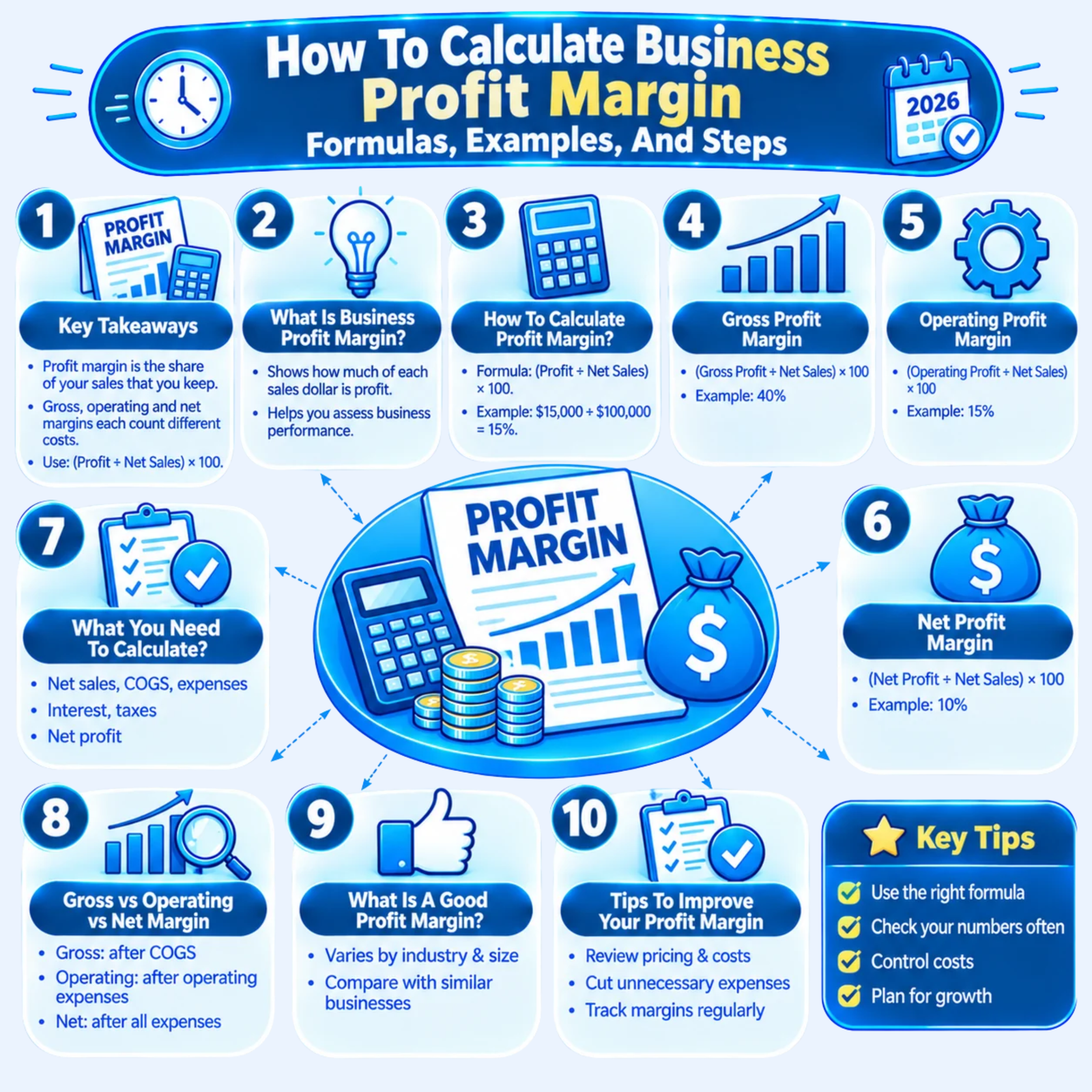
How to Calculate Business Profit Margin: Formulas and Examples
Learn how to calculate gross, operating, and net profit margins using simple formulas and examples. Understand what makes a good margin and how to improve business profitability.
Explore related resources on business finances, operating expenses, and profitability:
– What Is A Registered Agent And Do You Need One? A Guide For US Business Owners
Explains the role of a registered agent in maintaining an LLC’s legal compliance and receiving official documents. Covers registered-agent responsibilities, service costs, and appointment requirements, helping business owners understand an important ongoing business expense when evaluating operating costs and profitability.
– How To Prepare A Cash Flow Statement For A Small Business
Explains how to prepare a cash flow statement by tracking operating, investing, and financing activities. Shows how to monitor money coming into and going out of a business, helping owners understand the difference between reported profit and available cash when reviewing financial performance.
– How To Open A US LLC As A Non-Resident: Step-by-Step Guide
Outlines the steps involved in establishing a US LLC as a non-US resident, including state selection, registration, EIN applications, and compliance requirements. Highlights the initial formation fees and ongoing business obligations that entrepreneurs should consider when planning expenses, managing budgets, and building a profitable business.